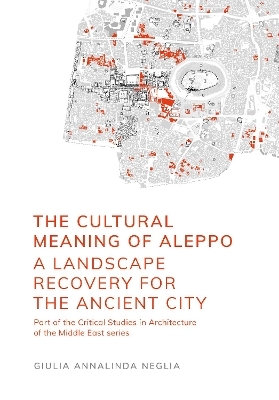
The Cultural Meaning of Aleppo
Intellect Books (Verlag)
978-1-78938-177-1 (ISBN)
Through a capillary documentation of the palimpsest of Aleppo – the peculiar characteristics of its courtyard houses and the neighbourhoods of Bayyada, Bab Quinnesrin and al-Farafra – this is a theoretical and practical handbook for architects, urban planners and restorers alike. Through this analytical discussion of the city’s urban fabric, it introduces the concept of the cultural urban landscape acting as a 'cohesive territorial organism', nourished by different cultures, in which contrasting scales of land, city and neighbourhood are interconnected in a fractal state. With a focus on retaining the uniqueness and diversity of this residential typology, which bore witness to the rich cultural history of Syria and the Middle East as a whole, Neglia maps a future reconstruction that focuses on cultural continuity, tradition and the re-establishment of a crucial social memory.
Of particular interest and relevance to cultural heritage experts, urban planners architects and designers. Also, to researchers, scholars and students interested in studies on urban morphology and building typology, UNESCO and ICOMOS. Scholars and students interested in the Middle East.
Will also be of significant interest to professionals dealing with the implementation of rehabilitation measures in other cities inscribed on the Word Cultural Heritage List, or cities with a sound historic fabric which has been destroyed due to war or other events.
Giulia Annalinda Neglia is associate professor of landscape architecture in the Department of Civil Engineering Sciences and Architecture at the Polytechnic University of Bari in Italy.
Forewords by Nada al Hassan, Attilio Petruccioli and Sakhar Olabi
Acknowledgements
Introduction: Why Aleppo is Important: Framework and War Scenario
Chapter I: The Cultural Significance of Aleppo’s Forma Urbis: An Overview of Layers and Ideas of Urban Conformation
Natura Naturalis and Natura Artificialis: The Plateau and the Tells
Hellenistic Planning
Roman Planning
The Medieval Byzantine City
The Medieval Islamic City
The Specialized Mamluk and Ottoman City
The Gutted and Transformed Modern City
Chapter II: The Cultural Significance of Aleppo’s Courtyard House: A Mirror of Middle Eastern Cultural History
The Courtyard House Layout
The Basic Elements of the House: Multi-purpose and Special Rooms
The Inner Garden
Typological Features
Chapter III: The Cultural Significance of the Reconstruction: Urban Recovery against Amnesia
Framework for Reconstruction and Recovery
Terms for Urban Recovery
Reconstruction: Consciousness or Amnesia?
Memory, Culture and Identity: Challenges for a Culture-Oriented Recovery
Recommendations and Strategies for a Culture-Oriented Urban Recovery
Conclusion
References
List of Figures
Notes
| Erscheinungsdatum | 10.05.2021 |
|---|---|
| Reihe/Serie | Critical Studies in Architecture of the Middle East |
| Mitarbeit |
Herausgeber (Serie): Mohammad Gharipour, Christiane Gruber |
| Zusatzinfo | 70 Halftones, black and white |
| Sprache | englisch |
| Maße | 170 x 230 mm |
| Themenwelt | Technik ► Architektur |
| Technik ► Bauwesen | |
| ISBN-10 | 1-78938-177-0 / 1789381770 |
| ISBN-13 | 978-1-78938-177-1 / 9781789381771 |
| Zustand | Neuware |
| Informationen gemäß Produktsicherheitsverordnung (GPSR) | |
| Haben Sie eine Frage zum Produkt? |
aus dem Bereich