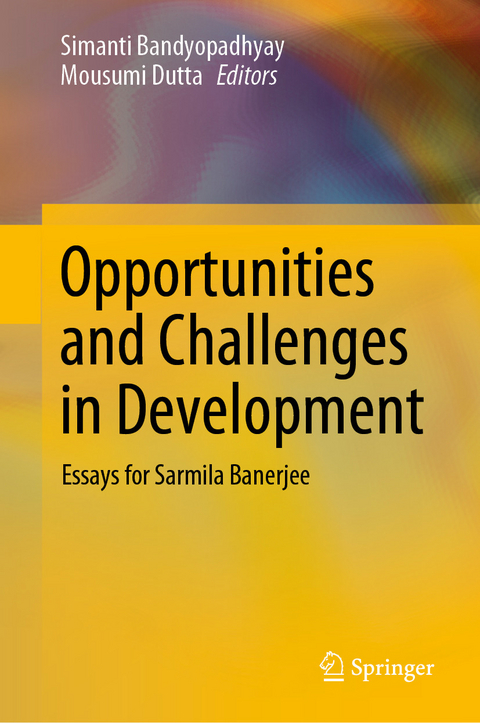
Opportunities and Challenges in Development (eBook)
564 Seiten
Springer Singapore (Verlag)
978-981-13-9981-7 (ISBN)
Simanti Bandyopadhyay is currently Associate Professor, Economics and Public Policy Area, School of Management and Entrepreneurship, Shiv Nadar University, India. She has nineteen years of research, consultancy and teaching experience, and currently focuses on applied development economics, mainly related to public finance and public policy. She completed her Ph.D. in Economics on a UGC Fellowship from the Centre for Economic Studies and Planning, Jawaharlal Nehru University, New Delhi, and has been an International Centre for Tax and Development Postdoctoral Fellow at the Andrew Young School of Policy Studies, USA, and Institute of Development Studies, UK. She has undertaken research, teaching and research guidance at various respected universities and research institutions in India and abroad and has also been a recipient of MacArthur Foundation Award. She regularly contributes articles on public policy, economics and operations research, and serves as an external reviewer for a number of international journals, and she has led important development projects and has worked closely with organizations like the World Bank, ADB, UNDP, IFMR, ICRIER, Planning Commission and different ministries and government bodies. She has also been the Chief Researcher for the background study of the Fourth State Finance Commission of the state of Tamil Nadu in India.
Mousumi Dutta is currently a Professor and the Head of the Economics Department, Presidency University. She is a Gold Medalist in M.Sc. (Economics) from Calcutta University and completed her doctoral degree on 'Economics of conservation of built heritage: the case of Kolkata' from the same university. She has been the Principal or co-Investigator of several projects, funded by The International Growth Center, Rosa Luxemburg Society, Berlin, ICSSR and UGC. Prof. Dutta has published extensively on the built environment, health and gender issues in journals like Tourism Management, Journal of Cultural Heritage, Social Indicators Research and Journal of International Development. She has presented her work at Stockholm University, Corvinus University, Gutenberg University, Liverpool University, Leeds University, Winchester University and Shanghai University and at international conferences organized by the European Population Association, British Society for Population Studies, IUSSP and Asian Population Association. Prof. Dutta has also published four books, including two on gender and reproductive health, respectively.
This book provides a broad overview of the current research on various aspects of development, with a focus on India. The content and treatment of the subject of development in this volume is distinctive in many ways. It is a balanced mix of theory and practical elements, dealing with a number of issues at micro as well as macro levels. The analyses of the current socio-economic problems are attempted in an elegant yet simple manner which makes it equally useful for an aspiring researcher in economics or any inter disciplinary field. The methodologies of the articles include analytical verbal argumentative logic, theoretical constructs or different versions of statistical, econometric or programming techniques. It also contains well written survey articles, which are useful in grasping the fundamental research issues and in tracing the progress of research in an area. The general scope of the book is very wide as the readership can include researchers, scholars, graduate and undergraduate students, policy makers and practitioners. Though the contributors are primarily scholars in the field of Economics or Statistics, the book contains useful takeaways for those working in the area of Development. It will also be of interest to policy makers and practitioners interested in development issues, and to post graduate students in Economics or any field, in social science, management or development.
Foreword 6
Preface 12
Contents 14
Editors, Authors and Reviewers 17
Macroeconomic Issues 21
Theories of Expectations Including Rational Expectations and Their Uses in Different Versions of the Philips Curve 22
1 Introduction 22
2 Alternative Theories/Models of Expectations 24
2.1 Theory of Naïve, i.e. Static Expectations and Cobweb Model 24
2.2 Theory of Adaptive Expectations (AE) 26
2.3 Theory of Rational Expectations 30
3 Phillips Curve—Development of Its Different Versions 33
3.1 Phillips Curve—Its Initial Version (and also Mark-up Pricing) 33
3.2 Friedman (1968)–Phelps(1967) Expectations-Augmented Phillips Curve 36
3.3 New Classical Version of Phillips Curve 38
4 Concluding Remarks 40
References 41
Keynes, Working Hours, Lifestyles and the Environment: A Note 43
References 47
A Perspective on the Slowdown in Private Corporate Investments in India 48
1 Introduction 49
2 Determinants of Business Investments: Lessons from Theory and Evidence from India 50
2.1 Theoretical Underpinnings 50
2.2 Empirical Studies on Determination of Private Corporate Investments in India: A Review 51
2.3 Studies on the Current Investment Slowdown in India: A Review 52
3 Evidence on the Current Slowdown 55
3.1 Potential Determinants of Private Corporate Investments in India: Recent Trends 55
3.2 Regression Analysis 60
4 Conclusion 64
Appendix 64
References 66
On the Lead–Lag Relationship Between Market Capitalization Ratio and Per Capita Growth 68
1 Introduction 68
2 Asset Pricing with Production and Investment 70
2.1 Market Capitalization Ratio and Growth 71
3 Empirical Analysis 75
3.1 Motivation 75
3.2 Data 76
3.3 Cross-Country Evidence of Lead–Lag Relationship Between Market Capitalization Ratio and Growth 77
4 Concluding Remarks 89
References 89
A Study of Volatility of Five Major Stock Indices of Indian Stock Market 92
1 Introduction 92
2 Survey of Literature 94
3 Methodology, Descriptive Statistics and Diagnostic Tests 96
4 Volatility Modeling for Sectoral Indices Using GARCH 97
4.1 Diagnostic Test to Run GARCH 98
4.2 GARCH Model Estimation and Volatility Clustering 100
4.3 Half-Life Estimation for the Entire Horizon and Sub- Periods 105
5 Leverage Effect and Volatility Spillover from the USA 107
5.1 EGARCH Estimates: Leverage Effect 107
5.2 EGARCH (Asymmetric—GARCH) Estimates: Spillover Effect 109
6 Conclusion 111
Appendix 113
References 116
Institutions and Development 118
Uncertain R& D Outcomes and Cooperation in R&
1 Introduction 119
2 Framework of Analysis 121
2.1 Benchmark Case: Marjit (1991) Model 122
2.2 Patent Protection and Imitation 124
2.3 Technology Transfer Under Non-cooperative R& D
2.4 Cooperative Research in Two Labs 127
2.5 R& D Under Incomplete Information
2.6 Conceivable Two Innovations 129
3 Possible Extensions 130
4 Conclusion 130
References 131
Informal Sector: Progression or Persistence? 133
1 Introduction 134
1.1 Prologue 134
1.2 Our Interventions 135
1.3 Methodology and Data Source 136
1.4 Some Sample Characteristics 136
1.5 Chapter Organisation 140
2 Beyond Firm: A Brief Description of Our Study Areas Along with Some General Firm-Level Characteristics 140
2.1 Tantipara: A Tale of Surplus Extraction Using Feudal Institutions 140
2.2 Dhaniakhali: A Tale of Unequal Competition and Lust for Life 144
2.3 Asansol and Bolpur: Stagnant Market and Intense Competition 144
3 Empirical Analysis 148
3.1 Role of Labour and Owner–Worker Relationship 148
3.2 Market Dependence 154
3.3 Accumulation or Survival? 158
4 Conclusion 161
References 163
Group Formation and Endogenous Information Collection in Microcredit 165
1 Introduction 165
2 The Model 167
2.1 Limited Liability Individual Lending 169
2.2 Joint Liability Group Lending 175
3 Comparisons Between Individual and Joint Liability Loan Contracts 181
4 Concluding Remarks 182
References 185
Formal Contract Enforcement and Entrepreneurial Success of the Marginalized 187
1 Introduction 187
2 Model 190
3 Data 195
3.1 Data on Court Quality 195
3.2 Measures of Court Quality 196
3.3 Industry Performance Data 199
4 Empirical Model 202
5 Results 204
5.1 Baseline 204
5.2 Various Business Efficiency Measures 206
5.3 Robustness 207
5.4 Business Ownership: Caste 208
6 Conclusion 210
References 210
Does Social Connectivity Influence Tap Water Access? Evidence from India 212
1 Introduction 213
2 Access to Piped Water 215
2.1 Tap Water Coverage in India 215
2.2 Determinants of Tap Water Use 216
3 Data and Methods 217
3.1 Tap Water Use in IHDS 217
3.2 Estimation Strategy 219
3.3 Variable Construction 223
3.4 Descriptive Statistics 224
4 Results 225
4.1 Estimation Results 225
4.2 Discussion 234
5 Conclusion 235
Appendix 236
References 238
Public Finance and International Economics 242
Political Economy of Fiscal Reform in Indian States 243
1 Introduction 244
2 Empirical Methodology and Data Requirements 246
3 Results 247
4 Conclusion 253
Appendix 1: Regression Results with Own-Tax Revenue as an Indicator for Fiscal Reform 254
Appendix 2: The Test of Endogeneity 254
References 255
Vertical Fiscal Imbalances and Its Impact on Fiscal Performance: A Case for Indian States 257
1 Introduction 257
2 Vertical Fiscal Imbalance and Fiscal Performance: A Review of Literature 259
3 On Vertical Fiscal Imbalance in States in India 261
4 A Measure of Vertical Fiscal Imbalance 263
5 An Assessment of Vertical Fiscal Imbalance in Indian States 263
6 Econometric Evidence 268
7 Conclusion 276
Appendix 276
References 295
Exchange-Rate Pass-Through to Sectoral Import Prices in an Emerging Market Economy: An Indian Evidence 297
1 Introduction 298
2 Some Snapshots on India’s Trade and Exchange Rate Reforms 301
2.1 Exchange Rate: Policy Changes and Movements 304
2.2 Movements in India’s Import Prices 306
3 Empirical Estimation 306
3.1 The Empirical Model 307
3.2 The Data and Method 309
4 Estimation Results 311
5 Conclusions 314
Appendix 1 315
Appendix 2 316
Appendix 3 318
Appendix 4 321
References 321
Pricing of Energy Goods in India: How Is It Done? 324
1 Introduction 324
2 International Crude Oil Pricing 325
3 Pricing of Petroleum Products in India 332
3.1 APM and Regulated Market—Salient Features 332
3.2 Free Market Pricing 333
3.3 Rangarajan Committee Suggestions 333
3.4 Pricing of Petrol and Diesel 335
3.5 Subsidies on the Three Fossil Fuels 336
4 Electricity Pricing 338
5 Concluding Comments 340
References 341
International Joint Ventures in Developing Countries: The Implications of Policy Uncertainty and Information Asymmetry 343
1 Introduction 343
2 Policy Uncertainties 344
3 Information Asymmetry 356
4 Conclusion 364
References 364
Labour and Human Capital 367
Household Self-Employment Eliminates Child Labour 368
1 Introduction 368
2 The Model 370
3 Concluding Remarks 375
References 376
Handloom in West Bengal: Decline or Dynamism? 378
1 Introduction 378
2 Existing Literature and Scope of Present Study 380
3 Profile of Handloom Weavers in West Bengal 383
3.1 Composition of the Weaving Community 383
3.2 Intensity of Engagement of Households in Handloom and Household Income from Handloom 387
4 Decline or Dynamism: Handloom Production in West Bengal 388
5 Handloom in the Context of Economic Trends in West Bengal 390
6 Conclusion 394
References 396
Total Factor Productivity Growth of Elementary Education in India and Its Determinants: Evidence from a Non-parametric Data Envelopment Approach 398
1 Introduction 399
2 The Literature Review and the Contribution of the Paper 401
3 Methodology and Data Sources 406
3.1 Estimation of Total Factor Productivity Growth (TFPG) 406
3.2 Non-parametric Methodology 411
3.3 The Determinants of Productivity Score 412
3.4 Data Sources 413
4 Empirical Findings 413
4.1 Results of Estimation on Total Factor Productivity Growth 413
4.2 Decomposition of the Productivity Score 418
4.3 Analysis of the Determinants of Total Factor Productivity Growth 419
5 Conclusions 424
Bibliography 426
Gulf War Syndrome: The Plight of War Veterans 428
1 Introduction 428
2 Study Motivation and the Data 430
2.1 The National Survey of Veterans 430
2.2 Early Surprise: Preliminary Results from the Survey Data 430
2.3 Characteristics of 2001 NSV Data 432
3 The Logistic Model 435
4 The Generalized Additive Model (GAM) 437
4.1 Limitations of Logistic Model for Controlling Age Effect 437
4.2 Methodology for Generalized Additive Model 438
4.3 Results from GAM Estimation 446
5 Conclusions 451
References 452
Foetal Starvation, Economic Adversity and Health a Difference-in-Difference Approach 454
1 Background 455
2 Hypotheses and Method of Data Collection 458
2.1 Research Hypotheses 458
2.2 Survey Site 459
2.3 Sampling Strategy 460
2.4 Sample Profile 461
2.5 Statistical Methodology 461
3 Findings and Discussion 465
3.1 Mismatch Between Actual and Expected Environment 465
3.2 Impact of Ramadan Fasting 468
3.3 Facing Economic Adversity 471
4 Conclusion 472
References 473
Inequality and Well-Being 477
Sustainable Development and the Problem of Economic Inequality 478
1 Introduction 478
2 Sustainable Development as Non-decreasing Comprehensive Wealth 479
3 Creating Public Policies from Scientific and Economic Knowledge 482
4 Some Alternative Pathways to Reduce Inequality 484
4.1 Technological Primacy 484
4.2 Ethics and Values 485
4.3 Rational Choice 485
4.4 A Crude Look at the whole 486
4.5 Radical Ecology 487
4.6 Marx and Nature 488
4.7 Inequality as the First Priority to be Addressed 488
5 Conclusion 489
References 490
Informality and Disaster Vulnerability: A Preliminary Exploration 491
1 Introduction 491
2 Informal Work and Vulnerability 493
3 Heterogeneity Within the Informal Economy 495
4 Household Survey Data from Indonesia 497
5 Between-and Within-Sector Heterogeneity 498
6 Within-Sector Differences in Disaster Vulnerability in the Informal Economy 504
7 Some Broad Conclusions 508
References 510
Estimation of Median Incomes of the American States: Bayesian Estimation of Means of Subpopulations 513
1 Introduction 514
2 The Fay–Herriot Model and the Random Regression Coefficient Model 516
3 Four-Person Family Median Income Estimation 519
4 A Simulation Study 521
5 Concluding Remarks 523
6 Appendix 524
References 525
Entropy-Based Consumption Diversity—The Case of India 527
1 Introduction 528
2 Data and Variable Description 531
2.1 Data 531
2.2 Variable Description 531
3 Diversity Measure and Random Coefficient Model 533
3.1 Entropy-Based Diversity Measure 533
3.2 Econometric Model 534
4 Results 540
5 Conclusion 543
Appendix 1: Description of Items 544
Appendix 2: Average Income Elasticity 546
References 546
Trend in Inter-state Disparity of Well-Being in India in the Post-Reforms Period 549
1 Introduction 549
2 Methodology 553
3 Data and the Analysis 558
4 Concluding Remarks 566
References 567
26 Correction to: Informality and Disaster Vulnerability: A Preliminary Exploration 569
Correction to: Chapter “Informality and Disaster Vulnerability: A Preliminary Exploration” in: S. Bandyopadhyay and M. Dutta (eds.), Opportunities and Challenges in Development, https://doi.org/10.1007/978-981-13-9981-7_22 569
A Personal Reflection on Professor Sarmila Banerjee 570
| Erscheint lt. Verlag | 28.9.2019 |
|---|---|
| Zusatzinfo | XXII, 564 p. 73 illus., 63 illus. in color. |
| Sprache | englisch |
| Themenwelt | Technik |
| Wirtschaft ► Betriebswirtschaft / Management ► Unternehmensführung / Management | |
| Wirtschaft ► Volkswirtschaftslehre ► Makroökonomie | |
| Schlagworte | Emerging Markets • Fiscal Reforms • international joint ventures • Labor and Human Capital • Money and Finance • sustainable development • Welfare and Health |
| ISBN-10 | 981-13-9981-6 / 9811399816 |
| ISBN-13 | 978-981-13-9981-7 / 9789811399817 |
| Informationen gemäß Produktsicherheitsverordnung (GPSR) | |
| Haben Sie eine Frage zum Produkt? |
 PDF (Wasserzeichen)
DRM: Digitales Wasserzeichen
Dieses eBook enthält ein digitales Wasserzeichen und ist damit für Sie personalisiert. Bei einer missbräuchlichen Weitergabe des eBooks an Dritte ist eine Rückverfolgung an die Quelle möglich.
Dateiformat: PDF (Portable Document Format)
Mit einem festen Seitenlayout eignet sich die PDF besonders für Fachbücher mit Spalten, Tabellen und Abbildungen. Eine PDF kann auf fast allen Geräten angezeigt werden, ist aber für kleine Displays (Smartphone, eReader) nur eingeschränkt geeignet.
Systemvoraussetzungen:
PC/Mac: Mit einem PC oder Mac können Sie dieses eBook lesen. Sie benötigen dafür einen PDF-Viewer - z.B. den Adobe Reader oder Adobe Digital Editions.
eReader: Dieses eBook kann mit (fast) allen eBook-Readern gelesen werden. Mit dem amazon-Kindle ist es aber nicht kompatibel.
Smartphone/Tablet: Egal ob Apple oder Android, dieses eBook können Sie lesen. Sie benötigen dafür einen PDF-Viewer - z.B. die kostenlose Adobe Digital Editions-App.
Buying eBooks from abroad
For tax law reasons we can sell eBooks just within Germany and Switzerland. Regrettably we cannot fulfill eBook-orders from other countries.
aus dem Bereich