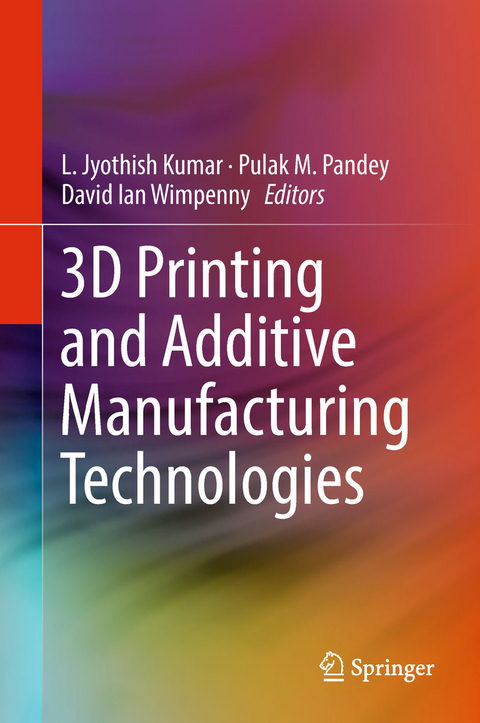
3D Printing and Additive Manufacturing Technologies (eBook)
311 Seiten
Springer Singapore (Verlag)
978-981-13-0305-0 (ISBN)
This book presents a selection of papers on advanced technologies for 3D printing and additive manufacturing, and demonstrates how these technologies have changed the face of direct, digital technologies for the rapid production of models, prototypes and patterns. Because of their wide range of applications, 3D printing and additive manufacturing technologies have sparked a powerful new industrial revolution in the field of manufacturing. The evolution of 3D printing and additive manufacturing technologies has changed design, engineering and manufacturing processes across such diverse industries as consumer products, aerospace, medical devices and automotive engineering. This book will help designers, R&D personnel, and practicing engineers grasp the latest developments in the field of 3D Printing and Additive Manufacturing.
Mr. Jyothish Kumar is the Founder CEO of Rapitech Solutions Inc., Bangalore and the Founder President of the Additive Manufacturing Society of India (AMSI), Bangalore. He received his Bachelor of Engineering in Mechanical Engineering from the National Institute of Engineering, Mysore and his Master's degree in Rapid Product Development from De Montfort University, UK. Mr. Kumar is currently pursuing PhD research in Aerospace Applications of Additive Manufacturing Technologies. Prior to that he served in various areas of the Mechanical Engineering industry, such as Quality Assurance, Marketing, Sales and Product Development in India and abroad. He has specialized experience in Quality Management Systems and Rapid Product Development. Mr. Kumar is currently the Managing Editor of the Additive Manufacturing Technology Magazine, the only journal for in 3D Printing and Additive Manufacturing Technologies in India.
Professor Pulak M. Pandey is currently serving as a Professor in the Department of Mechanical Engineering in Indian Institute of Technology (IIT) Delhi. After completing his B.Tech from H.B.T.I. Kanpur in 1993, he went on to do his Master's and PhD from IIT Kanpur, where his PhD was in the area of Additive Manufacturing/3D Printing. In IIT Delhi, Dr Pandey diversified his research areas in the field of micro and nano finishing, micro-deposition and also continued working in the area of 3D Printing. He supervised 21 Ph.D.s and more than 33 M.Tech. theses in last 10 years and also filed 13 Indian patent applications. He has approximately 119 international journal papers and 44 international/national refereed conference papers to his credit. These papers have been cited for more than 3056 times with h-index as 26. He received Highly Commended Paper Award by Rapid Prototyping Journal for the paper 'Fabrication of three dimensional open porous regular structure of PA 2200 for enhanced strength of scaffold using selective laser sintering' published in 2017. Many of the B. Tech and M. Tech projects he has supervised have received awards and accolades, and his students have won the GYTI (Gandhian Young Technological Innovation) Award in 2013, 2015 and 2017. Prof Pandey is the recipient of the Outstanding Young Faculty Fellowship (IIT Delhi) sponsored by Kusuma Trust, Gibraltar and J.M. Mahajan outstanding teacher award of IIT Delhi.
Professor David Ian Wimpenny is currently the Chief Technologist at the Manufacturing Technology Centre (MTC), Coventry, UK. He joined the MTC as a Technology Manager in 2011 and worked as a full time Technologist of the Component Technology Group at the MTC. He is the Chairman of the Additive Manufacturing & 3D Printing Forum for the HVM Catapult. His past roles include being Head of the research at De Montfort University, Leicester, UK from 2009 to 2011, and Director of the Additive Manufacturing Technology Group at the Department of Engineering and Technology, De Montfort University, from 2001 to 2011. Professor Wimpenny is also a member of the Additive Manufacturing Special Interest Group (AM-SIG), which was established by the Technology Strategy Board to develop a road map for the UK AM sector. His major activities are in the areas of Additive Manufacturing, Rapid Product Development, Laser Printing, Surface Engineering and Manufacturing Production Tooling. He has published more than 60 papers in international/national journals and presented papers at seminars and international conferences. He holds three patents for Rapid Prototyping, Reverse Engineering and Computer Aided Design. Professor Wimpenny also serves on the review committee of several reputed International Journals like Additive Manufacturing, Rapid Prototyping, Materials Processing Technology etc. He has two books to his credit, and was a co-editor of the Rapid Prototyping Case Book, Professional Engineering Publications.
This book presents a selection of papers on advanced technologies for 3D printing and additive manufacturing, and demonstrates how these technologies have changed the face of direct, digital technologies for the rapid production of models, prototypes and patterns. Because of their wide range of applications, 3D printing and additive manufacturing technologies have sparked a powerful new industrial revolution in the field of manufacturing. The evolution of 3D printing and additive manufacturing technologies has changed design, engineering and manufacturing processes across such diverse industries as consumer products, aerospace, medical devices and automotive engineering. This book will help designers, R&D personnel, and practicing engineers grasp the latest developments in the field of 3D Printing and Additive Manufacturing.
Mr. Jyothish Kumar is the Founder CEO of Rapitech Solutions Inc., Bangalore and the Founder President of the Additive Manufacturing Society of India (AMSI), Bangalore. He received his Bachelor of Engineering in Mechanical Engineering from the National Institute of Engineering, Mysore and his Master’s degree in Rapid Product Development from De Montfort University, UK. Mr. Kumar is currently pursuing PhD research in Aerospace Applications of Additive Manufacturing Technologies. Prior to that he served in various areas of the Mechanical Engineering industry, such as Quality Assurance, Marketing, Sales and Product Development in India and abroad. He has specialized experience in Quality Management Systems and Rapid Product Development. Mr. Kumar is currently the Managing Editor of the Additive Manufacturing Technology Magazine, the only journal for in 3D Printing and Additive Manufacturing Technologies in India. Professor Pulak M. Pandey is currently serving as a Professor in the Department of Mechanical Engineering in Indian Institute of Technology (IIT) Delhi. After completing his B.Tech from H.B.T.I. Kanpur in 1993, he went on to do his Master’s and PhD from IIT Kanpur, where his PhD was in the area of Additive Manufacturing/3D Printing. In IIT Delhi, Dr Pandey diversified his research areas in the field of micro and nano finishing, micro-deposition and also continued working in the area of 3D Printing. He supervised 21 Ph.D.s and more than 33 M.Tech. theses in last 10 years and also filed 13 Indian patent applications. He has approximately 119 international journal papers and 44 international/national refereed conference papers to his credit. These papers have been cited for more than 3056 times with h-index as 26. He received Highly Commended Paper Award by Rapid Prototyping Journal for the paper “Fabrication of three dimensional open porous regular structure of PA 2200 for enhanced strength of scaffold using selective laser sintering” published in 2017. Many of the B. Tech and M. Tech projects he has supervised have received awards and accolades, and his students have won the GYTI (Gandhian Young Technological Innovation) Award in 2013, 2015 and 2017. Prof Pandey is the recipient of the Outstanding Young Faculty Fellowship (IIT Delhi) sponsored by Kusuma Trust, Gibraltar and J.M. Mahajan outstanding teacher award of IIT Delhi. Professor David Ian Wimpenny is currently the Chief Technologist at the Manufacturing Technology Centre (MTC), Coventry, UK. He joined the MTC as a Technology Manager in 2011 and worked as a full time Technologist of the Component Technology Group at the MTC. He is the Chairman of the Additive Manufacturing & 3D Printing Forum for the HVM Catapult. His past roles include being Head of the research at De Montfort University, Leicester, UK from 2009 to 2011, and Director of the Additive Manufacturing Technology Group at the Department of Engineering and Technology, De Montfort University, from 2001 to 2011. Professor Wimpenny is also a member of the Additive Manufacturing Special Interest Group (AM-SIG), which was established by the Technology Strategy Board to develop a road map for the UK AM sector. His major activities are in the areas of Additive Manufacturing, Rapid Product Development, Laser Printing, Surface Engineering and Manufacturing Production Tooling. He has published more than 60 papers in international/national journals and presented papers at seminars and international conferences. He holds three patents for Rapid Prototyping, Reverse Engineering and Computer Aided Design. Professor Wimpenny also serves on the review committee of several reputed International Journals like Additive Manufacturing, Rapid Prototyping, Materials Processing Technology etc. He has two books to his credit, and was a co-editor of the Rapid Prototyping Case Book, Professional Engineering Publications.
Preface 5
Acknowledgements 6
Contents 7
About the Editors 10
1 Finite Element Analysis of Melt Pool Characteristics in Selective Laser Spot Melting on a Powder Layer 12
Abstract 12
1 Introduction 13
2 Model Description 14
2.1 Powder Bed Properties 16
2.2 Governing Transport Equations 16
2.2.1 Phase Change in the Powder Layer 16
2.2.2 Substrate 18
2.3 Boundary Conditions 18
2.4 Volume Contraction of the Powder Layer 19
3 Results 20
4 Conclusion 23
References 23
2 Thermal Transport Phenomena in Multi-layer Deposition Using Arc Welding Process 25
Abstract 25
1 Introduction 26
2 Model Description 28
3 Governing Transport Equations 29
3.1 Mass Conservation 30
3.2 Energy Conservation 30
3.3 Momentum Conservation 30
3.4 Boundary Conditions 31
4 Results and Discussions 32
4.1 Temperature Distribution 32
4.2 Velocity Distribution and Melt Pool Shape 34
5 Conclusions 35
References 36
3 Comparison of Bonding Strength of Ti–6Al–4V Alloy Deposit and Substrate Processed by Laser Metal Deposition 38
Abstract 38
1 Introduction 38
2 Experimental Methods 39
2.1 Three-Point Bending Test of Ti–6Al–4V Deposit and Substrate 40
3 Results and Discussion 42
3.1 Three-Point Bending Test of Ti–6Al–4V Deposit and Substrate 42
3.2 Scanning Electron Micrograph (SEM) and Energy Dispersive X-ray Spectroscope Studies (EDS) 44
4 Conclusion 45
Acknowledgements 46
References 46
4 Study on Rayleigh–Bénard Convection in Laser Melting Process 47
Abstract 47
1 Introduction 47
2 Numerical Model 48
3 Results and Discussions 50
4 Conclusion 52
References 52
5 Enhancing Surface Finish of Fused Deposition Modelling Parts 53
Abstract 53
1 Introduction 54
2 Literature Review 55
3 Experimental Method 56
3.1 Stage-I: Prototype Fabrication 57
3.2 Stage-II: Chemical Post Processing 58
4 Analysis of Surface Roughness Results 58
5 Chemical Post Processing 62
6 Conclusions 63
References 64
6 Development and Analysis of Accurate and Adaptive FDM Post-finishing Approach 66
Abstract 66
1 Introduction 67
2 A New Methodological Framework for Post-Finishing Operation 68
2.1 Selective Melting (SM) Tool 73
2.2 Thermally Assisted Finishing (TAF) and Surface Roughness Measurement 74
3 Results and Discussion 74
3.1 Surface Profiles Characterization Analysis 76
4 Conclusions 77
References 77
7 Toolpath Generation for Additive Manufacturing Using CNC Milling Machine 79
Abstract 79
1 Introduction 80
2 Methodology 81
2.1 CAD Model and STL Preparation 81
2.2 Importing STL in MATLAB 81
2.3 Slicing of the Tessellated Model 82
2.4 Raster/Perimeter Based Tool Path 82
3 Development of Graphical User Interface (GUI) 84
4 Experimental Validation of Toolpath Through CNC Milling Machine 86
5 Conclusion 87
Acknowledgements 88
References 88
8 Modelling of Heat Transfer in Powder Bed Based Additive Manufacturing Process Using Lattice Boltzmann Method 89
Abstract 89
1 Introduction 90
2 Numerical Modelling 91
2.1 Computational Domain 95
3 Results and Discussion 96
4 Conclusions 99
References 99
9 Effect of Process Parameters on Mechanical Properties of Solidified PLA Parts Fabricated by 3D Printing Process 101
Abstract 101
1 Introduction 101
2 Planning of Experiments 103
3 Results and Discussions 105
3.1 Analysis for Tensile Strength 105
3.2 Analysis for Flexural Strength 107
4 Conclusions 109
References 109
10 Metal Powder Based Additive Manufacturing Technologies—Business Forecast 111
Abstract 111
1 Introduction 112
2 AM Challenges—Techno-economic Barriers 113
3 Metal Powder for AM 114
3.1 Metal AM Capabilities 115
4 AM Forecast 116
4.1 Revenue Estimates for 2016–25 Using CAGR 116
4.2 Multiple Regression 119
5 AM Patents 120
6 Conclusions 122
References 123
11 Design and Development of Drug Delivery System for Chronic Wound Using Additive Manufacturing 125
Abstract 125
1 Introduction 125
2 Literature Review 127
3 Design and Manufacture of the Product 127
3.1 Modelling 127
3.2 Manufacturing Method 128
3.3 Manufacture of the End Product 128
3.3.1 Preprocessing 130
3.3.2 Building 130
3.3.3 Post Process 130
4 Conclusion 131
References 131
12 Design and Development of Orthosis for Clubfoot Deformity 133
Abstract 133
1 Introduction 133
2 Literature Review 134
2.1 Congenital Malformations 135
2.2 Club Foot Treatment 137
3 Design of the Customized Orthosis for Clubfoot 138
3.1 Design I 138
3.2 Design-II 139
3.3 Design-III 140
4 Manufacturing of Customized Orthosis 141
4.1 Machine Specifications 141
4.2 Manufacturing of the Prototypes 141
5 Conclusion 143
References 144
13 Optimization of Selective Laser Sintering Process Parameters on Surface Quality 146
Abstract 146
1 Introduction 146
2 Experimental Methods and Methodology 148
2.1 Processing of Specimen 148
2.2 Selection of SLS Process Parameters and Their Levels 149
2.3 Taguchi Quality Engineering 149
2.4 Selection of Orthogonal Array (OA) 150
2.5 Process Parameter and Responses 150
3 Results and Discussion 152
3.1 Taguchi Analysis of Length (L) on SLS Process 152
3.2 Taguchi Analysis of Depth (D) on SLS Process 155
3.3 Taguchi Analysis of Surface Roughness (Ra) on SLS Process 158
4 Conclusion 161
References 161
14 Reconstruction of Damaged Parts by Integration Reverse Engineering (RE) and Rapid Prototyping (RP) 163
Abstract 163
1 Introduction 164
2 Experimental Process for Replacement of Damaged Parts 164
3 Reverse Engineering (RE) 165
3.1 Contact Based Scanning Technique 166
3.2 Non-contact Based Scanning Technique 166
4 Formation of Modified Model 166
5 Rapid Prototyping (RP) 166
6 Case Study—Gear Wheel 167
6.1 3D Scanning of Damaged Gear Wheel 168
6.2 Reconstruction of Broken and Damaged Area of Gear Wheel 169
6.3 Rapid Prototyping of New Created Parts 173
7 Conclusions 174
References 175
15 The Impact of Additive Manufacturing on Indian GDP 176
Abstract 176
1 Introduction 177
1.1 Additive Manufacturing 177
1.2 3D Printers 177
1.3 Types of 3D Printing Technology 178
1.3.1 Fused Deposition Modelling 178
1.3.2 Stereo-Lithography 179
1.3.3 Selective Laser Sintering 179
2 Contribution of Manufacturing To GDP 181
2.1 Indian Manufacturing GDP 181
2.2 Employment in Manufacturing Sector 182
3 Effects of Additive Manufacturing on India 183
3.1 Applications 183
4 Future Project Scope 187
5 Conclusions 187
Acknowledgements 188
References 188
16 Optimization of the Print Quality by Controlling the Process Parameters on 3D Printing Machine 189
Abstract 189
1 Introduction 189
2 Methodology 191
2.1 Work Material 191
2.2 Experimental Set Up 191
3 Model data 192
3.1 Process Parameters 192
4 Results and Discussion 193
5 Conclusion 196
References 196
17 A Review on Current State of Art of Bioprinting 197
Abstract 197
1 Introduction 197
2 3D Bioprinting Approaches 198
3 The Process 199
4 Bioprinting Techniques 200
5 Applications 202
6 Future Prospects 202
References 203
18 A Turnkey Manufacturing Solution for Customized Insoles Using Material Extrusion Process 204
Abstract 204
1 Introduction 205
2 Insole Personalization and Manufacturing Process 206
2.1 Foot Digitization Using Foot Measurement System 206
2.2 Foot Diagnosis 209
2.3 Insole Design Software 209
2.4 Additive Manufacturing of Insoles 211
3 Results and Evaluation Criteria 213
4 Conclusions 216
References 217
19 Parameter Optimization for Polyamide in Selective Laser Sintering Based on Mechanical Behavior 218
Abstract 218
1 Introduction 218
2 Experimentation 220
2.1 Preparation of Test Samples by Using SLS Process 220
2.2 Selection of Factors and Their Levels of SLS Process 221
2.3 Taguchi Design of Experiments 221
2.4 Assigned Orthogonal Array 222
2.5 Design of Experiments with Results 223
3 Results and Discussion 224
3.1 Taguchi Analysis of Hardness (H) on SLS Process 224
3.2 Taguchi Analysis of Ultimate Tensile Strength (UTS) on SLS Process 225
4 Conclusion 231
References 231
20 Analysis of Adjacent Vertebrae Post Vertebroplasty 233
Abstract 233
1 Introduction 234
2 Methodology 234
2.1 3D Modelling of Normal Vertebrae Using Mimics 235
2.2 Meshing in 3-Matic 235
2.3 Stress Analysis of Normal Vertebrae Using ANSYS 236
2.4 3D Modelling of Fractured Vertebrae Using Mimics 236
2.5 Stress Analysis of Fractured Vertebrae Using ANSYS 236
2.6 3D Modelling of Cement Injected Vertebrae Using Mimics 237
2.7 Stress Analysis of Cement Injected Vertebrae Using ANSYS 238
3 Results and Discussions 238
4 Conclusion 242
References 242
21 Design and Processing of Functionally Graded Material: Review and Current Status of Research 243
Abstract 243
1 Introduction 244
2 Functionally Graded Materials 246
2.1 On the Basis of Amount of Volume in Which Graded Properties Are Present 246
2.2 On the Basis of Nature of Gradient 246
2.3 Achievement of Graded Structures 246
3 Overview of Techniques Utilized for FGM Fabrication 247
4 Additive Manufacturing 248
5 Development of FGMs via Additive Manufacturing 249
6 Applications of FGMs 250
7 Future Trends 251
8 Concluding Summary 251
References 252
22 Development of Electrical Discharge Machining (EDM) Electrode Using Fused Deposition Modeling (FDM) 256
Abstract 256
1 Introduction 257
2 Methodologies 257
2.1 Electrode Preparation 257
2.2 Experimental Set-up 258
2.3 Design of Experiments 258
2.4 Data Collection 259
2.5 Calculation of Responses 259
3 Result and Discussion 261
4 Analysis 262
4.1 Mathematical Analysis 262
4.1.1 Regression Analysis 262
4.1.2 Analysis of Variance (ANOVA) 263
4.2 Comparison Between Experimental and Mathematical Analysis 264
4.2.1 RP Electrode 264
4.2.2 Solid Electrode 265
5 Conclusions 266
Acknowledgements 267
References 267
23 State of the Art of Powder Bed Fusion Additive Manufacturing: A Review 268
Abstract 268
1 Introduction 269
2 Powder Bed Fusion Additive Manufacturing (PBF) 270
3 Some Recent Studies Related to Powder Bed Fusion Additive Manufacturing 272
4 Concluding Remarks 277
References 277
24 Distortion in Metal Additive Manufactured Parts 279
Abstract 279
1 Introduction 279
2 Defects in Metal Additive Manufacturing Process 281
2.1 Defects Due to Geometry of the Part, Orientation and Supports 281
2.2 Defects Due to Improper Process Control 283
2.3 Defects Based on the Materials Used 285
2.4 Defects Due to Physical Phenomenon 287
3 Distortion Characterisation 288
4 Conclusion 289
References 289
25 Laser Metal Deposition of Titanium Parts with Increased Productivity 294
Abstract 294
1 Introduction 294
2 System Setup and Methodology 295
3 Design 298
4 Part-Adaptive Process Planning 299
4.1 Manufacturing Tool Path Optimization 300
4.2 Part-Building Strategies 300
5 Geometrical Characterization 303
6 Metallographic Characterization (Porosity) 305
7 Conclusions 307
References 308
| Erscheint lt. Verlag | 7.6.2018 |
|---|---|
| Zusatzinfo | XIV, 311 p. 198 illus., 163 illus. in color. |
| Verlagsort | Singapore |
| Sprache | englisch |
| Themenwelt | Technik ► Maschinenbau |
| Schlagworte | Additive Manufacturing • Fused Deposition Modelling (FDM) • Marangoni Convection • Multi-Laver Desposition • Raster Toolpath • Selective Laser Melting |
| ISBN-10 | 981-13-0305-3 / 9811303053 |
| ISBN-13 | 978-981-13-0305-0 / 9789811303050 |
| Informationen gemäß Produktsicherheitsverordnung (GPSR) | |
| Haben Sie eine Frage zum Produkt? |
 PDF (Wasserzeichen)
DRM: Digitales Wasserzeichen
Dieses eBook enthält ein digitales Wasserzeichen und ist damit für Sie personalisiert. Bei einer missbräuchlichen Weitergabe des eBooks an Dritte ist eine Rückverfolgung an die Quelle möglich.
Dateiformat: PDF (Portable Document Format)
Mit einem festen Seitenlayout eignet sich die PDF besonders für Fachbücher mit Spalten, Tabellen und Abbildungen. Eine PDF kann auf fast allen Geräten angezeigt werden, ist aber für kleine Displays (Smartphone, eReader) nur eingeschränkt geeignet.
Systemvoraussetzungen:
PC/Mac: Mit einem PC oder Mac können Sie dieses eBook lesen. Sie benötigen dafür einen PDF-Viewer - z.B. den Adobe Reader oder Adobe Digital Editions.
eReader: Dieses eBook kann mit (fast) allen eBook-Readern gelesen werden. Mit dem amazon-Kindle ist es aber nicht kompatibel.
Smartphone/Tablet: Egal ob Apple oder Android, dieses eBook können Sie lesen. Sie benötigen dafür einen PDF-Viewer - z.B. die kostenlose Adobe Digital Editions-App.
Buying eBooks from abroad
For tax law reasons we can sell eBooks just within Germany and Switzerland. Regrettably we cannot fulfill eBook-orders from other countries.
aus dem Bereich