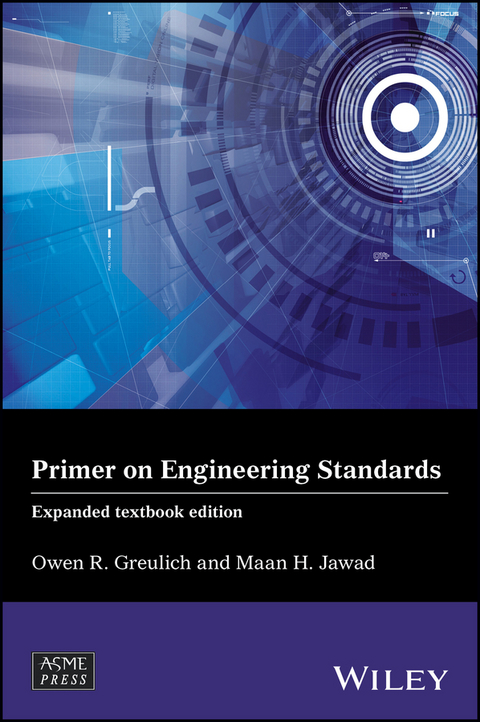
Primer on Engineering Standards (eBook)
John Wiley & Sons (Verlag)
978-1-119-46615-4 (ISBN)
A Clear, Comprehensive Introduction to Standards in the Engineering Professions
Standards supplement the design process by guiding the designer toward consistency, safety, and reliability. As daily life involves increasingly complex and sophisticated instruments, standards become indispensable engineering tools to ensure user safety and product quality. Primer on Engineering Standards: Expanded Textbook Edition delves into standards creation and compliance to provide students and engineers with a comprehensive reference.
The different types of standards are dissected and discussed in terms of development, value, impact, interpretation, and compliance, and options are provided for situations where conformance is not possible. The process of standards creation is emphasized in terms of essential characteristics and common pitfalls to avoid, with detailed guidance on how, where, and with whom one may get involved in official development.
Organized for both quick reference and textbook study, this new Expanded Textbook Edition provides a quick, clear understanding of critical concepts, ramifications, and implications as it:
- Introduces the concepts, history, and classification of standards, rules, and regulations
- Discusses the federal, state, and local government's role in standards development and enforcement
- Distinguishes voluntary consensus standards, limited consensus standards, and jurisdictional versus non-jurisdictional government standards
- Covers the need for and process of exemptions to existing standards
- Examines the characteristics of a good standard, and discusses opportunities for involvement in development
- Includes case studies to demonstrate standards applications, and extensive appendices to direct further inquiry
Owen Greulich, M.E., P.E., is an active member of the American Society of Mechanical Engineers (ASME) Process Piping Code Committee and the American Institute of Aeronautics and Astronautics (AIAA) Committee on Aerospace Pressure Vessels. He currently serves as Pressure and Energetic Systems Safety Manager in the Office of Safety and Mission Assurance at NASA Headquarters. Previously, Mr. Greulich worked in the private sector metals fabrication and machining industry.
Maan Jawad, Ph.D., P.E., is president of Global Engineering and Technology, an engineering consulting firm for the pressure vessel, power, petrochemical, and nuclear industries. Previously, he was with the Nooter Corporation in St. Louis, Missouri, prior to retiring.
Owen R. Greulich, M.E., P.E., is an active member of the American Society of Mechanical Engineers (ASME) Process Piping Code Committee and the American Institute of Aeronautics and Astronautics (AIAA) Committee on Aerospace Pressure Vessels. He currently serves as Pressure and Energetic Systems Safety Manager in the Office of Safety and Mission Assurance at NASA Headquarters. Previously, Mr. Greulich worked in the private sector metals fabrication and machining industry. Maan H. Jawad, Ph.D., P.E., is president of Global Engineering and Technology, an engineering consulting firm for the pressure vessel, power, petrochemical, and nuclear industries. He has been active on ASME Boiler and Pressure Vessel Code committees as a member and chairperson since 1972, a member of the Missouri Board of Boiler and Pressure Vessel Rules, and is a Fellow of the ASME. Prior to retiring, he was with the Nooter Corporation in St. Louis, Missouri.
Chapter 1
Introduction
(Courtesy of XKCD, www.xkcd.com)
1.1 Background
Standards, including procedures, rules, codes, regulations, and jurisdictional requirements, play an important role in the engineering world. They furnish a means of ensuring consistent designs, quality, and operating characteristics, with adequate reliability, safe operation of components, and well-defined configurations. This book details their development, applications, limitations, and benefits to give the user, specifier, and standard writer a proper perspective of their importance, usefulness, and limitations, to promote their effective use and to improve the quality of future standards. While focusing on standards themselves, it also provides a brief introduction to the field of conformity assessment, by which compliance with standards is assured and verified.
This book does not attempt to address legal, commercial, or other nonengineering aspects of standards.
Rules, procedures, and standards can be developed by a single individual within or with authority over an organization or operation, by a subgroup of an organization, by the organization as a whole, or by other groups with a common interest.
The reader will find that common usage of terminology related to standards is inconsistent in the literature. Accordingly, the following definitions are provided and will be used in this book:
- Rule: A single specific requirement that must be met. Many types of such requirements exist, such as requirements to perform actions, for how to perform actions, for results that must be achieved, for specific properties or characteristics that must be attained, and for dimensions that must be met.
- Procedure: A set of rules regarding how a task or function is performed. Procedures are used to ensure consistency of results and to promote efficiency.
- Standard: A set of rules and/or procedures recognized as authoritative in a particular area of interest.
One definition of standards given by the American Society of Mechanical Engineers (ASME) is as follows:
A set of technical definitions, instructions, rules, guidelines, or characteristics set forth to provide consistent and comparable results, including:
- Items manufactured uniformly, providing for interchangeability.
- Tests and analyses conducted reliably, minimizing the uncertainty of the results.
- Facilities designed and constructed for safe operation.
It is of interest to note that by custom, some standards are called codes.
The effectiveness of standards in conducting business is best explained by the American Society for Testing and Materials (ASTM) in a 1991 report:
Standards are the vehicle of communication for producers and users. They serve as a common language, defining quality and establishing safety criteria. Costs are lower if procedures are standardized; training is also simplified.
While the importance of standards is well recognized and while there is what might be called the “legal” definition, as provided in the National Technology Transfer and Advancement Act (NTTAA) (see below), even the National Institute of Standards and Technology, a part of the US Department of Commerce and that part of the US Government most directly charged with standards development, coordination, and quality, approaches the definition of standards by offering multiple explanations from different sources.
The following text provides the definition from the NTTAA of a standard (clearly covering more than just the engineering standards that are the subject of this book):
DEFINITION OF TECHNICAL STANDARDS – As used in this subsection, the term ‘technical standards’ means performance-based or design-specific technical specifications and related management systems practices.
The Office of Management and Budget OMB Circular A-119 further amplifies upon this:
- The term “standard,” or “technical standard,” (hereinafter “standard”) as cited in the NTTAA, includes all of the following:
- common and repeated use of rules, conditions, guidelines or characteristics for products or related processes and production methods, and related management systems practices;
- the definition of terms; classification of components; delineation of procedures; specification of dimensions, materials, performance, designs, or operations; measurement of quality and quantity in describing materials, processes, products, systems, services, or practices; test methods and sampling procedures; formats for information and communication exchange; or descriptions of fit and measurements of size or strength; and
- terminology, symbols, packaging, marking or labeling requirements as they apply to a product, process, or production method.
- The term “standard” does not include the following:
- professional standards of personal conduct; or
- institutional codes of ethics.
- “Government-unique standard” is a standard developed by and for use by the Federal government in its regulations, procurements, or other program areas specifically for government use (i.e., it is not generally used by the private sector unless required by regulation, procurement, or program participation). The standard was not developed as a voluntary consensus standard as described in Sections d and e.
- “Voluntary consensus standard” is a type of standard developed or adopted by voluntary consensus standards bodies, through the use of a voluntary consensus standards development process as described in Chapter 3. These bodies often have intellectual property rights (IPR) policies that include provisions requiring that owners of relevant patented technology incorporated into a standard make that intellectual property available to implementers of the standard on nondiscriminatory and royalty-free or reasonable royalty terms (and to bind subsequent owners of standards essential patents to the same terms). In order to qualify as a “voluntary consensus standard” for the purposes of this Circular, a standard that includes patented technology needs to be governed by such policies, which should be easily accessible, set out clear rules governing the disclosure and licensing of the relevant intellectual property, and take into account the interests of all stakeholders, including the IPR holders and those seeking to implement the standard.
- “Voluntary consensus standards body” is a type of association, organization, or technical society that plans, develops, establishes, or coordinates voluntary consensus standards using a voluntary consensus standards development process that includes the following attributes or elements:
- Openness: The procedures or processes used are open to interested parties. Such parties are provided meaningful opportunities to participate in standards development on a non-discriminatory basis. The procedures or processes for participating in standards development and for developing the standard are transparent.
- Balance: The standards development process should be balanced. Specifically, there should be meaningful involvement from a broad range of parties, with no single interest dominating the decision-making.
- Due process: Due process shall include documented and publically available policies and procedures, adequate notice of meetings and standards development, sufficient time to review drafts and prepare views and objections, access to views and objections of other participants, and a fair and impartial process for resolving conflicting views.
- Appeals process: An appeals process shall be available for the impartial handling of procedural appeals.
- Consensus: Consensus is defined as general agreement, but not necessarily unanimity. During the development of consensus, comments and objections are considered using fair, impartial, open, and transparent processes.
Some definitions of standards include only those standards with which compliance is voluntary, referring to mandatory standards as technical regulations or by other names. Because many voluntary consensus standards have been incorporated into laws and regulations, confusing the meaning of voluntary, this book does not make this distinction.
Other definitions require consensus, or establishment or approval by a recognized body. These distinctions are often significant, but would exclude such important documents as the standards of the American Boiler Manufacturers Association and the Tubular Exchanger Manufacturers Association (TEMA) as well as certain standards developed by private corporations but well recognized as authoritative (An example of the latter is a series of material and other standards developed by the AO Smith Company and used by them and other companies in the construction of many thousands of pressure vessels beginning in the 1940s and continuing into the 1960s.).
Conformity Assessment: Processes used to verify the compliance of a product, service, person, process or system to either a standard or a regulation (e.g., testing, certification, inspection).
1.2 Procedures and Rules
Procedures and rules are usually developed within an organization to establish operating methods that will lead to consistent desired results. They include such items as drawing and calculation formats, dimensional standards, checking sequences, and hierarchical progression of a task within the organization....
| Erscheint lt. Verlag | 7.3.2018 |
|---|---|
| Reihe/Serie | Wiley-ASME Press Series |
| Wiley-ASME Press Series | Wiley-ASME Press Series |
| Sprache | englisch |
| Themenwelt | Technik ► Maschinenbau |
| Schlagworte | analytic standards • ANSI • ASME • ASTM • compliance methods • Construction standards • design standards • example standards • Festkörpermechanik • government standards consensus standards • history of standards • IEEE • ineffective standards</p> • inspection methodology • introduction to standards • jurisdictional standards • <p>manufacturing standards • Maschinenbau • Maschinenbau - Entwurf • mechanical engineering • Mechanical Engineering - Design • non-governmental standards • non-jurisdictional standards • reference standards • Safety Standards • solid mechanics • standard issuing bodies • standards case studies • standards characteristics • standards committees • standards compliance • standards conformity • standards creation • standards development • standards enforcement • standards exemptions • standards explained • standards incorporation • standards inspections • standards interpretation • standards liability • standards noncompliance • standards organizations • standards primer • standards reference • standards textbook • standards variances • standards versus codes • UL • value of standards • VCS • Voluntary Standards |
| ISBN-10 | 1-119-46615-6 / 1119466156 |
| ISBN-13 | 978-1-119-46615-4 / 9781119466154 |
| Informationen gemäß Produktsicherheitsverordnung (GPSR) | |
| Haben Sie eine Frage zum Produkt? |
 EPUB (Adobe DRM)
Kopierschutz: Adobe-DRM
Adobe-DRM ist ein Kopierschutz, der das eBook vor Mißbrauch schützen soll. Dabei wird das eBook bereits beim Download auf Ihre persönliche Adobe-ID autorisiert. Lesen können Sie das eBook dann nur auf den Geräten, welche ebenfalls auf Ihre Adobe-ID registriert sind.
Details zum Adobe-DRM
Dateiformat: EPUB (Electronic Publication)
EPUB ist ein offener Standard für eBooks und eignet sich besonders zur Darstellung von Belletristik und Sachbüchern. Der Fließtext wird dynamisch an die Display- und Schriftgröße angepasst. Auch für mobile Lesegeräte ist EPUB daher gut geeignet.
Systemvoraussetzungen:
PC/Mac: Mit einem PC oder Mac können Sie dieses eBook lesen. Sie benötigen eine
eReader: Dieses eBook kann mit (fast) allen eBook-Readern gelesen werden. Mit dem amazon-Kindle ist es aber nicht kompatibel.
Smartphone/Tablet: Egal ob Apple oder Android, dieses eBook können Sie lesen. Sie benötigen eine
Geräteliste und zusätzliche Hinweise
Buying eBooks from abroad
For tax law reasons we can sell eBooks just within Germany and Switzerland. Regrettably we cannot fulfill eBook-orders from other countries.
aus dem Bereich