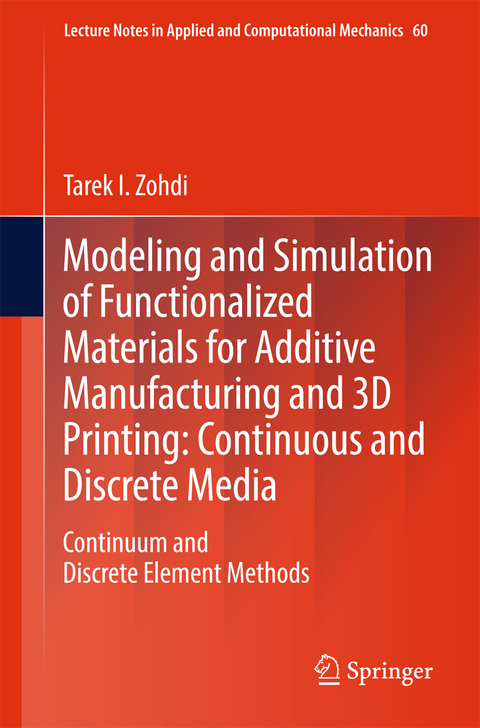
Modeling and Simulation of Functionalized Materials for Additive Manufacturing and 3D Printing: Continuous and Discrete Media (eBook)
XIX, 298 Seiten
Springer International Publishing (Verlag)
978-3-319-70079-3 (ISBN)
Within the last decade, several industrialized countries have stressed the importance of advanced manufacturing to their economies. Many of these plans have highlighted the development of additive manufacturing techniques, such as 3D printing which, as of 2018, are still in their infancy. The objective is to develop superior products, produced at lower overall operational costs. For these goals to be realized, a deep understanding of the essential ingredients comprising the materials involved in additive manufacturing is needed. The combination of rigorous material modeling theories, coupled with the dramatic increase of computational power can potentially play a significant role in the analysis, control, and design of many emerging additive manufacturing processes. Specialized materials and the precise design of their properties are key factors in the processes. Specifically, particle-functionalized materials play a central role in this field, in three main regimes:
(1) to enhance overall filament-based material properties, by embedding particles within a binder, which is then passed through a heating element and the deposited onto a surface,
(2) to 'functionalize' inks by adding particles to freely flowing solvents forming a mixture, which is then deposited onto a surface and
(3) to directly deposit particles, as dry powders, onto surfaces and then to heat them with a laser, e-beam or other external source, in order to fuse them into place.
The goal of these processes is primarily to build surface structures which are extremely difficult to construct using classical manufacturing methods. The objective of this monograph is introduce the readers to basic techniques which can allow them to rapidly develop and analyze particulate-based materials needed in such additive manufacturing processes. This monograph is broken into two main parts: 'Continuum Method' (CM) approaches and 'Discrete Element Method' (DEM) approaches. The materials associated with methods (1) and (2) are closely related types of continua (particles embedded in a continuous binder) and are treated using continuum approaches. The materials in method (3), which are of a discrete particulate character, are analyzed using discrete element methods.
Preface 7
Contents 9
List of Figures 14
1 Introduction: Additive/3D Printing Materials---Filaments, Functionalized Inks, and Powders 1
1.1 Objectives 23
References 24
2 Continuum Methods (CM): Basic Continuum Mechanics 26
2.1 Notation 26
2.2 Kinematics of Deformations 26
2.2.1 Deformation of Line Elements 28
2.3 Equilibrium/Kinetics of Continua 29
2.3.1 Postulates on Volume and Surface Quantities 29
2.3.2 Balance Law Formulations 31
2.4 The First Law of Thermodynamics/An Energy Balance 31
2.5 Linearly Elastic Constitutive Equations 33
2.5.1 The Infinitesimal Strain Case 33
2.5.2 Material Response 33
2.5.3 Material Component Interpretation 35
References 37
3 CM Approaches: Characterization of Particle-Functionalized Materials 38
3.1 Introduction 38
3.2 Basic Micro--Macro Concepts 39
3.2.1 Testing Procedures 40
3.2.2 The Average Strain Theorem 41
3.2.3 The Average Stress Theorem 42
3.2.4 Satisfaction of Hill's Energy Condition 42
3.2.5 The Hill--Reuss--Voigt Bounds 43
3.2.6 Improved Estimates 44
References 45
4 CM Approaches: Estimation and Optimization of the Effective Properties of Mixtures 48
4.1 Combining Bounds 48
4.2 Local Fields: Stresses and Strains 49
4.3 Optimization: Formulation of a Cost Function 51
4.4 Suboptimal Properties Due to Defects---Effects of Pores/voids 57
References 58
5 CM Approaches: Numerical Thermo-Mechanical Formulations 60
5.1 Transient Thermo-Mechanical Coupled Fields 61
5.2 Iterative Staggering Scheme 63
5.3 Temporal Discretization of Fields 67
5.4 The Overall Solution Scheme 68
5.5 Numerical Examples 71
5.6 Summary and Extensions 76
5.7 Chapter Appendix 1: Summary of Spatial Finite Difference Stencils 79
5.8 Chapter Appendix 2: Second-Order Temporal Discretization 80
5.9 Chapter Appendix 3: Temporally Adaptive Iterative Methods 82
5.10 Chapter Appendix 4: Laser Processing 84
5.10.1 Formulations for Particulate-Laden Continua 85
5.10.2 A Specific Numerical Example---Controlled Heating 86
5.10.3 Numerical Examples 87
5.10.4 Extensions: Advanced Models for Conduction Utilizing Thermal Relaxation 92
References 95
6 PART II---Discrete Element Method (DEM) Approaches: Dynamic Powder Deposition 99
6.1 Direct Particle Representation/Calculations 102
6.1.1 Comments on Rolling 102
6.1.2 Particle-to-particle Contact Forces 103
6.1.3 Particle-Wall Contact 104
6.1.4 Contact Dissipation 104
6.1.5 Regularized Contact Friction Models 105
6.1.6 Particle-to-particle Bonding Relation 106
6.1.7 Electromagnetic Forces 106
6.1.8 Inter-particle Near-Field Interaction 107
6.1.9 Magnetic Forces 108
6.1.10 Interstitial Damping 108
6.2 Time-Stepping 109
6.2.1 Iterative (Implicit) Solution Method 109
6.2.2 Algorithm 111
6.3 Thermal Fields 113
6.3.1 Heat Transfer Model 113
6.3.2 Lasers---Various Levels of Description 114
6.3.3 Numerical Integration 116
6.4 Total System Coupling: Multiphysical Staggering Scheme 116
6.4.1 A General Iterative Framework 117
6.4.2 Overall Solution Algorithm 117
6.4.3 Interaction Lists 118
6.5 Numerical Examples 120
6.6 Summary for DEM Approaches 124
6.7 Chapter Appendix 1: Contact Area Parameter and Alternative Models 125
6.8 Chapter Appendix 2: Phase Transformations 128
References 129
7 DEM Extensions: Electrically Driven Deposition of Polydisperse Particulate Powder Mixtures 1
7.1 Introduction 136
7.2 Algorithm 137
7.3 Numerical Examples of Involving Polydisperse Depositions 138
References 148
8 DEM Extensions: Electrically Aided Compaction and Sintering 150
8.1 Introduction 150
8.1.1 Objectives 150
8.2 Direct Particle Representation 152
8.3 Thermal Fields 153
8.3.1 Governing Equations 153
8.3.2 Numerical Integration 154
8.4 Modeling of Current Flow 155
8.4.1 Particle Model Simplification 155
8.4.2 Iterative Flux Summation/Solution Process 156
8.4.3 Overall Solution Algorithm 158
8.5 Numerical Examples 159
8.5.1 STEP 1: Pouring the Particles 160
8.5.2 STEP 2: Compacting the Particles 160
8.6 Extensions and Conclusions 163
8.7 Chapter Appendix 1: Joule-Heating 164
8.7.1 Characterizing Electrical Losses 164
8.7.2 Joule-Heating 165
8.8 Chapter Appendix 2: Time-Scaling Arguments for calPtapprox0 165
References 166
9 DEM Extensions: Flexible Substrate Models 169
9.1 Introduction 169
9.2 A Multibody Dynamics Model for the Particles 170
9.2.1 Overall Contributing Forces 170
9.3 Induced Substrate Stresses 171
9.3.1 Individual Particle Contributions---Normal Load 171
9.3.2 Individual Particle Contributions---Tangential Load 172
9.3.3 Superposition of Contributions for the Total Substrate Stresses 173
9.4 Numerical Examples 175
9.5 Summary, Conclusions, and Extensions 179
References 180
10 DEM Extensions: Higher-Fidelity Laser Modeling 185
10.1 Propagation of Electromagnetic Energy 186
10.1.1 Electromagnetic Wave Propagation 186
10.1.2 Plane Harmonic Wave Fronts 187
10.1.3 Special Case: Natural (Random) Electromagnetic Energy Propagation 188
10.1.4 Beam Decomposition into Rays 188
10.2 Thermal Conversion of Beam (Optical) Losses 194
10.2.1 Algorithmic Details 195
10.3 Phase Transformations: Solid Liquid Vapor 196
10.3.1 Optional Time Scaling and Simulation Acceleration 197
10.4 Numerical Examples 199
10.5 Summary and Extensions 204
10.6 Chapter Appendix: Geometrical Ray Theory 206
References 208
11 DEM Extensions: Acoustical Pre-Processing 211
11.1 Introduction 211
11.2 Dynamic Response of an Agglomeration 214
11.3 Particle-Shock Wave Contact 214
11.3.1 Ray-Tracing: Incidence, Reflection, and Transmission 215
11.3.2 Acoustical-Pulse Computational Algorithm 217
11.3.3 Iterative (Implicit) Solution Method Algorithm 218
11.4 Numerical Example 219
11.5 Closing Statements 222
References 228
12 Summary and Closing Remarks 232
References 235
Appendix Monograph Appendix A: Elementary Notation and Mathematical Operations 238
A.1 Vectors, Products, and Norms 238
A.2 Basic Linear Algebra 239
A.3 Integral Transformations 243
Appendix Monograph Appendix B---CM Approaches: Effective Electrical Properties of Mixtures 245
B.1 Computing the Effective Electrical Conductivity 246
B.2 Concentration Tensors and Load-Sharing 247
B.3 ``Load-Sharing'' Interpretation 248
B.4 Joule-Heating 249
B.5 The Controllable Quantities: langleJrangle? and langleErangle? 251
B.6 Joule-Heating Load-Shares 253
B.7 Examples of Joule-Heating Load-Sharing 256
B.7.1 A General Dielectric Mixture 256
B.7.2 An Extreme Mixture: High-Conductivity (``Superconducting'') Particles in a Low-Conductivity Matrix 257
B.7.3 An Extreme Mixture: Low-Conductivity (``Insulator'') Particles in a High-Conductivity Matrix 258
B.8 Optimization Example: Dielectric Properties Using Genetic Algorithms 259
B.9 Additional Dielectric Properties: Electrical Permittivity and Magnetic Permeability 261
B.10 The Concentration Tensor 261
B.11 ``Load-Sharing'' Interpretation 264
B.12 Thermal Conductivity 264
Appendix Monograph Appendix C---CM Approaches: Extensions to Multiphase Materials 268
C.1 Electrical Conductivity 268
C.1.1 The Hill--Reuss--Voigt--Weiner (HRVW) Bounds 269
C.1.2 The Hashin--Shtrikman (HS) Bounds 269
C.2 Electrical Permittivity 270
C.2.1 The Hill--Reuss--Voigt--Weiner Bounds 270
C.2.2 The Hashin--Shtrikman Bounds 270
C.3 Magnetic Permeability 271
C.3.1 The Hill--Reuss--Voigt--Weiner Bounds 271
C.3.2 The Hashin--Shtrikman Bounds 271
C.4 Thermal Conductivity 272
C.4.1 The Hill--Reuss--Voigt--Weiner Bounds 272
C.4.2 The Hashin--Shtrikman Bounds 272
C.5 Elastic Moduli 273
C.5.1 Bulk Modulus 273
C.5.1.1 The Hill--Reuss--Voigt--Weiner Bounds 273
C.5.1.2 The Hashin--Shtrikman Bounds 273
C.5.2 Shear Modulus 274
C.5.2.1 The Hill--Reuss--Voigt--Weiner Bounds 274
C.5.2.2 The Hashin--Shtrikman Bounds 275
C.6 Concentration Tensors for Multiphase materials 275
Appendix Monograph Appendix D---Pumping of Fluidized Particle-Laden Materials 278
D.1 Introduction 278
D.2 Channel Flow 279
D.3 Pressure Gradients 280
D.4 Velocity Profile Characteristics 281
D.5 Models for Effective Properties of Particle-Laden Fluids 282
D.5.1 Effective Density 282
D.5.2 Ancillary Effective Viscosities 283
D.6 Correlation of Pressure Gradient to Particle Volume Fraction 283
D.7 Trends 284
D.8 Summary 285
Appendix Monograph Appendix E---Hybrid DEM-CM Approaches for Particle-Functionalized Fluids 289
E.1 Applications 289
E.2 A Quick Review of General Governing Fluid Equations 292
E.3 Numerical Simulation of Coupled Fluid--Multiparticle Systems 295
E.4 The Overall Approach 295
E.5 Simplifying Assumptions 295
E.6 Modeling and Simulation of the Particle Dynamics Problem 296
E.7 Characterization of Particle/Fluid Interaction 297
E.8 Discretization of the Fluid 299
E.8.1 Temporal Discretization 299
E.8.2 Spatial Discretization: Spatial Finite Difference Stencils 300
E.9 Overall Iterative (Implicit) Solution Method 301
| Erscheint lt. Verlag | 22.12.2017 |
|---|---|
| Reihe/Serie | Lecture Notes in Applied and Computational Mechanics | Lecture Notes in Applied and Computational Mechanics |
| Zusatzinfo | XIX, 298 p. 83 illus., 34 illus. in color. |
| Verlagsort | Cham |
| Sprache | englisch |
| Themenwelt | Technik ► Maschinenbau |
| Schlagworte | Deposition • Final Product Analysis • Modeling and Simulation • Particulate-based Additive Manufacturing • Post-processing • Rapid-Prototyping |
| ISBN-10 | 3-319-70079-0 / 3319700790 |
| ISBN-13 | 978-3-319-70079-3 / 9783319700793 |
| Informationen gemäß Produktsicherheitsverordnung (GPSR) | |
| Haben Sie eine Frage zum Produkt? |
 PDF (Wasserzeichen)
DRM: Digitales Wasserzeichen
Dieses eBook enthält ein digitales Wasserzeichen und ist damit für Sie personalisiert. Bei einer missbräuchlichen Weitergabe des eBooks an Dritte ist eine Rückverfolgung an die Quelle möglich.
Dateiformat: PDF (Portable Document Format)
Mit einem festen Seitenlayout eignet sich die PDF besonders für Fachbücher mit Spalten, Tabellen und Abbildungen. Eine PDF kann auf fast allen Geräten angezeigt werden, ist aber für kleine Displays (Smartphone, eReader) nur eingeschränkt geeignet.
Systemvoraussetzungen:
PC/Mac: Mit einem PC oder Mac können Sie dieses eBook lesen. Sie benötigen dafür einen PDF-Viewer - z.B. den Adobe Reader oder Adobe Digital Editions.
eReader: Dieses eBook kann mit (fast) allen eBook-Readern gelesen werden. Mit dem amazon-Kindle ist es aber nicht kompatibel.
Smartphone/Tablet: Egal ob Apple oder Android, dieses eBook können Sie lesen. Sie benötigen dafür einen PDF-Viewer - z.B. die kostenlose Adobe Digital Editions-App.
Buying eBooks from abroad
For tax law reasons we can sell eBooks just within Germany and Switzerland. Regrettably we cannot fulfill eBook-orders from other countries.
aus dem Bereich