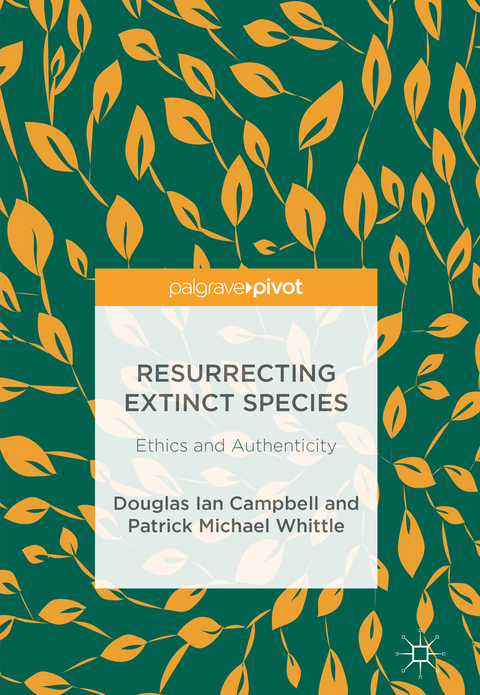
Resurrecting Extinct Species (eBook)
IX, 128 Seiten
Springer International Publishing (Verlag)
978-3-319-69578-5 (ISBN)
This book is about the philosophy of de-extinction. To make an extinct species 'de-extinct' is to resurrect it by creating new organisms of the same, or similar, appearance and genetics. The book describes current attempts to resurrect three species, the aurochs, woolly mammoth and passenger pigeon. It then investigates two major philosophical questions such projects throw up. These are the Authenticity Question-'will the products of de-extinction be authentic members of the original species?'-and the Ethical Question-'is de-extinction something that should be done?' The book surveys and critically evaluates a raft of arguments for and against the authenticity or de-extinct organisms, and for and against the ethical legitimacy of de-extinction. It concludes, first, that authentic de-extinctions are actually possible, and second, that de-extinction can potentially be ethically legitimate, especially when deployed as part of a 'freeze now and resurrect later' conservation strategy.
Douglas Campbell is Philosophy Lecturer at the University of Canterbury, New Zealand, and completed his PhD at the University of Arizona, USA. With a background in biology, he has worked as a wildlife warden and conservationist. His research interests include philosophy of mind, philosophical logic, epistemology and metaphysics. His work on de-extinction has included public lectures, conference presentations, and academic journal articles.
Patrick Michael Whittle, who holds a PhD in Philosophy from the University of Canterbury, New Zealand, is a freelance writer and journalist based in Christchurch, New Zealand. As well as writing about science, politics and environmental issues (including de-extinction) at both a popular and academic level, he has worked in universities and educational establishments in New Zealand, Europe, the Middle East and Central Asia.
Douglas Campbell is Philosophy Lecturer at the University of Canterbury, New Zealand, and completed his PhD at the University of Arizona, USA. With a background in biology, he has worked as a wildlife warden and conservationist. His research interests include philosophy of mind, philosophical logic, epistemology and metaphysics. His work on de-extinction has included public lectures, conference presentations, and academic journal articles.Patrick Michael Whittle, who holds a PhD in Philosophy from the University of Canterbury, New Zealand, is a freelance writer and journalist based in Christchurch, New Zealand. As well as writing about science, politics and environmental issues (including de-extinction) at both a popular and academic level, he has worked in universities and educational establishments in New Zealand, Europe, the Middle East and Central Asia.
Chapter 1. Wildlife Conservation in a Brave New World.- Chapter 2. Backbreeding: From Cow to Auroch.- Chapter 3: From Elephant to Mammoth by Coning and Genetic Engineering.- Chapter 4. Bringing back birds: passenger pigeons and huia.- Chapter 5. Resurrecting Neanderthals: De-extinction at the ethical limit.- Chapter 6. Mammoth or pseudo-mammoth? The authenticity question.- Chapter 7. Arguments For and Against De-extinction.- Chapter 8. Why, Which, When, and How: the ethics of de-extinction.
| Erscheint lt. Verlag | 25.11.2017 |
|---|---|
| Zusatzinfo | IX, 128 p. 1 illus. |
| Verlagsort | Cham |
| Sprache | englisch |
| Themenwelt | Geisteswissenschaften ► Philosophie ► Ethik |
| Technik | |
| Schlagworte | authenticity • biodiversity • conservation • de-extinction • ethics • Moral Hazard • Research • Restorative Justice • Resurrection |
| ISBN-10 | 3-319-69578-9 / 3319695789 |
| ISBN-13 | 978-3-319-69578-5 / 9783319695785 |
| Informationen gemäß Produktsicherheitsverordnung (GPSR) | |
| Haben Sie eine Frage zum Produkt? |
 PDF (Wasserzeichen)
DRM: Digitales Wasserzeichen
Dieses eBook enthält ein digitales Wasserzeichen und ist damit für Sie personalisiert. Bei einer missbräuchlichen Weitergabe des eBooks an Dritte ist eine Rückverfolgung an die Quelle möglich.
Dateiformat: PDF (Portable Document Format)
Mit einem festen Seitenlayout eignet sich die PDF besonders für Fachbücher mit Spalten, Tabellen und Abbildungen. Eine PDF kann auf fast allen Geräten angezeigt werden, ist aber für kleine Displays (Smartphone, eReader) nur eingeschränkt geeignet.
Systemvoraussetzungen:
PC/Mac: Mit einem PC oder Mac können Sie dieses eBook lesen. Sie benötigen dafür einen PDF-Viewer - z.B. den Adobe Reader oder Adobe Digital Editions.
eReader: Dieses eBook kann mit (fast) allen eBook-Readern gelesen werden. Mit dem amazon-Kindle ist es aber nicht kompatibel.
Smartphone/Tablet: Egal ob Apple oder Android, dieses eBook können Sie lesen. Sie benötigen dafür einen PDF-Viewer - z.B. die kostenlose Adobe Digital Editions-App.
Buying eBooks from abroad
For tax law reasons we can sell eBooks just within Germany and Switzerland. Regrettably we cannot fulfill eBook-orders from other countries.
aus dem Bereich