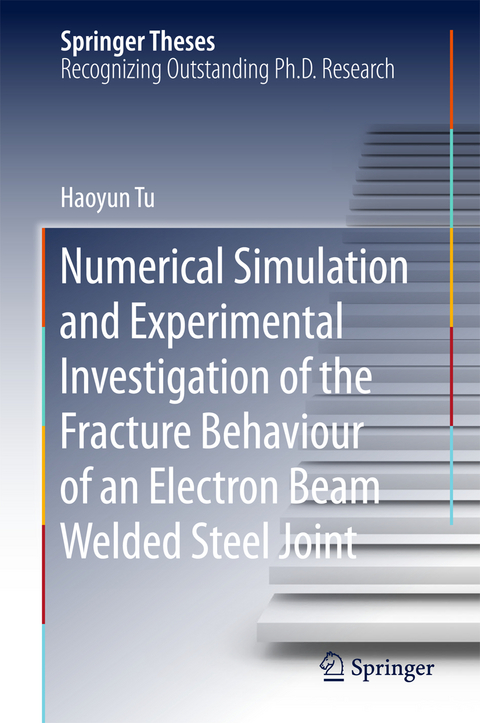
Numerical Simulation and Experimental Investigation of the Fracture Behaviour of an Electron Beam Welded Steel Joint
Springer International Publishing (Verlag)
978-3-319-67276-2 (ISBN)
Haoyun Tu is an Assistant Professor at the School of Aerospace Engineering and Applied Mechanics, Tongji University, PR China. He received his BE and ME from Northwestern Polytechnical University, China and Dr.-Ing. from University of Stuttgart, Germany. His research interests are on fracture mechanism of metals and welded joints from metals with experimental and finite element methods as well as on characterization techniques such as 3D optical deformation measurement and Synchrotron radiation-computed laminography (SRCL).
Introduction.- Scientific background.- Characterization of steel S355 electron beam welded (EBW) joints.- The Rousselier model.- The Gurson-Tvergaard-Needleman (GTN) model.- The Cohesive zone model.- Optical measurement of crack propagation with the ARAMIS system.- In situ laminography investigation of damage evolution in S355 base material.- Summary and Outlook.
| Erscheinungsdatum | 16.11.2017 |
|---|---|
| Reihe/Serie | Springer Theses |
| Zusatzinfo | XVII, 171 p. 190 illus., 163 illus. in color. |
| Verlagsort | Cham |
| Sprache | englisch |
| Maße | 155 x 235 mm |
| Gewicht | 456 g |
| Themenwelt | Technik ► Maschinenbau |
| Schlagworte | 2D Rousselier model • 3D optical deformation measurement system • Characterization and Evaluation of Materials • Chemistry and Materials Science • Cohesive zone model • Continuum Mechanics and Mechanics of Materials • Crack propagation • Gurson-Tvergaard-Needleman (GTN) model • Materials Science • mechanical engineering & materials • Mechanical engineering & materials • metal fracture behaviour • Metallic materials • metals technology / metallurgy • numerical fracture energy • shear coalescence mechanism • Surface chemistry & adsorption • surface chemistry & adsorption • Surfaces and Interfaces, Thin Films • synchrotron radiation-computed laminography • Testing of materials • void initiation |
| ISBN-10 | 3-319-67276-2 / 3319672762 |
| ISBN-13 | 978-3-319-67276-2 / 9783319672762 |
| Zustand | Neuware |
| Informationen gemäß Produktsicherheitsverordnung (GPSR) | |
| Haben Sie eine Frage zum Produkt? |
aus dem Bereich