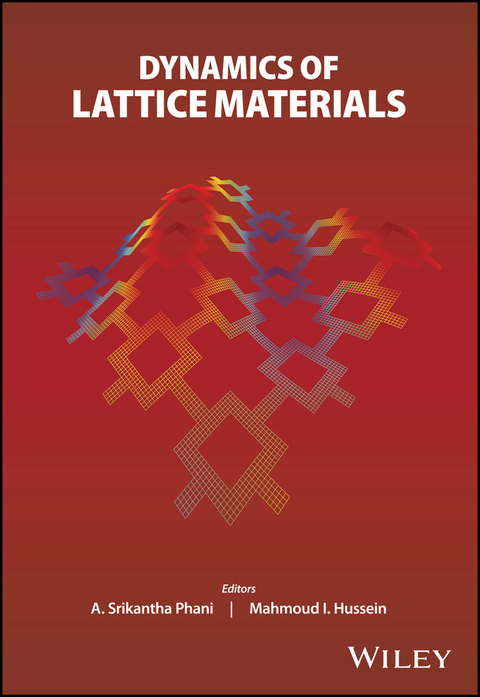
Dynamics of Lattice Materials (eBook)
John Wiley & Sons (Verlag)
978-1-118-72956-4 (ISBN)

- Provides a comprehensive introduction to the dynamic response of lattice materials, covering the fundamental theory and applications in engineering practice
- Offers comprehensive treatment of dynamics of lattice materials and periodic materials in general, including phononic crystals and elastic metamaterials
- Provides an in depth introduction to elastostatics and elastodynamics of lattice materials
- Covers advanced topics such as damping, nonlinearity, instability, impact and nanoscale systems
- Introduces contemporary concepts including pentamodes, local resonance and inertial amplification
- Includes chapters on fast computation and design optimization tools
- Topics are introduced using simple systems and generalized to more complex structures with a focus on dispersion characteristics
Editors
A. Srikantha Phani, University of British Columbia, Canada
Mahmoud I. Hussein, University of Colorado Boulder, USA
Provides a comprehensive introduction to the dynamic response of lattice materials, covering the fundamental theory and applications in engineering practice Offers comprehensive treatment of dynamics of lattice materials and periodic materials in general, including phononic crystals and elastic metamaterials Provides an in depth introduction to elastostatics and elastodynamics of lattice materials Covers advanced topics such as damping, nonlinearity, instability, impact and nanoscale systems Introduces contemporary concepts including pentamodes, local resonance and inertial amplification Includes chapters on fast computation and design optimization tools Topics are introduced using simple systems and generalized to more complex structures with a focus on dispersion characteristics
Editors A. Srikantha Phani, University of British Columbia, Canada Mahmoud I. Hussein, University of Colorado Boulder, USA
Cover 1
Title Page 5
Copyright 6
Dedication 7
Contents 9
List of Contributors 15
Foreword 17
Preface 27
Chapter 1 Introduction to Lattice Materials 29
1.1 Introduction 29
1.2 Lattice Materials and Structures 30
1.2.1 Material versus Structure 31
1.2.2 Motivation 31
1.2.3 Classification of Lattices and Maxwell's Rule 32
1.2.4 Manufacturing Methods 34
1.2.5 Applications 35
1.3 Overview of Chapters 36
Acknowledgment 38
References 38
Chapter 2 Elastostatics of Lattice Materials 47
2.1 Introduction 47
2.2 The RVE 49
2.3 Surface Average Approach 50
2.4 Volume Average Approach 53
2.5 Force-based Approach 53
2.6 Asymptotic Homogenization Method 54
2.7 Generalized Continuum Theory 57
2.8 Homogenization via Bloch Wave Analysis and the Cauchy-Born Hypothesis 60
2.9 Multiscale Matrix-based Computational Technique 62
2.10 Homogenization based on the Equation of Motion 64
2.11 Case Study: Property Predictions for a Hexagonal Lattice 66
2.12 Conclusions 70
References 71
Chapter 3 Elastodynamics of Lattice Materials 81
3.1 Introduction 81
3.2 One-dimensional Lattices 83
3.2.1 Bloch's Theorem 85
3.2.2 Application of Bloch's Theorem 87
3.2.3 Dispersion Curves and Unit-cell Resonances 87
3.2.4 Continuous Lattices: Local Resonance and sub-Bragg Band Gaps 89
3.2.5 Dispersion Curves of a Beam Lattice 90
3.2.6 Receptance Method 92
3.2.7 Synopsis of 1D Lattices 95
3.3 Two-dimensional Lattice Materials 95
3.3.1 Application of Bloch's Theorem to 2D Lattices 95
3.3.2 Discrete Square Lattice 98
3.4 Lattice Materials 100
3.4.1 Finite Element Modelling of the Unit Cell 103
3.4.2 Band Structure of Lattice Topologies 105
3.4.3 Directionality of Wave Propagation 112
3.5 Tunneling and Evanescent Waves 113
3.6 Concluding Remarks 115
3.7 Acknowledgments 115
References 115
Chapter 4 Wave Propagation in Damped Lattice Materials 121
4.1 Introduction 121
4.2 One-dimensional Mass-Spring-Damper Model 123
4.2.1 1D Model Description 123
4.2.2 Free-wave Solution 124
State-space Wave Calculation 125
Bloch-Rayleigh Perturbation Method 125
4.2.3 Driven-wave Solution 126
4.2.4 1D Damped Band Structures 126
4.3 Two-dimensional Plate-Plate Lattice Model 127
4.3.1 2D Model Description 127
4.3.2 Extension of Driven-wave Calculations to 2D Domains 128
4.3.3 2D Damped Band Structures 129
References 132
Chapter 5 Wave Propagation in Nonlinear Lattice Materials 135
5.1 Overview 135
5.2 Weakly Nonlinear Dispersion Analysis 136
5.3 Application to a 1D Monoatomic Chain 142
5.3.1 Overview 142
5.3.2 Model Description and Nonlinear Governing Equation 142
5.3.3 Single-wave Dispersion Analysis 143
5.3.4 Multi-wave Dispersion Analysis 144
Case 1. General Wave-Wave Interactions 145
Case 2. Long-wavelength Limit Wave-Wave Interactions 147
5.3.5 Numerical Verification and Discussion 150
5.4 Application to a 2D Monoatomic Lattice 151
5.4.1 Overview 151
5.4.2 Model Description and Nonlinear Governing Equation 152
5.4.3 Multiple-scale Perturbation Analysis 153
5.4.4 Analysis of Predicted Dispersion Shifts 155
5.4.5 Numerical Simulation Validation Cases 157
Analysis Method 158
Orthogonal and Oblique Interaction 159
5.4.6 Application: Amplitude-tunable Focusing 161
Summary 162
Acknowledgements 163
References 163
Chapter 6 Stability of Lattice Materials 167
6.1 Introduction 167
6.2 Geometry, Material, and Loading Conditions 168
6.3 Stability of Finite-sized Specimens 169
6.4 Stability of Infinite Periodic Specimens 170
6.4.1 Microscopic Instability 170
6.5 Post-buckling Analysis 173
6.6 Effect of Buckling and Large Deformation on the Propagation Of Elastic Waves 174
6.7 Conclusions 178
References 179
Chapter 7 Impact and Blast Response of Lattice Materials 183
7.1 Introduction 183
7.2 Literature Review 183
7.2.1 Dynamic Response of Cellular Structures 183
7.2.2 Shock- and Blast-loading Responses of Cellular Structures 185
7.2.3 Dynamic Indentation Performance of Cellular Structures 186
7.3 Manufacturing Process 187
7.3.1 The Selective Laser Melting Technique 187
7.3.2 Sandwich Panel Manufacture 188
7.4 Dynamic and Blast Loading of Lattice Materials 189
7.4.1 Experimental Method - Drop-hammer Impact Tests 189
7.4.2 Experimental Method - Blast Tests on Lattice Cubes 190
7.4.3 Experimental Method - Blast Tests on Composite-lattice Sandwich Structures 191
7.5 Results and Discussion 193
7.5.1 Drop-hammer Impact Tests 193
7.5.2 Blast Tests on the Lattice Structures 195
7.5.3 Blast Tests on the Sandwich Panels 198
Concluding Remarks 201
Acknowledgements 202
References 202
Chapter 8 Pentamode Lattice Structures 207
8.1 Introduction 207
8.2 Pentamode Materials 211
8.2.1 General Properties 211
8.2.2 Small Rigidity and Poisson's Ratio of a PM 213
8.2.3 Wave Motion in a PM 214
8.3 Lattice Models for PM 215
8.3.1 Effective PM Properties of 2D and 3D Lattices 215
8.3.2 Transversely Isotropic PM Lattice 216
Effective Moduli: 2D 218
8.4 Quasi-static Pentamode Properties of a Lattice in 2D and 3D 220
8.4.1 General Formulation with Rigidity 220
8.4.2 Pentamode Limit 222
8.4.3 Two-dimensional Results for Finite Rigidity 223
8.5 Conclusion 223
Acknowledgements 224
References 224
Chapter 9 Modal Reduction of Lattice Material Models 227
9.1 Introduction 227
9.2 Plate Model 228
9.2.1 Mindlin-Reissner Plate Finite Elements 228
9.2.2 Bloch Boundary Conditions 230
9.2.3 Example Model 231
9.3 Reduced Bloch Mode Expansion 232
9.3.1 RBME Formulation 232
9.3.2 RBME Example 233
9.3.3 RBME Additional Considerations 235
9.4 Bloch Mode Synthesis 236
9.4.1 BMS Formulation 236
9.4.2 BMS Example 238
9.4.3 BMS Additional Considerations 238
9.5 Comparison of RBME and BMS 240
9.5.1 Model Size 240
9.5.2 Computational Efficiency 241
9.5.3 Ease of Implementation 242
References 242
Chapter 10 Topology Optimization of Lattice Materials 245
10.1 Introduction 245
10.2 Unit-cell Optimization 246
10.2.1 Parametric, Shape, and Topology Optimization 246
10.2.2 Selection of Studies from the Literature 246
10.2.3 Design Search Space 247
10.3 Plate-based Lattice Material Unit Cell 248
10.3.1 Equation of Motion and FE Model 249
10.3.2 Mathematical Formulation 250
10.4 Genetic Algorithm 251
10.4.1 Objective Function 251
10.4.2 Fitness Function 252
10.4.3 Selection 252
10.4.4 Reproduction 252
10.4.5 Initialization and Termination 253
10.4.6 Implementation 253
10.5 Appendix 254
References 256
Chapter 11 Dynamics of Locally Resonant and Inertially Amplified Lattice Materials 261
11.1 Introduction 261
11.2 Locally Resonant Lattice Materials 262
11.2.1 1D Locally Resonant Lattices 262
11.2.2 2D Locally Resonant Lattices 269
11.2.3 3D Locally Resonant Lattices 271
11.3 Inertially Amplified Lattice Materials 274
11.3.1 1D Inertially Amplified Lattices 274
11.3.2 2D Inertially Amplified Lattices 276
11.3.3 3D Inertially Amplified Lattices 281
11.4 Conclusions 283
References 284
Chapter 12 Dynamics of Nanolattices: Polymer-Nanometal Lattices 287
12.1 Introduction 287
12.2 Fabrication 287
12.2.1 Case Study 290
12.3 Lattice Dynamics 291
12.3.1 Lattice Properties 292
Geometries of 3D Lattices 292
Effective Material Properties of Nanometal-coated Polymer Lattices 293
12.3.2 Finite-element Model 294
Displacement Field 294
Kinetic Energy 296
Strain Potential Energy 297
Collected Equation of Motion 298
12.3.3 Floquet-Bloch Principles 299
Generalized Forces in Bloch Analysis 300
Reduced Equation of Motion 302
12.3.4 Dispersion Curves for the Octet Lattice 303
12.3.5 Lattice Tuning 305
Bandgap Placement 305
Lattice Optimization 305
12.4 Conclusions 306
12.5 Appendix: Shape Functions for a Timoshenko Beam with Six Nodal Degrees of Freedom 307
References 308
Index 311
EULA 315
| Erscheint lt. Verlag | 10.7.2017 |
|---|---|
| Sprache | englisch |
| Themenwelt | Technik ► Maschinenbau |
| Schlagworte | Acoustic/Elastic metamaterials • Band structure and band gaps • Bruchmechanik • Cellular Materials • dispersion curves • Failure Fracture • Festkörpermechanik • impact resistance • Lattice materials • Maschinenbau • Materials Science • Materialwissenschaften • mechanical engineering • periodic structures • phononic crystals • solid mechanics • Ultralight structures • vibration engineering |
| ISBN-10 | 1-118-72956-0 / 1118729560 |
| ISBN-13 | 978-1-118-72956-4 / 9781118729564 |
| Informationen gemäß Produktsicherheitsverordnung (GPSR) | |
| Haben Sie eine Frage zum Produkt? |
 PDF (Adobe DRM)
Kopierschutz: Adobe-DRM
Adobe-DRM ist ein Kopierschutz, der das eBook vor Mißbrauch schützen soll. Dabei wird das eBook bereits beim Download auf Ihre persönliche Adobe-ID autorisiert. Lesen können Sie das eBook dann nur auf den Geräten, welche ebenfalls auf Ihre Adobe-ID registriert sind.
Details zum Adobe-DRM
Dateiformat: PDF (Portable Document Format)
Mit einem festen Seitenlayout eignet sich die PDF besonders für Fachbücher mit Spalten, Tabellen und Abbildungen. Eine PDF kann auf fast allen Geräten angezeigt werden, ist aber für kleine Displays (Smartphone, eReader) nur eingeschränkt geeignet.
Systemvoraussetzungen:
PC/Mac: Mit einem PC oder Mac können Sie dieses eBook lesen. Sie benötigen eine
eReader: Dieses eBook kann mit (fast) allen eBook-Readern gelesen werden. Mit dem amazon-Kindle ist es aber nicht kompatibel.
Smartphone/Tablet: Egal ob Apple oder Android, dieses eBook können Sie lesen. Sie benötigen eine
Geräteliste und zusätzliche Hinweise
Buying eBooks from abroad
For tax law reasons we can sell eBooks just within Germany and Switzerland. Regrettably we cannot fulfill eBook-orders from other countries.
aus dem Bereich