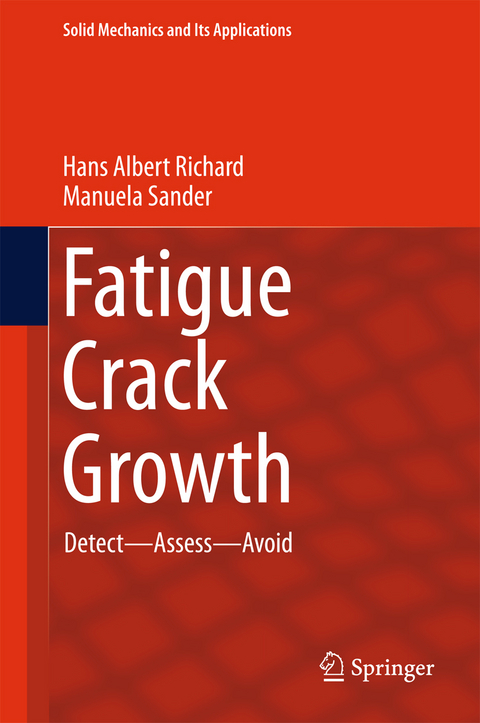
Fatigue Crack Growth (eBook)
XIX, 292 Seiten
Springer International Publishing (Verlag)
978-3-319-32534-7 (ISBN)
This book offers a concise introduction to fatigue crack growth, based on practical examples. It discusses the essential concepts of fracture mechanics, fatigue crack growth under constant and variable amplitude loading and the determination of the fracture-mechanical material parameters. The book also introduces the analytical and numerical simulation of fatigue crack growth as well as crack initiation. It concludes with a detailed description of several practical case studies and some exercises.
The target group includes graduate students, researchers at universities and practicing engineers.
Preface 6
Contents 8
Symbols 15
1 Designing Components and Structures According to Strength Criteria 20
1.1 Loads on Components and Structures 21
1.2 Stresses and Stress States in Components and Structures 24
1.2.1 Plane Stress State 25
1.2.2 Spatial Stress State 25
1.2.3 Principal Stresses 25
1.2.4 Plane Stress State or Plane Strain State 27
1.3 Proof of Static Strength 28
1.3.1 Equivalent Stress 28
1.3.2 Allowable Stress 29
1.3.3 Proof of Strength—Operational Sequence 30
1.3.4 Taking Account of the Notch Effect 31
1.3.5 Stress Concentration Factors 32
1.3.6 Material Parameters and Safety Factors 32
1.4 Proof of Fatigue Strength 37
1.4.1 Effective and Allowable Stresses 37
1.4.2 Material Parameters 38
1.4.3 Surface and Size Coefficients 40
1.4.4 Proof of Fatigue Strength with Notched Components 42
1.5 Proof of Structural Durability 42
1.6 Other Proofs 43
1.7 Limits of Classic Component Design 43
References 44
2 Damages Caused by Crack Growth 45
2.1 Crack Initiation and Crack Growth 47
2.2 Stable and Unstable Crack Growth 49
2.3 Damage Analysis/Fracture Surface Analysis 50
2.4 Fatigue Crack Growth in an ICE Wheel Tire 54
2.5 Crack Growth in a Press Frame 55
2.6 Fatigue Crack Growth in the Fastener Body of an Internal High-Pressure Metal Forming Machine 57
2.7 Fracture of the Drive Shaft of a Vintage Car 57
2.8 Other Damage Events 57
2.9 Basic Crack Paths and Crack Shapes in Components and Structures 59
2.9.1 Crack Paths of Basic Stress States 60
2.9.2 Crack Paths and Crack Shapes in Shafts 61
2.9.3 Systematizing Crack Types in Components and Structures 63
2.10 Crack Detection Using Non-destructive Testing Methods 67
References 69
3 Fundamentals of Fracture Mechanics 72
3.1 Cracks and Crack Modes 72
3.1.1 Mode I 73
3.1.2 Mode II 74
3.1.3 Mode III 74
3.1.4 Mixed Mode 74
3.2 Stress Distributions at Cracks 75
3.2.1 Solving Crack Problems with Elasticity Theory 75
3.2.2 Stress Distributions for Plane Crack Problems 76
3.2.2.1 Stress Distributions in Mode I 78
3.2.2.2 Stress Distributions for Plane Mixed-Mode Loading 78
3.2.3 Stress Distributions for Spatial Crack Problems 81
3.2.3.1 Stress Distributions in Cartesian Coordinates 81
3.2.3.2 Stress Distributions in Cylindrical Coordinates 81
3.3 Displacement Fields Near the Crack 83
3.4 Stress Intensity Factors 84
3.4.1 Stress Intensity Factors for Crack Modes I, II and III 84
3.4.1.1 Definition of the Stress Intensity Factors KI, KII, KIII 84
3.4.1.2 Dimension and Unit of Stress Intensity Factors 85
3.4.2 Stress Intensity Factors for Basic Crack Problems 85
3.4.2.1 Griffith Crack in an Infinitely Extended Plate 85
3.4.2.2 Circular Crack in an Infinitely Extended Body Under Tensile Loading 86
3.4.2.3 Internal Crack in a Finitely Extended Plate 86
3.4.2.4 Edge Crack in a Semi-infinitely and Finitely Extended Plate Under Tensile Loading 87
3.4.2.5 Inclined Internal Crack in an Infinitely Extended Plate Under Uniaxial Loading 88
3.4.2.6 Semi-elliptical Surface Crack in a Tensile-Loaded Component 89
3.4.2.7 Semi-circular Edge Crack in a Component 90
3.4.2.8 Notch Crack Problems 92
3.4.2.9 Interpolation Formula for Mode I Stress Intensity Factors 94
3.4.2.10 Interpolation Formulae for Mode II and Mode III Stress Intensity Factors 94
3.4.3 Superposition of Stress Intensity Factors, Equivalent Stress Intensity Factors 94
3.4.3.1 Superposition of Stress Intensity Factors 96
3.4.3.2 Equivalent Stress Intensity Factor with Plane Mixed-Mode Loading 97
3.4.3.3 Equivalent Stress Intensity Factor with Spatial Mixed-Mode Loading 98
3.5 Local Plasticity at the Crack Tip 101
3.5.1 Estimating the Plastic Zone 101
3.5.2 Crack Length Correction 104
3.5.3 Significance of the Plastic Zone in Fatigue Crack Propagation 105
3.6 Energy Release Rate and the J-Integral 105
3.6.1 Energy Release Rate 105
3.6.2 J-Integral 106
3.7 Determining the Stress Intensity Factors and Other Fracture-Mechanical Quantities 107
3.7.1 Determining the Stress Intensity Factors from the Stress Field in the Vicinity of the Crack 108
3.7.2 Determining the Stress Intensity Factors from the Displacement Field in the Vicinity of the Crack 109
3.7.3 Determining Fracture-Mechanical Quantities with the J-Integral 109
3.7.4 Determining Fracture-Mechanical Quantities with the Crack Closure Integral 110
3.8 Concepts for Predicting Unstable Crack Growth 112
3.8.1 K-Concept for Mode I 113
3.8.2 K-Concept for Mode II, Mode III and Mixed Mode Loadings 113
3.8.2.1 K-Concept for Mode II 114
3.8.2.2 K-Concept for Mode III 114
3.8.2.3 K-Concept for Plane Mixed Mode 115
3.8.2.4 K-Concept for Spatial Mixed Mode 116
3.8.3 Criterion of Energy Release Rate 119
3.8.4 J-Criterion 119
3.9 Fracture Toughness 120
3.10 Assessing Components with Cracks Using Fracture-Mechanical Methods 120
3.10.1 Fracture-Mechanical Proof—Operational Sequence 120
3.10.2 Applying the Fracture Criterion and the Fracture-Mechanical Analysis to Mode I Crack Problems 122
3.10.3 Applying the Fracture Criterion and the Fracture-Mechanical Analysis to Mode II, Mode III and Mixed Mode Problems 124
3.11 Combining Strength Calculation and Fracture Mechanics 125
References 128
4 Fatigue Crack Growth Under Cyclic Loading with Constant Amplitude 130
4.1 Relation Between Component Loading and Cyclic Stress Intensity 131
4.1.1 Stress Fields with Time-Varying Mode I Loading 132
4.1.2 Cyclic Stress Intensity Factor for Mode I 132
4.1.3 R-ratio 133
4.1.4 Crack Propagation Process 134
4.1.5 Stress Field with Time-Varying Mode II, Mode III and Mixed-Mode Loading 134
4.1.6 Cyclic Stress Intensity Factor for Mode II 135
4.1.7 Cyclic Stress Intensity Factor for Mode III 136
4.1.8 Two-Dimensional Mixed-Mode Loading 136
4.1.9 Three-Dimensional Mixed-Mode Loading 136
4.2 Relationship Between Crack Growth Rate and the Cyclic Stress Intensity Factor 137
4.2.1 Limits of Fatigue Crack Propagation for Mode I 139
4.2.2 Factors Influencing the Crack Growth Curve 139
4.2.3 Crack Closure Behavior During Fatigue Crack Growth 140
4.2.3.1 Plasticity-Induced Crack Closure 141
4.2.3.2 Roughness-Induced Crack Closure 141
4.2.3.3 Oxide-Induced Crack Closure 142
4.2.3.4 Fluid-Induced Crack Closure 143
4.2.3.5 Determining the Crack Opening Stress Intensity Factor 143
4.2.4 Threshold Value and Threshold Value Behavior 144
4.2.4.1 Threshold Value Behavior on the Basis of Crack Closure 145
4.2.4.2 Two-Criteria Approach to Threshold Value Behavior 146
4.3 Crack Propagation Concepts for Mode I 149
4.3.1 Paris Law 150
4.3.2 Erdogan/Ratwani Law 150
4.3.3 Forman/Mettu Equation 151
4.3.4 Comparison of the Crack Propagation Equations 152
4.3.5 Determining Residual Lifetime 154
4.4 Crack Growth Under Mode II, Mode III and Mixed-Mode Loading 157
4.4.1 Crack Growth Under Mode II Loading on the Initial Crack 157
4.4.2 Crack Growth Under Mode III Loading on the Initial Crack 159
4.4.3 Crack Growth Under Two-Dimensional Mixed-Mode Loading 159
4.4.4 Crack Growth Under Three-Dimensional Mixed-Mode Loading 160
4.5 Procedure for Assessing Fatigue Crack Growth 161
4.5.1 Fracture-Mechanical Assessment of Fatigue Crack Growth 162
4.5.2 Determining the Crack Length at Which Fatigue Crack Growth Is Possible 163
4.5.3 Safety Against the Occurrence of Fatigue Crack Growth 164
4.5.4 Area of Fatigue Crack Growth 164
4.5.5 Defining Inspection Intervals 165
4.6 Combination of Fatigue Strength Calculation and Fracture Mechanics 166
References 167
5 Experimental Determination of Fracture-Mechanical Material Parameters 169
5.1 Critical Stress Intensity Factor and Fracture Toughness 169
5.1.1 Determining Fracture Toughness According to ASTM E 399 170
5.1.1.1 Test Specimens and Sampling 170
5.1.1.2 Minimum Specimen Dimensions 172
5.1.1.3 Starter Notch and Initial Fatigue Crack 173
5.1.2 Testing Methods for Determining the Fracture Toughness 174
5.1.3 KIC or KQ?—Assessment of the Tests 174
5.1.3.1 Finding KQ and KIC Values in Force-Displacement Diagrams 174
5.1.3.2 Crack Length Measurement 175
5.1.3.3 Validity of the KIC Test 177
5.2 Threshold Values and Crack Growth Curves 177
5.2.1 Determining Threshold Values and Crack Growth Curves Acc. to ASTM E 647 177
5.2.1.1 Test Specimens and Specimen Dimensions 178
5.2.1.2 Starter Notch and Precracking 179
5.2.1.3 Testing Methods for Determining the Fatigue Crack Growth Curve 180
5.2.2 Methods of Determining the Threshold Value 181
5.2.2.1 Tests with a Constant Stress Ratio 182
5.2.2.2 Tests with a Constant Maximum Stress Intensity 183
5.2.2.3 Tests with Increasing Cyclic Stress Intensity 183
5.2.3 Methods of Measuring Crack Length 184
5.2.3.1 Optical Methods 184
5.2.3.2 Current Potential Drop Method 185
5.2.3.3 Compliance Method 187
5.2.3.4 Crack Length Measurement on Fractured Specimens 187
5.2.4 Determining the Fatigue Crack Growth Rate 188
5.2.4.1 Secant Method 188
5.2.4.2 Incremental Polynomial Method 189
5.2.5 Evaluating the Threshold Value and Crack Growth Curve Tests 189
5.3 Material Parameters for Mode I Crack Growth 191
5.3.1 Fracture Toughnesses 191
5.3.1.1 Basic Dependencies of Fracture Toughnesses 191
5.3.1.2 Overview of the Fracture Toughnesses of Various Materials 191
5.3.1.3 Fracture Toughnesses for Selected Materials 191
5.3.2 Threshold Values of Fatigue Crack Growth 193
5.3.3 Fatigue Crack Growth Curves 193
5.3.3.1 Basic Course of the Crack Growth Curves for Selected Materials 194
5.3.3.2 Parameters for the Paris Equation 194
5.3.3.3 Parameters for the Forman/Mettu Equation 195
5.4 Material Parameters for Mode II and Mixed-Mode Loading 195
5.4.1 Mode II Loading 197
5.4.2 Two-Dimensional Mixed-Mode Loading 198
5.4.3 Three-Dimensional Mixed-Mode Loading 199
References 201
6 Fatigue Crack Growth Under Service Loads 203
6.1 Load Spectra and Cumulative Frequency Distribution 203
6.1.1 Determining Service Loads 204
6.1.2 Counting Methods 204
6.1.3 Standard Load Spectra 205
6.2 Interaction Effects 207
6.2.1 Overloads 207
6.2.1.1 Effect of Overloads on Fatigue Crack Growth 208
6.2.1.2 Quantifying Retardation Behavior 209
6.2.1.3 Factors Influencing the Retardation Effect 210
6.2.2 Underloads 212
6.2.3 Combinations of Underloads and Overloads 212
6.2.4 Overload Sequences 212
6.2.5 Block Loading 214
6.2.6 Service Loads 216
6.2.6.1 Effect of Service Loads 216
6.2.6.2 Implications of Reconstructing Load-Time Functions 217
6.2.6.3 Implications of Extrapolating Load-Time Functions 218
6.3 Crack Propagation Concepts for Variable Amplitude Loading 220
6.3.1 Global Analyses 220
6.3.2 Linear Damage Accumulation 221
6.3.3 Yield Zone Models 222
6.3.3.1 Wheeler Model 224
6.3.3.2 Gray/Gallagher Model 226
6.3.3.3 Willenborg Model 227
6.3.4 Crack Closure Models 229
6.3.5 Strip Yield Models 230
6.4 Mixed-Mode Loading 232
6.4.1 Crack Growth After a Change in the Loading Direction or in the Local Load at the Crack 233
6.4.2 Effect of Mixed-Mode Overloads on Fatigue Crack Growth 234
References 235
7 Simulations of Fatigue Crack Growth 238
7.1 Analytical Crack Growth Simulations 238
7.1.1 NASGRO and ESACRACK 239
7.1.2 AFGROW 240
7.2 Numerical Crack Growth Simulations 241
7.2.1 Basic Procedure with Finite Elements 241
7.2.2 Program System FRANC/FAM for Two-Dimensional Crack Propagation Simulations 244
7.2.3 Program System ADAPCRACK3D for Three-Dimensional Crack Propagation Simulations 245
7.3 Determining the Effect of Load Changes with Finite Element Analyses 247
References 250
8 Crack Initiation Under Cyclic Loading 253
8.1 Models for Describing Crack Initiation 254
8.1.1 Threshold Value Curve Concept 255
8.1.2 Theories of Critical Distances 257
8.1.3 Fatigue Crack Resistance Curve Concept 258
8.1.4 ?area Concept 260
8.2 Short Crack Growth 262
References 263
9 Practical Examples 265
9.1 Leak in a Pipeline 265
9.1.1 Stresses in the Pipe 265
9.1.2 Stress Intensity Factors for the Crack 267
9.1.3 Safety Against Unstable Crack Propagation 267
9.1.4 Crack Length at Which Unstable Crack Propagation Initiates 268
9.2 Investigating Fatigue Crack Growth in ICE Tires 268
9.2.1 Structure and Load of Rubber-Sprung Wheels 268
9.2.2 Numerical Stress Analysis 270
9.2.3 Damage Analysis of the Wheel Tire Fracture 271
9.2.4 Fracture-Mechanical Characterization of the Tire Material 272
9.2.5 Numerical Simulation of Fatigue Crack Growth 272
9.2.6 Experimental Simulation of Crack Growth 274
9.3 Simulation of Fatigue Crack Growth in a Press Frame 276
9.4 Preventing Crack Growth in a Piston 279
9.5 Investigating Crack Growth in an Aircraft Structure 281
9.6 Parameter Study of a Surface Crack in a Shaft Under Rotating Bending Load 284
9.6.1 Influence of the Cumulative Frequency Distribution 285
9.6.2 Influence of the Notch Effect and Press-Fit Stresses 287
9.6.3 Influence of the Initial Crack Depth and Geometry on Residual Life Simulation 288
9.7 Restoration of a Press 289
9.7.1 Modeling the Crack Geometry in the Sealing Cap 290
9.7.2 Stress Analysis for the Cap 290
9.7.3 Results of the FE Analyses for the Cracked Sealing Cap 291
9.7.4 Fracture-Mechanical Assessment of the FE Results 291
9.7.5 Consequences for Continued Machine Operation 292
9.8 Measures for Extending the Residual Life of Machines and Equipment 292
9.8.1 Continued Operation of a Machine or System After Crack Detection 293
9.8.1.1 Continued Operation with Regular Inspections 293
9.8.1.2 Continuous Operation Under Reduced Load 294
9.8.1.3 Extending Residual Life by Means of Targeted Restoration Measures 294
9.8.1.4 Exchanging the Damaged Component 295
9.8.2 Optimization Measures for a New Design 295
9.8.2.1 Limiting or Reducing Component Load 295
9.8.2.2 Reducing Local Stresses in the Component 295
9.8.2.3 Selecting a Material that Is Less Susceptible to Cracking 295
9.8.2.4 Preventing Manufacturing Defects 296
9.8.2.5 Optimization Potential 296
References 296
Index 298
| Erscheint lt. Verlag | 13.6.2016 |
|---|---|
| Reihe/Serie | Solid Mechanics and Its Applications | Solid Mechanics and Its Applications |
| Zusatzinfo | XIX, 292 p. 226 illus. |
| Verlagsort | Cham |
| Sprache | englisch |
| Themenwelt | Technik ► Bauwesen |
| Technik ► Maschinenbau | |
| Schlagworte | Fatigue crack growth • fracture mechanics • Mixed Mode Fracture • Simulation of Fatigue Crack Growth • Variable amplitude loading |
| ISBN-10 | 3-319-32534-5 / 3319325345 |
| ISBN-13 | 978-3-319-32534-7 / 9783319325347 |
| Informationen gemäß Produktsicherheitsverordnung (GPSR) | |
| Haben Sie eine Frage zum Produkt? |
 PDF (Wasserzeichen)
DRM: Digitales Wasserzeichen
Dieses eBook enthält ein digitales Wasserzeichen und ist damit für Sie personalisiert. Bei einer missbräuchlichen Weitergabe des eBooks an Dritte ist eine Rückverfolgung an die Quelle möglich.
Dateiformat: PDF (Portable Document Format)
Mit einem festen Seitenlayout eignet sich die PDF besonders für Fachbücher mit Spalten, Tabellen und Abbildungen. Eine PDF kann auf fast allen Geräten angezeigt werden, ist aber für kleine Displays (Smartphone, eReader) nur eingeschränkt geeignet.
Systemvoraussetzungen:
PC/Mac: Mit einem PC oder Mac können Sie dieses eBook lesen. Sie benötigen dafür einen PDF-Viewer - z.B. den Adobe Reader oder Adobe Digital Editions.
eReader: Dieses eBook kann mit (fast) allen eBook-Readern gelesen werden. Mit dem amazon-Kindle ist es aber nicht kompatibel.
Smartphone/Tablet: Egal ob Apple oder Android, dieses eBook können Sie lesen. Sie benötigen dafür einen PDF-Viewer - z.B. die kostenlose Adobe Digital Editions-App.
Buying eBooks from abroad
For tax law reasons we can sell eBooks just within Germany and Switzerland. Regrettably we cannot fulfill eBook-orders from other countries.
aus dem Bereich