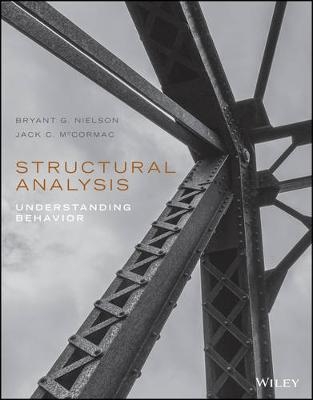
Structural Analysis
John Wiley & Sons Inc (Verlag)
978-1-119-32957-2 (ISBN)
- Titel erscheint in neuer Auflage
- Artikel merken
Bryant G. Nielson is the Cottingham Distinguished Professor of Practice in the Glenn Department of Civil Engineering at Clemson University. He holds a BS and MS in civil engineering from Utah State University and a PhD in civil engineering from the Georgia Institute of Technology. Professor Nielson is an educator at heart. He is the recipient of numerous teaching awards and has been actively engaged in teaching structural analysis and other related courses for over a decade – in both traditional and online settings. He has also worked for several years as a structural designer which has provided context and direction for teaching the discipline of structural engineering to the engineers of the future. Jack C. McCormac is Alumni Distinguished Professor o Civil Engineering, Emeritus at Clemson University. He holds a BS in civil engineering from the Citadel, an MS in civil engineering from Massachusetts Institute of Technology, and a Doctor of Letters from Clemson University. His contributions to engineering education and the engineering profession have been recognized by many, including the American Society for Engineering Education, the American Institute of Steel Construction, and the American Concrete Institute. Professor McCormac was included in the International Who's Who in Engineering, and was named by the Engineering News-Record as one of the top 125 engineers or architects in the world in the last 125 years for his contributions to the construction industry. He was one of only two educators living in the world today to receive this honor. Professor McCormac belongs to the American Society of Civil Engineers and served as the principal civil engineering grader for the National Council of Examiners for Engineering and Surveying for many years.
PREFACE xv
PART 1 DETERMINATE STRUCTURES
1 INTRODUCTION 2
1.1 Structural Analysis and Design, 2
1.2 History of Structural Analysis, 3
1.3 Basic Principles of Structural Analysis, 6
1.4 Structural Components and Systems, 6
1.5 Structural Forces, 8
1.6 Calculation Accuracy, 8
1.7 Checks on Problems, 9
1.8 Using Computers for Structural Analysis, 10
1.9 Overview of this Textbook, 11
2 STRUCTURAL LOADS 12
2.1 Introduction, 12
2.2 Structural Safety, 13
2.3 Codes, Standards, and Specifications, 14
2.4 Types of Structural Loads, 15
2.5 Loading Conditions for Allowable Stress Design, 16
2.6 Loading Conditions for Strength Design, 17
2.7 Dead Loads, 19
2.8 Live Loads, 21
2.9 Live Load Impact Factors, 22
2.10 Live Loads on Roofs, 23
2.11 Rain Loads, 25
2.12 Snow Loads, 27
2.13 Wind Loads, 30
2.14 ASCE Envelope Procedure for Estimating Wind Loads, 32
2.15 Seismic Loads, 34
2.16 Equivalent Lateral Force Procedure for Seismic Loads, 36
2.17 Highway Bridge Loads, 40
2.18 Railway Bridge Loads, 41
2.19 Other Loads, 42
2.20 Examples with Video Solutions, 43
2.21 Problems for Solution, 43
3 VERTICAL SYSTEM LOADING AND BEHAVIOR 46
3.1 Introduction, 46
3.2 Structural Idealization, 47
3.3 Vertical Load Path, 48
3.4 Tributary Areas, 51
3.5 Influence Area, 57
3.6 Floor Live Load Reductions, 58
3.7 Columns in Multistory Buildings, 60
3.8 Examples with Video Solutions, 62
3.9 Problems for Solution, 62
4 LATERAL SYSTEM LOADING AND BEHAVIOR 65
4.1 Introduction, 65
4.2 Lateral Load Path, 66
4.3 Vertical Lateral Force Resisting Systems, 68
4.4 Diaphragms, 71
4.5 Tributary Approach, 73
4.6 Examples with Video Solutions, 80
4.7 Problems for Solution, 81
5 REACTIONS 83
5.1 Equilibrium, 83
5.2 Calculation of Unknowns, 84
5.3 Types of Supports, 84
5.4 Role and Analysis of Springs, 86
5.5 Internal Releases, 86
5.6 Stability and Statical Determinacy, 87
5.7 Unstable Equilibrium and Geometric Instability, 90
5.8 Free-Body Diagrams, 91
5.9 Reactions for Single Rigid-Body Systems, 92
5.10 Reactions for Multiple Connected Rigid-Body Systems, 97
5.11 Matrix Formulation for Reactions, 102
5.12 SAP2000 Computer Applications, 104
5.13 Examples with Video Solutions, 107
5.14 Problems for Solution, 107
6 AXIAL FORCE, SHEAR FORCE, AND BENDING MOMENT 115
6.1 Introduction, 115
6.2 Member Internal Forces, 115
6.3 Axial, Shear, and Bending Moment Equations, 118
6.4 Relation between Load, Shear, and Moment, 121
6.5 Shear and Bending Moment Diagrams for Beams, 123
6.6 Axial Diagrams, 129
6.7 Shear and Bending Moment Diagrams for Frames, 130
6.8 Moment Diagrams Using Superposition, 134
6.9 Structural System Consideration, 135
6.10 SAP2000 Computer Applications, 137
6.11 Examples with Video Solutions, 141
6.12 Problems for Solution, 142
7 PLANE TRUSSES 150
7.1 Introduction, 150
7.2 Assumptions for Truss Analysis, 151
7.3 Roof Trusses, 152
7.4 Bridge Trusses, 153
7.5 Arrangement of Truss Members, 154
7.6 Stability and Statical Determinacy of Trusses, 154
7.7 Methods of Analysis and Conventions, 158
7.8 Method of Joints, 159
7.9 Matrix Formulation for Reactions and Bar Forces, 162
7.10 Zero-Force Members, 164
7.11 Method of Sections, 166
7.12 Simple, Compound, and Complex Trusses, 172
7.13 Structural System Consideration, 173
7.14 SAP2000 Computer Applications, 175
7.15 Examples with Video Solutions, 178
7.16 Problems for Solution, 178
8 DEFLECTIONS AND ANGLE CHANGES IN STRUCTURES 187
8.1 Introduction, 187
8.2 Reasons for Computing Deflections, 188
8.3 Long Term Deflections, 189
8.4 Sketching Deformed Shapes of Structures, 189
8.5 Determining Sense of Reactions from Deformed Shape, 194
8.6 Elastic Beam Theory, 195
8.7 Deflection by Double Integration, 197
8.8 SAP2000 Computer Applications, 202
8.9 Examples with Video Solutions, 204
8.10 Problems for Solution, 205
9 DEFLECTION AND ANGLE CHANGES USING VIRTUALWORK 211
9.1 Introduction to Energy Methods, 211
9.2 Conservation of Energy Principle, 211
9.3 Virtual Work or Complementary Virtual Work Method, 212
9.4 Truss Deflections by Virtual Work, 213
9.5 Application of Virtual Work to Trusses, 214
9.6 Deflections and Angle Changes of Beams and Frames, 217
9.7 Application of Virtual Work Using Visual Integration, 221
9.8 Application of Virtual Work to Springs, 225
9.9 Consideration of Shear Deformations, 227
9.10 SAP2000 Computer Applications, 228
9.11 Examples with Video Solutions, 230
9.12 Problems for Solution, 230
PART 2 INDETERMINATE STRUCTURES
10 INTRODUCTION TO STATICALLY INDETERMINATE STRUCTURES 238
10.1 Introduction, 238
10.2 Continuous Structures, 239
10.3 Advantages of Statically Indeterminate Structures, 240
10.4 Disadvantages of Statically Indeterminate Structures, 241
10.5 Methods of Analyzing Statically Indeterminate Structures, 242
10.6 Looking Ahead, 243
11 FORCEMETHOD FOR STATICALLY INDETERMINATE STRUCTURES 244
11.1 Beams and Frames with One Redundant, 244
11.2 Maxwell’s Law of Reciprocal Deflections, 252
11.3 Beams and Frames with Two or More Redundants, 253
11.4 Support Settlement, 254
11.5 SAP2000 Computer Applications, 256
11.6 Examples with Video Solutions, 258
11.7 Problems for Solution, 259
12 FORCEMETHODFORSTATICALLY INDETERMINATESTRUCTURESCONTINUED 262
12.1 Analysis of Externally Redundant Trusses, 262
12.2 Analysis of Internally Redundant Trusses, 264
FOR SCREEN VIEWING IN BPA ONLY
Neilson 1114 Ch January 27, 2017 5:32pm
12.3 Analysis of Composite Structures, 266
12.4 Temperature Changes, Shrinkage, Fabrication Errors, and So On, 270
12.5 SAP2000 Computer Applications, 271
12.6 Examples with Video Solutions, 274
12.7 Problems for Solution, 274
13 MOMENT DISTRIBUTION FOR BEAMS 278
13.1 Introduction, 278
13.2 Sign Convention, 279
13.3 Basic Concepts and Definitions, 280
13.4 Distribution Factors, 282
13.5 Application of Moment Distribution, 284
13.6 Modification of Stiffness and FEM for Simple Ends, 288
13.7 Shearing Force and Bending Moment Diagrams, 289
13.8 Spreadsheet Computer Applications, 291
13.9 Examples with Video Solutions, 292
13.10 Problems for Solution, 292
14 MOMENT DISTRIBUTION FOR FRAMES 295
14.1 Frames with Sidesway Prevented, 295
14.2 Sway Frames with Point Loads at Joints, 298
14.3 General Frames with Sidesway, 303
14.4 Frames with Sloping Legs, 308
14.5 Multistory Frames, 311
14.6 Examples with Video Solutions, 312
14.7 Problems for Solution, 312
15 APPROXIMATE ANALYSIS OF STATICALLY INDETERMINATE STRUCTURES 316
15.1 Introduction, 316
15.2 Trusses with Two Diagonals in Each Panel, 317
15.3 Continuous Beams, 318
15.4 Analysis of Building Frames for Vertical Loads, 320
15.5 Analysis of Portal Frames, 323
15.6 Analysis of Building Frames for Lateral Loads, 325
15.7 Exact and Approximate Analysis Results Comparison, 329
15.8 Analysis of Vierendeel Trusses, 330
15.9 Examples with Video Solutions, 331
15.10 Problems for Solution, 331
PART 3 IINFLUENCE LINES
16 INFLUENCE LINES FOR DETERMINATE STRUCTURES 336
16.1 Introduction, 336
16.2 The Influence Line Defined, 336
16.3 Influence Lines for Simple Beam Reactions, 337
16.4 Influence Lines for Simple Beam Shear Forces, 337
16.5 Influence Lines for Simple Beam Moments, 338
16.6 Influence Lines Using Quantitative Approach, 339
16.7 Qualitative Influence Lines, 341
16.8 Uses of Influence Lines: Concentrated Loads, 346
16.9 Uses of Influence Lines: Uniform Loads, 347
16.10 Determining Maximum Loading Effects Using Influence Lines, 348
16.11 Maximum Loading Effects Using Beam Curvature, 349
16.12 Maximum Values for Moving Loads, 350
16.13 Influence Lines for Trusses, 352
16.14 Examples with Video Solutions, 360
16.15 Problems for Solution, 360
17 INFLUENCE LINES FOR STATICALLY INDETERMINATE STRUCTURES 365
17.1 Influence Lines for Statically Indeterminate Beams, 365
17.2 Qualitative Influence Lines for Indeterminate Beams and Frames, 370
17.3 Influence Lines for Determining Loading Scenarios for Continuous Systems, 374
17.4 Examples with Video Solutions, 375
17.5 Problems for Solution, 375
PART 4 MATRIX METHODS FOR STRUCTURAL ANALYSIS
18 INTRODUCTION TOMATRIX METHODS 380
18.1 Structural Analysis Using the Computer, 380
18.2 Matrix Methods, 381
18.3 Force and Displacement Methods of Analysis, 382
18.4 Introduction to the Force or Flexibility Method, 382
18.5 Examples with Video Solutions, 387
18.6 Problems for Solution, 387
19 DIRECT STIFFNESS METHOD FOR TRUSSES 389
19.1 Introduction, 389
19.2 Definitions and Concepts, 390
19.3 Kinematic Determinacy, 392
19.4 Stiffness Method, 394
19.5 Stiffness Matrix for Axial Force Members, 400
19.6 Stiffness Matrix for Inclined Axial Force Members, 401
19.7 Assemblage of Structure-Level Stiffness Matrix for Planar Trusses, 405
19.8 Solving for Member End Forces, 408
19.9 Characteristics of Stiffness Matrices, 412
19.10 Spreadsheet Computer Applications, 412
19.11 Examples with Video Solutions, 417
19.12 Problems for Solution, 417
20 DIRECT STIFFNESS METHOD FOR BEAMS AND FRAMES 421
20.1 Introduction, 421
20.2 Stiffness Matrix for Flexural (Beam) Elements, 421
20.3 Matrix Stiffness Method Applied to Beams, 423
20.4 Solving for Member End Forces, 428
20.5 Plotting Deflections Using Beam Shape Functions, 431
20.6 Loading Between Nodes (Statical Equivalency), 434
20.7 Superposition to Obtain Shear, Moment, and Deflection Diagrams, 438
20.8 Stiffness Matrix for Combined Axial and Flexural (Frame) Elements, 441
20.9 Transformation Matrix for Inclined Frame Element, 442
20.10 Matrix Stiffness Method Applied to Frames, 443
20.11 Spreadsheet Computer Applications, 448
20.12 SAP2000 Computer Applications, 450
20.13 Examples with Video Solutions, 452
20.14 Problems for Solution, 452
21 ADDITIONAL TOPICS FOR THE DIRECT STIFFNESS METHOD 459
21.1 Introduction, 459
21.2 Stiffness Formulation for Structures with Enforced Displacements, 459
21.3 Stiffness Formulation for Structures Subjected to Temperature Changes, 462
21.4 Stiffness Formulation for Structures with Misfit Members, 468
21.5 Static Condensation, 470
21.6 Partially Restrained Connections, 474
21.7 Releases, 478
21.8 Inclined Supports, 481
21.9 SAP2000 Computer Applications, 485
21.10 Examples with Video Solutions, 488
21.11 Problems for Solution, 489
A ASCE 7-16 Information 494
B Introduction to SAP2000 499
B.1 Introduction, 499
B.2 Slides, 500
C Matrix Algebra 520
C.1 Introduction, 520
C.2 Matrix Definitions and Properties, 520
C.3 Special Matrix Types, 521
C.4 Determinant of a Square Matrix, 522
C.5 Adjoint Matrix, 523
C.6 Matrix Arithmetic, 524
C.7 Matrix Partitioning, 528
D Reference Charts 531
D.1 Introduction, 531
| Erscheinungsdatum | 04.07.2017 |
|---|---|
| Verlagsort | New York |
| Sprache | englisch |
| Maße | 10 x 10 mm |
| Gewicht | 454 g |
| Themenwelt | Technik ► Bauwesen |
| Technik ► Maschinenbau | |
| ISBN-10 | 1-119-32957-4 / 1119329574 |
| ISBN-13 | 978-1-119-32957-2 / 9781119329572 |
| Zustand | Neuware |
| Informationen gemäß Produktsicherheitsverordnung (GPSR) | |
| Haben Sie eine Frage zum Produkt? |
aus dem Bereich