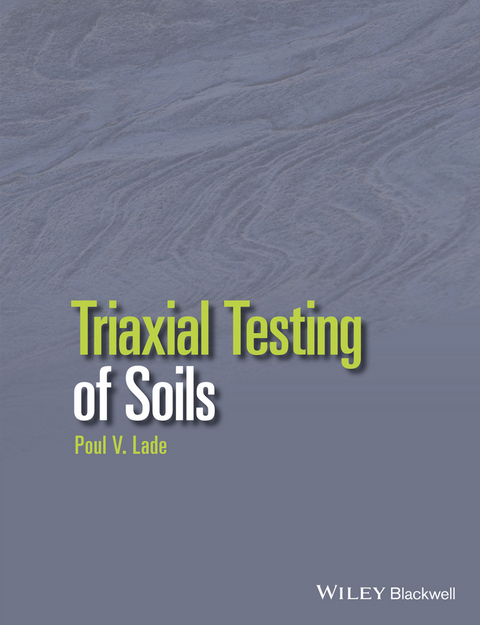
Triaxial Testing of Soils (eBook)
John Wiley & Sons (Verlag)
978-1-119-10659-3 (ISBN)
Poul Lade has a career in laboratory experimentation at university level to study and model the behaviour of soils. With his students, the author developed testing equipment, performed experiments and build constitutive models for the observed soil behaviour while a professor at University of California at Los Angeles (UCLA) (1972-1993), Johns Hopkins University (1993-1999), Aalborg University in Denmark (1999-2003), and Catholic University of America in Washington, D.C. (2003-2015). Many of the experimental techniques developed over this range of years are explained in the present book.
Triaxial Testing of Soils explains how to carry out triaxial tests to demonstrate the effects of soil behaviour on engineering designs. An authoritative and comprehensive manual, it reflects current best practice and instrumentation.References are made throughout to easily accessible articles in the literature and the book's focus is on how to obtain high quality experimental results.
Poul Lade has a career in laboratory experimentation at university level to study and model the behaviour of soils. With his students, the author developed testing equipment, performed experiments and build constitutive models for the observed soil behaviour while a professor at University of California at Los Angeles (UCLA) (1972-1993), Johns Hopkins University (1993-1999), Aalborg University in Denmark (1999-2003), and Catholic University of America in Washington, D.C. (2003-2015). Many of the experimental techniques developed over this range of years are explained in the present book.
1
Principles of Triaxial Testing
1.1 Purpose of triaxial tests
The purpose of performing triaxial tests is to determine the mechanical properties of the soil. It is assumed that the soil specimens to be tested are homogeneous and representative of the material in the field, and that the desired soil properties can in fact be obtained from the triaxial tests, either directly or by interpretation through some theory.
The mechanical properties most often sought from triaxial tests are stress–strain relations, volume change or pore pressure behavior, and shear strength of the soil. Included in the stress–strain behavior are also the compressibility and the value of the coefficient of earth pressure at rest, K0. Other properties that may be obtained from the triaxial tests, which include time as a component, are the permeability, the coefficient of consolidation, and properties relating to time dependent behavior such as rate effects, creep, and stress relaxation.
It is important that the natural soil deposit or the fill from which soil samples have been taken in the field are sufficiently uniform that the soil samples possess the properties which are appropriate and representative of the soil mass in the field. It is therefore paramount that the geology at the site is well-known and understood. Even then, samples from uniform deposits may not “contain” properties that are representative of the field deposit. This may happen either (a) due to the change in effective stress state which is always associated with the sampling process or (b) due to mechanical disturbance from sampling, transportation, or handling in the laboratory. The stress–strain and strength properties of very sensitive clays which have been disturbed cannot be regenerated in the laboratory or otherwise obtained by interpretation of tests performed on inadequate specimens. The effects of sampling will briefly be discussed below in connection with choice of consolidation pressure in the triaxial test. The topic of sampling is otherwise outside the scope of the present treatment.
1.2 Concept of testing
The concept to be pursued in testing of soils is to simulate as closely as possible the process that goes on in the field. Because there is a large number of variables (e.g., density, water content, degree of saturation, overconsolidation ratio, loading conditions, stress paths) that influence the resulting soil behavior, the simplest and most direct way of obtaining information pertinent to the field conditions is to duplicate these as closely as possible.
However, because of limitations in equipment and because of practical limitations on the amount of testing that can be performed for each project, it is essential that:
- The true field loading conditions (including the drainage conditions) are known.
- The laboratory equipment can reproduce these conditions to a required degree of accuracy.
- A reasonable estimate can be made of the significance of the differences between the field loading conditions and those that can be produced in the laboratory equipment.
It is clear that the triaxial test in many respects is incapable of simulating several important aspects of field loading conditions. For example, the effects of the intermediate principal stress, the effects of rotation of principal stresses, and the effects of partial drainage during loading in the field cannot be investigated on the basis of the triaxial test. The effects of such conditions require studies involving other types of equipment or analyses of boundary value problems, either by closed form solutions or solutions obtained by numerical techniques.
To provide some background for evaluation of the results of triaxial tests, other types of laboratory shear tests and typical results from such tests are presented in Chapter 11. The relations between the different types of tests are reviewed, and their advantages and limitations are discussed.
1.3 The triaxial test
The triaxial test is most often performed on a cylindrical specimen, as shown in Fig. 1.1(a). Principal stresses are applied to the specimen, as indicated in Fig. 1.1(b). First a confining pressure, σ3, is applied to the specimen. This pressure acts all around and therefore on all planes in the specimen. Then an additional stress difference, σd, is applied in the axial direction. The stress applied externally to the specimen in the axial direction is
and therefore
In the general case, three principal stresses, σ1, σ2 and σ3 may act on a soil element in the field. However, only two different principal stresses can be applied to the specimen in the conventional triaxial test. The intermediate principal stress, σ2, can only have values as follows:
The condition of triaxial extension can be achieved by applying negative stress differences to the specimen. This merely produces a reduction in compression in the extension direction, but no tension occurs in the specimen. The state of stress applied to the specimen is in both cases axisymmetric. The triaxial compression test will be discussed in the following, while the triaxial extension test is discussed in Chapter 10.
Figure 1.1 (a) Cylindrical specimen for triaxial testing and (b) stresses applied to a triaxial specimen.
The test is performed using triaxial apparatus, as seen in the schematic illustration in Fig. 1.2. The specimen is surrounded by a cap and a base and a membrane. This unit is placed in a triaxial cell in which the cell pressure can be applied. The cell pressure acts as a hydrostatic confinement for the specimen, and the pressure is therefore the same in all directions. In addition, a deviator load can be applied through a piston that goes through the top of the cell and loads the specimen in the axial direction.
Figure 1.2 Schematic diagram of triaxial apparatus.
The vertical deformation of the specimen may be measured by a dial gage attached to the piston which travels the same vertical distance as the cap sitting on top of the specimen. Drainage lines are connected to the water saturated specimen through the base (or both the cap and the base) and connected to a burette outside the triaxial cell. This allows for measurements of the volume changes of the specimen during the test.
Alternatively, the connection to the burette can be shut off thereby preventing the specimen from changing volume. Instead the pore water pressure can be measured on a transducer connected to the drainage line.
The following quantities are measured in a typical triaxial test:
- Confining pressure
- Deviator load
- Vertical (or axial) deformation
- Volume change or pore water pressure
These measurements constitute the data base from which other quantities can be derived [e.g., stress difference (σ1 – σ3), axial strain ε1, and volumetric strain εv].
1.4 Advantages and limitations
Whereas the triaxial test potentially can provide a substantial proportion of the mechanical properties required for a project, it has limitations, especially when special conditions are encountered and necessitates clarification based on experimentation.
The advantages of the triaxial test are:
- Drainage can be controlled (on–off)
- Volume change or pore pressure can be measured
- Suction can be controlled in partially saturated soils
- Measured deformations allow calculation of strains and moduli
- A larger variety of stress and strain paths that occur in the field can be applied in the triaxial apparatus than in any other testing apparatus (e.g., initial anisotropic consolidation at any stress ratio including K0, extension, active and passive shear).
The limitations of the triaxial test are:
- Stress concentrations due to friction between specimen and end plates (cap and base) cause nonuniform strains and stresses and therefore nonuniform stress–strain, volume change, or pore pressure response.
- Only axisymmetric stress conditions can be applied to the specimen, whereas most field problems involve plane strain or general three-dimensional conditions with rotation of principal stresses.
- Triaxial tests cannot provide all necessary data required to characterize the behavior of an anisotropic or a cross-anisotropic soil deposit, as illustrated in Fig. 1.3.
- Although the axisymmetric principal stress condition is limited, it is more difficult to apply proper shear stresses or tension to soil in relatively simple tests.
Figure 1.3 Cross-anisotropic soil requiring results from more than triaxial tests for full characterization.
The first limitation listed above can be overcome by applying lubricated ends on the specimen such that uniform strains and stresses and therefore correct soil response can be produced. This is discussed in Chapter 3. In addition to the limitations listed above, it should be mentioned that it may be easier to reproduce certain stress paths in other specialty equipment than in the triaxial apparatus (e.g., K0-test).
Although the triaxial test is limited as explained...
| Erscheint lt. Verlag | 9.3.2016 |
|---|---|
| Sprache | englisch |
| Themenwelt | Technik ► Bauwesen |
| Schlagworte | air pluviation of sand • Bauingenieur- u. Bauwesen • bender element tests • B-value test • CAP and BASE • cell and pore pressures • Civil Engineering & Construction • Civil Engineering & Construction Special Topics • clay slurry consolidation • coefficient of consolidation • compaction of clayey soils • consolidated-undrained • consolidation and shearing • Consolidation objective • Corrections to measurements of vertical load • Data acquisition • Deformation • Deformation rate selection • degree of saturation • depiction of stress invariants • depositional techniques for silty sand • (-= diagrams • diagrams of stress-strain behavior • drained • effects of stress rotation • electrical devices and operation principles • Erdbau • Erd- u. Grundbau • failure criteria • Grundbau • hydraulic conductivity • Instrument calibration • K0-tests • linear deformations • Membrane • partly saturated specimens • performance characteristics • p-q diagrams • Reasons for saturation • SHANSEP • simulated field conditions • Soil (Civil Engineering) • Spezialthemen Bauingenieur- u. Bauwesen • Strength Characteristics • strength diagrams • stress paths • stress-strain behavior of sand and clay • Test stages • Test Types • torsion shear tests • Triaxial specimen setup • Trimming of intact specimens • types of stresses and strains • unconsolidated-undrained • undercompaction • volume change devices |
| ISBN-10 | 1-119-10659-1 / 1119106591 |
| ISBN-13 | 978-1-119-10659-3 / 9781119106593 |
| Informationen gemäß Produktsicherheitsverordnung (GPSR) | |
| Haben Sie eine Frage zum Produkt? |
 EPUB (Adobe DRM)
Kopierschutz: Adobe-DRM
Adobe-DRM ist ein Kopierschutz, der das eBook vor Mißbrauch schützen soll. Dabei wird das eBook bereits beim Download auf Ihre persönliche Adobe-ID autorisiert. Lesen können Sie das eBook dann nur auf den Geräten, welche ebenfalls auf Ihre Adobe-ID registriert sind.
Details zum Adobe-DRM
Dateiformat: EPUB (Electronic Publication)
EPUB ist ein offener Standard für eBooks und eignet sich besonders zur Darstellung von Belletristik und Sachbüchern. Der Fließtext wird dynamisch an die Display- und Schriftgröße angepasst. Auch für mobile Lesegeräte ist EPUB daher gut geeignet.
Systemvoraussetzungen:
PC/Mac: Mit einem PC oder Mac können Sie dieses eBook lesen. Sie benötigen eine
eReader: Dieses eBook kann mit (fast) allen eBook-Readern gelesen werden. Mit dem amazon-Kindle ist es aber nicht kompatibel.
Smartphone/Tablet: Egal ob Apple oder Android, dieses eBook können Sie lesen. Sie benötigen eine
Geräteliste und zusätzliche Hinweise
Buying eBooks from abroad
For tax law reasons we can sell eBooks just within Germany and Switzerland. Regrettably we cannot fulfill eBook-orders from other countries.
aus dem Bereich