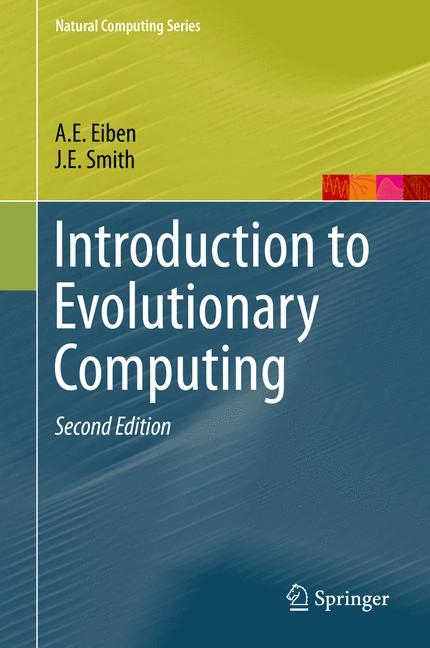
Introduction to Evolutionary Computing (eBook)
XII, 287 Seiten
Springer Berlin (Verlag)
978-3-662-44874-8 (ISBN)
Prof. Gusz Eiben received his Ph.D. in Computer Science in 1991. He was among the pioneers of evolutionary computing research in Europe, and served in key roles in steering committees, program committees and editorial boards for all the major related events and publications. His main research areas focused on multiparent recombination, constraint satisfaction, and self-calibrating evolutionary algorithms; he is now researching broader aspects of embodied intelligence and evolutionary robotics.Prof. James E. Smith received his Ph.D. in Computer Science in 1998. He is an associate professor of Interactive Artificial Intelligence and Head of the Artificial Intelligence Research Group in the Dept. of Computer Science and Creative Technologies of The University of the West of England, Bristol. His work has combined theoretical modelling with empirical studies in a number of areas, especially concerning self-adaptive and hybrid systems that "learn how to learn". His current research interests include optimization; machine learning and classification; memetic algorithms; statistical disclosure control; VLSI design verification; adaptive image segmentation and classification and computer vision systems for production quality control; and bioinformatics problems such as protein structure prediction and protein structure comparison.
Problems to Be Solved.- Evolutionary Computing: The Origins.- What Is an Evolutionary Algorithm?.- Representation, Mutation, and Recombination.- Fitness, Selection, and Population Management.- Popular Evolutionary Algorithm Variants.- Hybridisation with Other Techniques: Memetic Algorithms.- Nonstationary and Noisy Function Optimisation.- Multiobjective Evolutionary Algorithms.- Constraint Handling.- Interactive Evolutionary Algorithms.- Coevolutionary Systems.- Theory.- Evolutionary Robotics.- Parameters and Parameter Tuning.- Parameter Control.- Working with Evolutionary Algorithms.- References.
| Erscheint lt. Verlag | 1.7.2015 |
|---|---|
| Reihe/Serie | Natural Computing Series |
| Verlagsort | Berlin |
| Sprache | englisch |
| Themenwelt | Informatik ► Theorie / Studium ► Künstliche Intelligenz / Robotik |
| Mathematik / Informatik ► Mathematik | |
| Technik ► Maschinenbau | |
| Schlagworte | Estimation of Distribution Algorithms (EDA) • Evolutionary algorithm (EA) • Evolutionary Computing (EC) • Evolutionary Programming (EP) • Evolutionary Robotics • Evolution Strategies (ES) • Genetic Algorithms (GA) • Genetic Programming (GP) • Learning Classifier Systems (LCS) • Memetic Algorithms • Optimization |
| ISBN-10 | 3-662-44874-2 / 3662448742 |
| ISBN-13 | 978-3-662-44874-8 / 9783662448748 |
| Informationen gemäß Produktsicherheitsverordnung (GPSR) | |
| Haben Sie eine Frage zum Produkt? |
 PDF (Adobe DRM)
Kopierschutz: Adobe-DRM
Adobe-DRM ist ein Kopierschutz, der das eBook vor Mißbrauch schützen soll. Dabei wird das eBook bereits beim Download auf Ihre persönliche Adobe-ID autorisiert. Lesen können Sie das eBook dann nur auf den Geräten, welche ebenfalls auf Ihre Adobe-ID registriert sind.
Details zum Adobe-DRM
Dateiformat: PDF (Portable Document Format)
Mit einem festen Seitenlayout eignet sich die PDF besonders für Fachbücher mit Spalten, Tabellen und Abbildungen. Eine PDF kann auf fast allen Geräten angezeigt werden, ist aber für kleine Displays (Smartphone, eReader) nur eingeschränkt geeignet.
Systemvoraussetzungen:
PC/Mac: Mit einem PC oder Mac können Sie dieses eBook lesen. Sie benötigen eine
eReader: Dieses eBook kann mit (fast) allen eBook-Readern gelesen werden. Mit dem amazon-Kindle ist es aber nicht kompatibel.
Smartphone/Tablet: Egal ob Apple oder Android, dieses eBook können Sie lesen. Sie benötigen eine
Geräteliste und zusätzliche Hinweise
Buying eBooks from abroad
For tax law reasons we can sell eBooks just within Germany and Switzerland. Regrettably we cannot fulfill eBook-orders from other countries.
aus dem Bereich