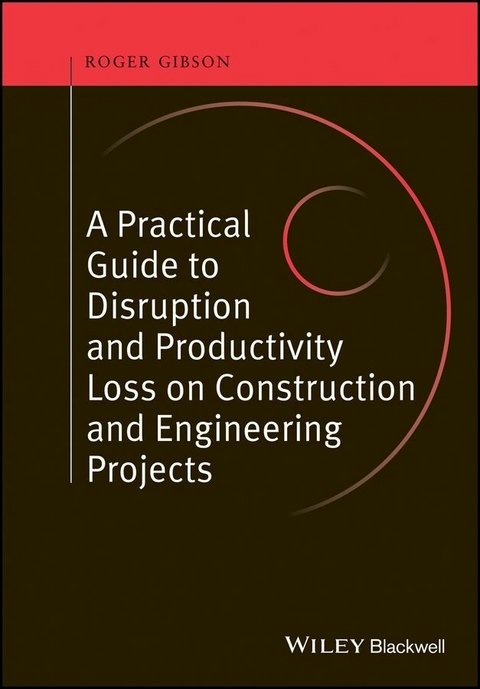
A Practical Guide to Disruption and Productivity Loss on Construction and Engineering Projects (eBook)
John Wiley & Sons (Verlag)
978-1-118-99217-3 (ISBN)
Disruption of a construction project is of key concern to the contractor as any delay to the project will involve the contractor in financial loss, unless those losses can be recovered from the employer. It is, however, acknowledged that disruption claims in construction are difficult to prove, usually the result of poor or inaccurate project records, but the cost of lost productivity or reduced efficiency to the contractor under these circumstances is very real.
Practical Guide to Disruption and Productivity Loss on Construction & Engineering Projects is clearly written to explain the key causes of disruption and productivity loss. Disruption claims rest on proof of causation, so it discusses the project records that are necessary to demonstrate the causes of disruption, lost productivity and reduced efficiency in detail. Quantification of a disruption claim in terms of delay to activities and the associated costs are also fully discussed. With many worked examples throughout the text, this will be an essential book for anyone either preparing or assessing a disruption and loss of productivity claims, including architects, contract administrators, project managers and quantity surveyors as well as contractors, contracts consultants and construction lawyers.
Roger Gibson has over fifty years' experience in construction. Beginning his career in construction contracting companies, primarily in planning roles and project management roles, he gained extensive expert witness and dispute resolution experience in a variety of construction and engineering consultants. He formed Gibson Consulting Limited in 2001, providing planning, programming and dispute resolution services, specializing in evaluating delay and extension of time claims involving concurrent delays, mitigation and disruption. Roger Gibson has been appointed as an expert on time related issues in numerous disputes and has provided both written expert evidence and oral testimony in court and before arbitration tribunals.
Disruption of a construction project is of key concern to the contractor as any delay to the project will involve the contractor in financial loss, unless those losses can be recovered from the employer. It is, however, acknowledged that disruption claims in construction are difficult to prove, usually the result of poor or inaccurate project records, but the cost of lost productivity or reduced efficiency to the contractor under these circumstances is very real. Practical Guide to Disruption and Productivity Loss on Construction & Engineering Projects is clearly written to explain the key causes of disruption and productivity loss. Disruption claims rest on proof of causation, so it discusses the project records that are necessary to demonstrate the causes of disruption, lost productivity and reduced efficiency in detail. Quantification of a disruption claim in terms of delay to activities and the associated costs are also fully discussed. With many worked examples throughout the text, this will be an essential book for anyone either preparing or assessing a disruption and loss of productivity claims, including architects, contract administrators, project managers and quantity surveyors as well as contractors, contracts consultants and construction lawyers.
Roger Gibson has over fifty years' experience in construction. Beginning his career in construction contracting companies, primarily in planning roles and project management roles, he gained extensive expert witness and dispute resolution experience in a variety of construction and engineering consultants. He formed Gibson Consulting Limited in 2001, providing planning, programming and dispute resolution services, specializing in evaluating delay and extension of time claims involving concurrent delays, mitigation and disruption. Roger Gibson has been appointed as an expert on time related issues in numerous disputes and has provided both written expert evidence and oral testimony in court and before arbitration tribunals.
Preface vii
Acknowledgements ix
1 Introduction 1
1.1 Introduction 1
1.2 The aims of this book 3
1.3 The SCL Protocol 3
1.4 Conclusion 9
2 Contracts and Case Law 11
2.1 Introduction 11
2.2 Contracts 13
2.3 Case law 18
3 Planning, Programmes and Record Keeping 61
3.1 Background and history of planning 61
3.2 Planning and programming 64
3.3 Programme submission, review and acceptance 78
3.4 Programme updates and revisions 84
3.5 Progress records and other record keeping 91
4 Delay, Disruption and Causation 99
4.1 Delay 99
4.2 Disruption 107
4.3 Causation 118
5 Loss of Productivity 123
5.1 Introduction 123
5.2 Productivity and efficiency 124
5.3 Common causes of loss of efficiency 128
5.4 Methods of productivity measurement 133
6 Acceleration and Mitigation 153
6.1 Acceleration 153
6.2 Mitigation 164
Appendix 1 Definitions and Glossary 169
Appendix 2 Levels of Programmes 177
Appendix 3 SCL Protocol; Guidance Clauses on 'Disruption' 187
Index 191
"This book provides valuable guidance on how to save time and therefore money by avoiding -- or at least coping -- with the factors that cause expensive delays, or disruption on construction and engineering projects. Certainly its sage advice on dispute resolution should prove indispensable to everyone from architects and construction lawyers to project managers and quantity surveyors." (Flickr.com, 7 August 2015)
Chapter 2
Contracts and Case Law
2.1 Introduction
This chapter covers two subjects: ‘Contracts’ and ‘Case Law’. The first section concerns the two most popular forms of contract used in the UK: the JCT and the NEC. The chapter reviews the clauses relating to disruption, loss of productivity, acceleration and mitigation.
In the second section, I review case law regarding disputes and judgments concerning disruption, loss of productivity, acceleration and mitigation.
2.1.1 Contracts
All of the standard forms of contract and subcontract include clauses for dealing with delays to the project. Most of these standard forms require the contract administrator (architect or engineer) to deal with a contractor’s claim for loss and expense.
For example, JCT2011 contains the following in clause 2.19:
“If and whenever it becomes reasonably apparent that the progress of the Works or any Section is being or is likely to be delayed the Contractor shall forthwith give the Architect/Contract Administrator notice of the cause of the delay. If in the Architect/Contract Administrator's opinion completion of the Works or Section has been, is being or is likely to be delayed beyond the relevant Completion Date by any of the Relevant Events, then, save where these Conditions expressly provide otherwise, the Architect/Contract Administrator, as soon as he is able to estimate the length of the delay beyond that date, shall by notice to the Contractor give a fair and reasonable extension of time for completion of the Works or Section.”
2.1.2 Case law
My review of ‘case law’ in respect of disruption, productivity, acceleration and mitigation covered the cases in the Technology and Construction Court in the period up to the end of 2013.
From this initial review, I examined in detail some 25 disputes which I considered to be the most important concerning disruption and/or loss of productivity, primarily due to the Court’s comments and advice on the approach and methodology used. The cases were:
- Norwest Holst Construction Ltd v. Co-Operative Wholesale Society Ltd [1997] EWHC Technology 356 (2 December 1997)
- P&O Developments Ltd v. The Guy's and St Thomas' National Health Service Trust, Austen Associates (a firm), Austen Associates Ltd [1998] EWHC Technology 295 (15 October 1998)
- How Engineering Services Ltd v. Lindner Ceilings Floors [1999] EWHC B7 (TCC) (24 June 1999)
- Miller Construction Ltd v. James Moore Earthmoving [2000] EWHC Technology 52 (1 November 2000)
- Royal Brompton Hospital NHS Trust v. Frederick A Hammond & Ors [2000] EWHC Technology 39 (18 December 2000)
- AMEC Process and Energy Ltd v. Stork Engineers & Contractors BV (No. 3) [2002] EWHC B1 (TCC) (15 March 2002)
- Johnson Control Systems Ltd. v. Techni-Track Europa Ltd [2002] EWHC 1613 (TCC) (2 August 2002)
- Royal Brompton Hospital National Health Service Trust v. Hammond & Ors [2002] EWHC 2037 (TCC) (11 October 2002)
- Joinery Plus Ltd (In Administration) v. Laing Ltd [2003] EWHC 3513 (TCC) (16 January 2003)
- Home of Homes Ltd v. London Borough of Hammersmith & Fulham & Anor [2003] EWHC 807 (TCC) (10 April 2003)
- Hurst Stores and Interiors Ltd v. M.L. Europe Property Ltd [2003] EWHC 1650 (TCC) (25 June 2003)
- Skanska Construction UK Ltd v. Egger (Barony) Ltd [2004] EWHC 1748 (TCC) (30 July 2004)
- Great Eastern Hotel Company Ltd v. John Laing Construction Ltd & Anor [2005] EWHC 181 (TCC) (24 February 2005)
- Plymouth & South West Co-Operative Society Ltd v. Architecture, Structure & Management Ltd [2006] EWHC 5 (TCC) (10 January 2006)
- Multiplex Constructions (UK) Ltd v. Cleveland Bridge UK Ltd [2006] EWHC 1341 (TCC) (5 June 2006)
- Mirant Asia-Pacific Construction (Hong Kong) Ltd v. Ove Arup and Partners International Ltd & Anor [2007] EWHC 918 (TCC) (20 April 2007)
- VGC Construction Ltd v. Jackson Civil Engineering Ltd [2008] EWHC 2082 (TCC) (15 August 2008)
- Fitzroy Robinson Ltd v. Mentmore Towers Ltd [2009] EWHC 1552 (TCC) (7 July 2009)
- BSkyb Ltd & Anor v. HP Enterprise Services UK Ltd & Anor (Rev 1) [2010] EWHC 86 (TCC) (26 January 2010)
- Tinseltime Ltd. V. Eryl Roberts [2011] EWHC 1199 (TCC) (13 May 2011)
- Carillion JM Ltd v. Phi Group Ltd [2011] EWHC 1379 (TCC) (15 June 2011)
- Carillion Construction Ltd V. Stephen Andrew Smith [2011] EWHC 2910 (TCC) (10 November 2011)
- Walter Lilly & Company Ltd v. Mackay & Anor [2012] EWHC 1773 (TCC) (11 July 2012)
- Constance Long Term Holdings Ltd v. Cavendish (Duke of Westminster) [2012] EWHC 3434 (TCC) (29 November 2012)
- Cleveland Bridge UK Ltd v. Severfield - Rowen Structures Ltd [2012] EWHC 3652 (TCC) (21 December 2012)
From my detailed review of these 25 judgments, I selected three in which I consider the Court made significant observations and gave meaningful advice in respect of ‘disruption’, ‘productivity’, ‘acceleration’ and ‘mitigation’. The three cases are:
- AMEC Process and Energy Ltd v. Stork Engineers & Contractors BV (No. 3) [2002] EWHC B1 (TCC) (15 March 2002)
- Johnson Control Systems Ltd v. Techni-Track Europa Ltd [2002] EWHC 1613 (TCC) (2 August 2002)
- Cleveland Bridge UK Ltd v. Severfield - Rowen Structures Ltd [2012] EWHC 3652 (TCC) (21 December 2012)
For each of these disputes I give details of (i) the project concerned, (ii) the dispute itself, (iii) the judgment and, finally (iv) a commentary on the important comments and advice given by the Court.
2.2 Contracts
All of the standard forms of contract and subcontract include clauses for dealing with delays to the project, and require the contract administrator (architect or engineer) to deal with a contractor’s claim for loss and expense.
The JCT205, Intermediate Building Contract, contains the following two clauses under ‘Adjustment of Completion Date’:
Notice of delay – extensions
Clause 2 · 19
- If and whenever it becomes reasonably apparent that the progress of the Works or any Section is being or is likely to be delayed the Contractor shall forthwith give the Architect/Contract Administrator notice of the cause of the delay. If in the Architect/Contract Administrator's opinion completion of the Works or Section has been, is being or is likely to be delayed beyond the relevant Completion Date by any of the Relevant Events, then, save where these Conditions expressly provide otherwise, the Architect/Contract Administrator, as soon as he is able to estimate the length of the delay beyond that date, shall by notice to the Contractor give a fair and reasonable extension of time for completion of the Works or Section.
- If any Relevant Event referred to in clauses 2 · 20 · 1 to 2 · 20 · 6 occurs after the relevant Completion Date but before practical completion is achieved, the Architect/ ContractAdministrator, as soon as he is able to estimate the length of the delay, if any, to the Works or any Section resulting from that event, shall by notice give a fair and reasonable extension of time for completion of the Works or Section.
- At any time up to 12 weeks after the date of practical completion of the Works or Section, the Architect/Contract Administrator may give an extension of time in accordance with the provisions of this clause 2 · 19, whether on reviewing a previous decision or otherwise and whether or not the Contractor has given notice as referred to in clause 2 · 19 · 1. Such an extension of time shall not reduce any extension previously given.
- Provided always that the Contractor shall:
- constantly use his best endeavours to prevent delay and do all that may reasonably be required to the satisfaction of the Architect/Contract Administrator to proceed with the Works or Section; and
- provide such information required by the Architect/Contract Administrator as is reasonably necessary for the purposes of this clause 2 · 19.
- In this clause 2 · 19 and, so far as relevant, in the other clauses of these Conditions, any reference to delay or extension of time includes any further delay or further extension of time.
Relevant Events
Clause 2 · 20
The following are the Relevant Events referred to in clause 2 · 19:
- Variations and any other matters or instructions which under these Conditions are to be treated as, or as requiring, a Variation;
- Architect/Contract Administrator's instructions:
- under any of clauses 2 · 13, 3 · 12 or 3 · 13 (excluding, where there are Contract Bills, an instruction for expenditure of a Provisional Sum for defined work);
- (to the extent provided therein) under clause 3 · 7 and Schedule 2; or
- for the opening up for inspection or testing of any work, materials or goods under clause 3 · 14 or...
| Erscheint lt. Verlag | 17.2.2015 |
|---|---|
| Sprache | englisch |
| Themenwelt | Recht / Steuern ► Allgemeines / Lexika |
| Recht / Steuern ► EU / Internationales Recht | |
| Technik ► Bauwesen | |
| Schlagworte | Bauingenieur- u. Bauwesen • Baurecht • Civil Engineering & Construction • Claims • construction law • construction projects • Disruption • Disruption claims • Engineering Projects • financial loss • Gewerberecht • Gewerbe- u. Technikrecht • Law • lost productivity • productivity loss • Project records • proof of causation • Rechtswissenschaft • reduced efficiency • Trade & Technology Law • Unterbrechung |
| ISBN-10 | 1-118-99217-2 / 1118992172 |
| ISBN-13 | 978-1-118-99217-3 / 9781118992173 |
| Informationen gemäß Produktsicherheitsverordnung (GPSR) | |
| Haben Sie eine Frage zum Produkt? |
 EPUB (Adobe DRM)
Kopierschutz: Adobe-DRM
Adobe-DRM ist ein Kopierschutz, der das eBook vor Mißbrauch schützen soll. Dabei wird das eBook bereits beim Download auf Ihre persönliche Adobe-ID autorisiert. Lesen können Sie das eBook dann nur auf den Geräten, welche ebenfalls auf Ihre Adobe-ID registriert sind.
Details zum Adobe-DRM
Dateiformat: EPUB (Electronic Publication)
EPUB ist ein offener Standard für eBooks und eignet sich besonders zur Darstellung von Belletristik und Sachbüchern. Der Fließtext wird dynamisch an die Display- und Schriftgröße angepasst. Auch für mobile Lesegeräte ist EPUB daher gut geeignet.
Systemvoraussetzungen:
PC/Mac: Mit einem PC oder Mac können Sie dieses eBook lesen. Sie benötigen eine
eReader: Dieses eBook kann mit (fast) allen eBook-Readern gelesen werden. Mit dem amazon-Kindle ist es aber nicht kompatibel.
Smartphone/Tablet: Egal ob Apple oder Android, dieses eBook können Sie lesen. Sie benötigen eine
Geräteliste und zusätzliche Hinweise
Buying eBooks from abroad
For tax law reasons we can sell eBooks just within Germany and Switzerland. Regrettably we cannot fulfill eBook-orders from other countries.
aus dem Bereich