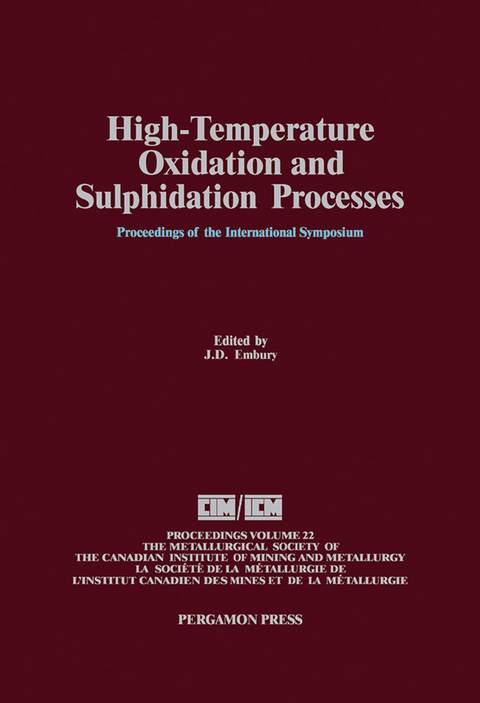
High-Temperature Oxidation and Sulphidation Processes (eBook)
360 Seiten
Elsevier Science (Verlag)
978-1-4832-8740-9 (ISBN)
This book deals with the fundamental description of the thermodynamics and kinetics of high temperature oxidation of sulphidation of metals and intermetallic compounds. It is a comprehensive account of a large amount of new work in the field including modelling, analysis and a range of experimental methods. The text deals with both basic materials, and some current high temperature structural materials.
Front Cover 1
High-Temperature Oxidation and Sulphidation Processes 4
Copyright Page 5
Table of Contents 8
Foreword 6
Chapter 1. Interactive mechanisms in the high-temperature oxidation of metals 10
INTRODUCTION 10
1. SPECIMEN SHAPE 10
2.THERMAL CYCLING 12
3.ALLOY OXIDATION 13
4.MULTIPLE OXIDANT GASES 14
5.EFFECT OF GAS VELOCITY 15
6.THE PRESENCE OF PARTICULATES IN THE GAS STREAM 17
CONCLUSIONS 20
REFERENCES 20
Chapter 2. Evolution of the structure of NiO and CoO scales 25
Introduction 25
Methods 26
Results 26
Discussion 35
Conclusions 36
Acknowledgment 36
References 36
Chapter 3. An in situ measurement of stresses generated during scale growth limited by cation/vacancy diffusion 37
Introduction 37
Methods 38
Results 40
Acknowledgments 43
References 43
Appendix 45
sin2 -method 45
Elastic anisotropy effect 45
The sin2 -integral method
Chapter 4. Isothermal oxidation properties of pure copper 52
Abstract 52
Key words 52
Introduction 52
Experimental 52
Results 53
Discussion and Conclusions 54
Acknowledgements 57
References 57
Chapter 5. Diffusion in quasi-steady-state irreversible systems epitaxy of nickel telluride from halide vapour phase
Abstract 64
Introduction 65
Chemical Vapor Transport 66
Source Zone 68
Deposition Zone 69
Growth Rates for (Te/Ni)s:1.7 and (Te/Ni)d:1.9 72
Mass-Transport 72
Growth Rates for NTc/NNi =1.9 and Ncl=0 76
References 77
Chapter 6. High-temperaturç sulphidation of iron-based alloys 79
Introduction 79
Sulfidation Behavior of Fe-Cr Alloys 79
Diffusional Analysis 82
Internal and Grain Boundary Sulfidation 88
References 89
Chapter 7. Surface effects in sulphidation reactions 91
Abstract 91
Introduction 91
Experimental 92
Sulfidation of Iron 93
Sulfidation of Fe-41Ni Alloy 95
References 98
Chapter 8. High-temperature oxidation of Fe-Cr-Al alloys:influence of Al content 102
ABSTRACT 102
INTRODUCTION 102
EXPERIMENTAL 103
OXIDATION RESULTS 104
DISCUSSION 106
CONCLUSIONS 109
REFERENCES 109
Chapter 9. Segregation of cerium in chromia scales 110
Abstract 110
Introduction 110
Experimental 110
Results and Discussion 111
SIMS Data 111
TEM/EDX. EELS and Electron Diffraction Data 112
Conclusions 114
Acknowledgement 114
References 114
Chapter 10. Breakdown of Cr2o> 3 scales by sulphur
Abstract 122
1 Introduction 122
2 Experimental Conditions 123
3. Experimental Results 124
4 Discussion 132
5 Summary 135
Acknowledgements 136
References 136
Chapter 11. Oxidation and sulphidation of type 31OS stainless steel at elevated temperatures 137
Abstract 137
INTRODUCTION 137
PROCEDURE 138
RESULTS AND DISCUSSION 140
CONCLUSIONS 150
REFERENCES 151
Chapter 12. External and internal sulphidation of ferritic and austenitic alloys in H2-H20-H2S mixtures after preoxidation 152
Abstract 152
1. Introduction 152
2. External Sulfidation After Preoxidation 153
3. Internal Sulfidation After Preoxidation 159
4. Discussion 161
5. Conclusions 162
Acknowledgement 163
References 163
Chapter 13. Kinetics of internal and external oxide formation for 316Land 310 stainless steels between 800°C and 1200°C 164
ABSTRACT 164
INTRODUCTION 164
EXPERIMENTAL 165
RESULTS 166
DISCUSSION 175
CONCLUSION 177
ACKNOLEDGEMENTS 177
REFERENCES 178
Chapter 14. Zirconium alloy oxidation — why do we still understand so little about it? 179
Abstract 179
1. Introduction 179
2. Surprises in the out-of-reactor observations 180
3. Surprises in the in-reactor observations 181
4. Conclusions 183
References 183
Chapter 15. Effect of microstructure on the corrosion of Zr-2.5Nb alloy 191
Abstract 191
Introduction 191
Microstructure 192
Out-Reactor Corrosion 193
Effect of Neutron Irradiation 194
Discussion 196
Summary 197
References 198
Chapter 16. High-temperature oxidation behaviour of U02in air and steam 207
Abstract 207
Introduction 207
Uranium-Oxygen Phase Relations 208
Experimental Description 209
Low Temperature Steam Oxidation (500-800°C) 209
Volatilization in Air (1700-2075°C) 209
Experimental Results 211
Low Temperature Steam Oxidation (500-800°C) 211
Volatilization in Air (1700-2075°C) 213
Discussion of Results 214
Low Temperature Steam Oxidation (500-800°C) 214
Volatilization in Air (1700-2075°C) 216
Summary and Conclusions 219
Acknowledgements 220
References 220
Chapter 17. Oxidation behaviour of iridium-aluminum and iridium-aluminum-silicon systems at very high temperatures (1500°C to 1800°C) 221
Introduction 221
Experimental 222
Results 222
Discussion 225
Summary 225
References 226
Chapter 18. Oxidation of nickel-aluminum alloys 231
ABSTRACT 231
INTRODUCTION 231
EXPERIMENTAL 235
RESULTS AND DISCUSSION 237
CONCLUSIONS 244
ACKNOWLEDGEMENTS 244
REFERENCES 244
Chapter 19. High-temperature oxidation studies of titanium disilicide 246
Abstract 246
Introduction 246
Experimental 248
Results and Discussion 249
Conclusions 264
References 265
Acknowledgements 265
Chapter 20. Mixed oxidant corrosion in coal combustion and conversion systems: manifestations and mechanisms 266
Abstract 266
Introduction 266
The Formation of a Protective Oxide on an Alloy 268
The Role of Second Qxidants: Mechanisms 269
The Phase Stability Diagram and the Reaction Path. 269
The Effect of the Second Oxidant on the Oxidation Process. 271
Breakaway Corrosion. 271
Practical Manifestations of Mixed Oxidant Corrosion 274
Summary 278
References 278
Chapter 21. Oxidation of boiler tube steels In steam 285
Introduction 285
Oxide Scale Growth and Morphology 286
Preventive and Remedial Measures 300
Conclusions 302
References 302
Chapter 22. High-temperature degradation of advanced gas turbine engine materials and coatings' 305
ABSTRACT 305
INTRODUCTION 305
DEGRADATION OF TITANIUM ALLOY COMPONENTS 306
DEGRADATION OF NICKEL BASE SUPERALLOY COMPONENTS 307
SUMMARY AND CONCLUSIONS 309
ACKNOWLEDGEMENTS 310
REFERENCES 310
Chapter 23. NaCl-induced high-temperature oxidation of Ni and Ni-Cr alloys 321
Introduction 321
Experimental Methods 321
Results and Discussion 322
Conclusion 330
References 331
Chapter 24. Sulphidation of Vanadium in H2S-H2 atmospheres attemperatures between 1073 K and 1273 K 332
Abstract 332
Key words 332
Introduction 332
Experimental 333
Results 333
Discussion and Conclusions 336
Acknowledgements 339
References 339
Chapter 25. Oxidation behaviour improvement on FeCrAl and FeCrAl and FeCrNi alloys by surface applied ceria 346
Introduction 346
Experimentais 346
Results 347
Discussion 351
Conclusion 353
References 354
Chapter 26. High-temperature oxidation properties of ODS MA754 alloy 355
Chapter 27. Phase stability and reactions of chromite with carbon 356
Authors' Index 358
Subject Index 360
| Erscheint lt. Verlag | 21.1.2016 |
|---|---|
| Sprache | englisch |
| Themenwelt | Technik ► Bauwesen |
| ISBN-10 | 1-4832-8740-8 / 1483287408 |
| ISBN-13 | 978-1-4832-8740-9 / 9781483287409 |
| Informationen gemäß Produktsicherheitsverordnung (GPSR) | |
| Haben Sie eine Frage zum Produkt? |
 PDF (Adobe DRM)
Kopierschutz: Adobe-DRM
Adobe-DRM ist ein Kopierschutz, der das eBook vor Mißbrauch schützen soll. Dabei wird das eBook bereits beim Download auf Ihre persönliche Adobe-ID autorisiert. Lesen können Sie das eBook dann nur auf den Geräten, welche ebenfalls auf Ihre Adobe-ID registriert sind.
Details zum Adobe-DRM
Dateiformat: PDF (Portable Document Format)
Mit einem festen Seitenlayout eignet sich die PDF besonders für Fachbücher mit Spalten, Tabellen und Abbildungen. Eine PDF kann auf fast allen Geräten angezeigt werden, ist aber für kleine Displays (Smartphone, eReader) nur eingeschränkt geeignet.
Systemvoraussetzungen:
PC/Mac: Mit einem PC oder Mac können Sie dieses eBook lesen. Sie benötigen eine
eReader: Dieses eBook kann mit (fast) allen eBook-Readern gelesen werden. Mit dem amazon-Kindle ist es aber nicht kompatibel.
Smartphone/Tablet: Egal ob Apple oder Android, dieses eBook können Sie lesen. Sie benötigen eine
Geräteliste und zusätzliche Hinweise
Buying eBooks from abroad
For tax law reasons we can sell eBooks just within Germany and Switzerland. Regrettably we cannot fulfill eBook-orders from other countries.
aus dem Bereich