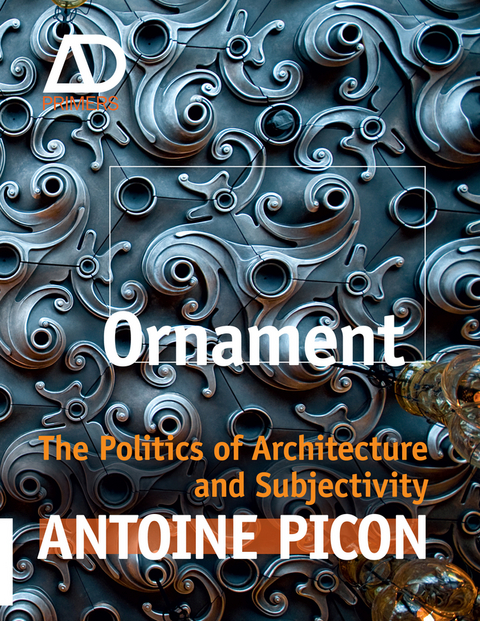
Ornament (eBook)
John Wiley & Sons (Verlag)
978-1-118-58753-9 (ISBN)
Once condemned by Modernism and compared to a 'crime' by Adolf Loos, ornament has made a spectacular return in contemporary architecture. This is typified by the works of well-known architects such as Herzog & de Meuron, Sauerbruch Hutton, Farshid Moussavi Architecture and OMA. There is no doubt that these new ornamental tendencies are inseparable from innovations in computer technology. The proliferation of developments in design software has enabled architects to experiment afresh with texture, colour, pattern and topology.
Though inextricably linked with digital tools and culture, Antoine Picon argues that some significant traits in ornament persist from earlier Western architectural traditions. These he defines as the 'subjective' - the human interaction that ornament requires in both its production and its reception - and the political. Contrary to the message conveyed by the founding fathers of modern architecture, traditional ornament was not meant only for pleasure. It conveyed vital information about the designation of buildings as well as about the rank of their owners. As such, it participated in the expression of social values, hierarchies and order. By bringing previous traditions in ornament under scrutiny, Picon makes us question the political issues at stake in today's ornamental revival. What does it tell us about present-day culture? Why are we presently so fearful of meaning in architecture? Could it be that by steering so vehemently away from symbolism, contemporary architecture is evading any explicit contribution to collective values?Antoine Picon is the G Ware Travelstead Professor of the History of Architecture and Technology and Co-Director of Doctoral Programs at Harvard Graduate School of Design (GSD). He is also Director of Research at Ecole Nationale des Ponts et Chaussées, Paris. He has published numerous books and articles mostly dealing with the complementary histories of architecture, science and technology, among which are: French Architects and Engineers in the Age of Enlightenment (Cambridge University Press, 1992 and 2009), Claude Perrault (1613-1688) ou la curiosité d'un classique (Picard, 1988), L'Invention de l'Ingénieur Moderne, L'Ecole des Ponts et Chaussées 1747-1851 (Presses de l'Ecole Nationale des Ponts et Chaussées, 1992), La Ville Territoire des Cyborgs (L'Imprimeur, 1998), Les Saint-Simoniens: Raison, Imaginaire, et Utopie (Belin, 2002), and Digital Culture in Architecture: An Introduction for the Design Professions (Birkhäuser, 2010).
Once condemned by Modernism and compared to a crime by Adolf Loos, ornament has made a spectacular return in contemporary architecture. This is typified by the works of well-known architects such as Herzog & de Meuron, Sauerbruch Hutton, Farshid Moussavi Architecture and OMA. There is no doubt that these new ornamental tendencies are inseparable from innovations in computer technology. The proliferation of developments in design software has enabled architects to experiment afresh with texture, colour, pattern and topology. Though inextricably linked with digital tools and culture, Antoine Picon argues that some significant traits in ornament persist from earlier Western architectural traditions. These he defines as the subjective the human interaction that ornament requires in both its production and its reception and the political. Contrary to the message conveyed by the founding fathers of modern architecture, traditional ornament was not meant only for pleasure. It conveyed vital information about the designation of buildings as well as about the rank of their owners. As such, it participated in the expression of social values, hierarchies and order. By bringing previous traditions in ornament under scrutiny, Picon makes us question the political issues at stake in today s ornamental revival. What does it tell us about present-day culture? Why are we presently so fearful of meaning in architecture? Could it be that by steering so vehemently away from symbolism, contemporary architecture is evading any explicit contribution to collective values?
Antoine Picon is the G Ware Travelstead Professor of the History of Architecture and Technology and Co-Director of Doctoral Programs at Harvard Graduate School of Design (GSD). He is also Director of Research at Ecole Nationale des Ponts et Chaussées, Paris. He has published numerous books and articles mostly dealing with the complementary histories of architecture, science and technology, among which are: French Architects and Engineers in the Age of Enlightenment (Cambridge University Press, 1992 and 2009), Claude Perrault (1613-1688) ou la curiosité d'un classique (Picard, 1988), L'Invention de l'Ingénieur Moderne, L'Ecole des Ponts et Chaussées 1747-1851 (Presses de l'Ecole Nationale des Ponts et Chaussées, 1992), La Ville Territoire des Cyborgs (L'Imprimeur, 1998), Les Saint-Simoniens: Raison, Imaginaire, et Utopie (Belin, 2002), and Digital Culture in Architecture: An Introduction for the Design Professions (Birkhäuser, 2010).
Cover 1
Title Page 5
Copyright Page 6
Acknowledgements 7
Contents 8
Introduction: Architecture as Ornament? 11
References 18
Chapter 1: A Problematic Return 19
The Ornamental Revival in Contemporary Architecture 21
Textures, Patterns and Topology: A Different Ornament 29
The Subjective and the Political 49
References 58
Chapter 2: Ornament and Subjectivity 61
The Visage of Architecture 62
The Architect, between Rules and Invention 64
Artists, Craftsmen and the Fabrication of Ornament 75
From Clients to Passers-By 84
Industrialisation and the Ornamental Impulse 92
The Ghost of Ornament 99
References 102
Chapter 3: Politics of Ornament 105
From Economics to Politics 105
Communication and Style 108
The Power of Architectural Décor 124
References 129
Chapter 4: Reinventing the Meaning of Ornament 131
A New Architectural Subject 131
Political Uncertainties 146
Meaning and Symbols 147
References 157
Bibliography 159
Index 165
Picture Credits 169
EULA 171
| Erscheint lt. Verlag | 28.5.2014 |
|---|---|
| Reihe/Serie | Architectural Design Primer |
| Architectural Design Primer | Architectural Design Primer |
| Sprache | englisch |
| Themenwelt | Technik ► Architektur |
| Schlagworte | architectural theory • Architecture • Architektur • Architektur / Theorie • Ornament in design, the use of ornament in architecture, ornament and digital techniques, current use of ornament in architecture design, contemporary use of ornament in architecture design, ornament in Herzog & de Meuron's Eberswald Library, ornament in Sauerbruch Hutton's Pharmacological Research Laboratories in Biberach, ornament in OMA's New Jeddah International Airport Project |
| ISBN-10 | 1-118-58753-7 / 1118587537 |
| ISBN-13 | 978-1-118-58753-9 / 9781118587539 |
| Informationen gemäß Produktsicherheitsverordnung (GPSR) | |
| Haben Sie eine Frage zum Produkt? |
 PDF (Adobe DRM)
Kopierschutz: Adobe-DRM
Adobe-DRM ist ein Kopierschutz, der das eBook vor Mißbrauch schützen soll. Dabei wird das eBook bereits beim Download auf Ihre persönliche Adobe-ID autorisiert. Lesen können Sie das eBook dann nur auf den Geräten, welche ebenfalls auf Ihre Adobe-ID registriert sind.
Details zum Adobe-DRM
Dateiformat: PDF (Portable Document Format)
Mit einem festen Seitenlayout eignet sich die PDF besonders für Fachbücher mit Spalten, Tabellen und Abbildungen. Eine PDF kann auf fast allen Geräten angezeigt werden, ist aber für kleine Displays (Smartphone, eReader) nur eingeschränkt geeignet.
Systemvoraussetzungen:
PC/Mac: Mit einem PC oder Mac können Sie dieses eBook lesen. Sie benötigen eine
eReader: Dieses eBook kann mit (fast) allen eBook-Readern gelesen werden. Mit dem amazon-Kindle ist es aber nicht kompatibel.
Smartphone/Tablet: Egal ob Apple oder Android, dieses eBook können Sie lesen. Sie benötigen eine
Geräteliste und zusätzliche Hinweise
Buying eBooks from abroad
For tax law reasons we can sell eBooks just within Germany and Switzerland. Regrettably we cannot fulfill eBook-orders from other countries.
aus dem Bereich