Multi-Storey Precast Concrete Framed Structures (eBook)
John Wiley & Sons (Verlag)
978-1-118-58735-5 (ISBN)
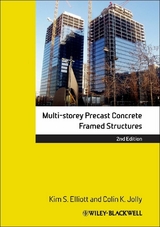
Precast reinforced and prestressed concrete frames provide a high strength, stable, durable and robust solution for any multi-storey structure, and are widely regarded as a high quality, economic and architecturally versatile technology for the construction of multi-storey buildings. The resulting buildings satisfy a wide range of commercial and industrial needs. Precast concrete buildings behave in a different way to those where the concrete is cast in-situ, with the components subject to different forces and movements. These factors are explored in detail in the second edition of Multi-Storey Precast Concrete Framed Structures, providing a detailed understanding of the procedures involved in precast structural design. This new edition has been fully updated to reflect recent developments, and includes many structural calculations based on EUROCODE standards. These are shown in parallel with similar calculations based on British Standards to ensure the designer is fully aware of the differences required in designing to EUROCODE standards.
Civil and structural engineers as well as final year undergraduate and postgraduate students of civil and structural engineering will all find this book to be thorough overview of this important construction technology.
Kim S. Elliott BTech, PhD, CEng, MICE is a self-employed consultant to the precast industry in the UK and Malaysia. He was Senior Lecturer in the School of Civil Engineering at Nottingham University, UK, from 1987 to 2010, and was formerly at Trent Concrete Structures Ltd, one of the UK's leading precast concrete manufacturers. Since 1987, he has been active in research into the behaviour of precast concrete structures and has published more than 120 papers and 6 text books. He is a member of the FIB UK Group and FIB Commission on Prefabrication.
Colin K. Jolly MSc, PhD, CEng, MICE, FIStructE is a self-employed consultant to Cranfield University and the construction industry. He was Senior Lecturer in the Department of Civil and Environmental Engineering at Southampton University, UK, from 1978 to 1999, and in the Engineering Systems Department at the Royal Military College of Science (now the Defence Academy) from 2000-2006, having formerly worked for Consulting Engineers in the UK and Oman. Since 1975, he has been active in research into the behaviour of a wide variety of composite materials in structures, and has published more than 280 papers and industrial reports. He is a member of the UK Expert Group providing recommendations for the evolution of the European loading code EN 1990.
Precast reinforced and prestressed concrete frames provide a high strength, stable, durable and robust solution for any multi-storey structure, and are widely regarded as a high quality, economic and architecturally versatile technology for the construction of multi-storey buildings. The resulting buildings satisfy a wide range of commercial and industrial needs. Precast concrete buildings behave in a different way to those where the concrete is cast in-situ, with the components subject to different forces and movements. These factors are explored in detail in the second edition of Multi-Storey Precast Concrete Framed Structures, providing a detailed understanding of the procedures involved in precast structural design. This new edition has been fully updated to reflect recent developments, and includes many structural calculations based on EUROCODE standards. These are shown in parallel with similar calculations based on British Standards to ensure the designer is fully aware of the differences required in designing to EUROCODE standards. Civil and structural engineers as well as final year undergraduate and postgraduate students of civil and structural engineering will all find this book to be thorough overview of this important construction technology.
Kim S. Elliott BTech, PhD, CEng, MICE is a self-employed consultant to the precast industry in the UK and Malaysia. He was Senior Lecturer in the School of Civil Engineering at Nottingham University, UK, from 1987 to 2010, and was formerly at Trent Concrete Structures Ltd, one of the UK's leading precast concrete manufacturers. Since 1987, he has been active in research into the behaviour of precast concrete structures and has published more than 120 papers and 6 text books. He is a member of the FIB UK Group and FIB Commission on Prefabrication. Colin K. Jolly MSc, PhD, CEng, MICE, FIStructE is a self-employed consultant to Cranfield University and the construction industry. He was Senior Lecturer in the Department of Civil and Environmental Engineering at Southampton University, UK, from 1978 to 1999, and in the Engineering Systems Department at the Royal Military College of Science (now the Defence Academy) from 2000-2006, having formerly worked for Consulting Engineers in the UK and Oman. Since 1975, he has been active in research into the behaviour of a wide variety of composite materials in structures, and has published more than 280 papers and industrial reports. He is a member of the UK Expert Group providing recommendations for the evolution of the European loading code EN 1990.
Preface ix
Notation xi
1 Precast Concepts, History and Design Philosophy 1
1.1 A Historical Note on the Development of Precast Frames 1
1.2 The Scope for Prefabricated Buildings 11
1.3 Current Attitudes towards Precast Concrete Structures 17
1.4 Recent Trends in Design, and a New Definition for Precast
Concrete 21
1.5 Precast Superstructure Simply Explained 23
1.6 Precast Design Concepts 32
2 Procurement and Documentation 43
2.1 Initial Considerations for the Design Team 43
2.2 Design Procurement 45
2.3 Construction Matters 58
2.4 Codes of Practice, Design Manuals, Textbooks and Technical
Literature 60
2.5 Definitions 68
3 Architectural and Framing Considerations 71
3.1 Frame and Component Selection 71
3.2 Component Selection 75
3.3 Special Features 113
3.4 Balconies 136
4 Design of Skeletal Structures 145
4.1 Basis for the Design 145
4.2 Materials 148
4.3 Structural Design 153
4.4 Columns Subjected to Gravity Loads 226
4.5 Staircases 237
5 Design of Precast Floors Used in Precast Frames 245
5.1 Flooring Options 245
5.2 Hollow-core Slabs 249
5.3 Double-Tee Slabs 309
5.4 Composite Plank Floor 315
5.5 Precast Beam-and-Plank Flooring 324
5.6 Design Calculations 325
6 Composite Construction 335
6.1 Introduction 335
6.2 Texture of Precast Concrete Surfaces 339
6.3 Calculation of Stresses at the Interface 344
6.4 Losses and Differential Shrinkage Effects 346
6.5 Composite Floors 352
6.6 Economic Comparison of Composite and Non-composite
Hollow-core Floors 364
6.7 Composite Beams 365
7 Design of Connections and Joints 375
7.1 Development of Connections 375
7.2 Design Brief 377
7.3 Joints and Connections 383
7.4 Criteria for Joints and Connections 384
7.5 Types of Joint 386
7.6 Bearings and Bearing Stresses 405
7.7 Connections 413
7.8 Design of Specific Connections in Skeletal Frames 425
7.9 Beam-to-Column and Beam-to-Wall Connections 435
7.10 Column Insert Design 438
7.11 Connections to Columns on Concrete Ledges 470
7.12 Beam-to-Beam Connections 493
7.13 Column Splices 503
7.14 Column Base Connections 517
8 Designing for Horizontal Load 547
8.1 Introduction 547
8.2 Distribution of Horizontal Load 549
8.3 Horizontal Diaphragm Action in Precast Concrete Floors
without Structural Toppings 558
8.4 Diaphragm Action in Composite Floors with Structural
Toppings 576
8.5 Horizontal Forces due to Volumetric Changes in Precast
Concrete 577
8.6 Vertical Load Transfer 581
8.7 Methods of Bracing Structures 593
9 Structural Integrity and the Design for Accidental Loading
627
9.1 Precast Frame Integrity - The Vital Issue 627
9.2 Ductile Frame Design 628
9.3 Background to the Present Requirements 634
9.4 Categorisation of Buildings 643
9.5 The Fully Tied Solution 643
9.6 Catenary Systems in Precast Construction 662
10 Site Practice and Temporary Stability 667
10.1 The Effects of Construction Techniques on Design 667
10.2 Designing for Pitching and Lifting 672
10.3 Temporary Frame Stability 690
10.4 On-Site Connections 697
10.5 Erection Procedure 699
10.6 In situ Concrete 709
10.7 Handover 714
References 715
Index 729
| Erscheint lt. Verlag | 7.10.2013 |
|---|---|
| Sprache | englisch |
| Themenwelt | Technik ► Bauwesen |
| Schlagworte | Bauingenieur- u. Bauwesen • Baustoffe • Betonbau • Betonfertigteil • Civil Engineering & Construction • construction materials • Hochbau • Hochhaus • Structural & Building Engineering • structural concrete, concrete structures, concrete panel structures, concrete framed structures, British National Application Documents, BS EN 1990, Basis of Structural Design, BS EN 1991, Actions on Structures, BS EN 1992, Design of Concrete Structures • Tief- u. Hochbau / Massivbau |
| ISBN-10 | 1-118-58735-9 / 1118587359 |
| ISBN-13 | 978-1-118-58735-5 / 9781118587355 |
| Informationen gemäß Produktsicherheitsverordnung (GPSR) | |
| Haben Sie eine Frage zum Produkt? |
 EPUB (Adobe DRM)
Kopierschutz: Adobe-DRM
Adobe-DRM ist ein Kopierschutz, der das eBook vor Mißbrauch schützen soll. Dabei wird das eBook bereits beim Download auf Ihre persönliche Adobe-ID autorisiert. Lesen können Sie das eBook dann nur auf den Geräten, welche ebenfalls auf Ihre Adobe-ID registriert sind.
Details zum Adobe-DRM
Dateiformat: EPUB (Electronic Publication)
EPUB ist ein offener Standard für eBooks und eignet sich besonders zur Darstellung von Belletristik und Sachbüchern. Der Fließtext wird dynamisch an die Display- und Schriftgröße angepasst. Auch für mobile Lesegeräte ist EPUB daher gut geeignet.
Systemvoraussetzungen:
PC/Mac: Mit einem PC oder Mac können Sie dieses eBook lesen. Sie benötigen eine
eReader: Dieses eBook kann mit (fast) allen eBook-Readern gelesen werden. Mit dem amazon-Kindle ist es aber nicht kompatibel.
Smartphone/Tablet: Egal ob Apple oder Android, dieses eBook können Sie lesen. Sie benötigen eine
Geräteliste und zusätzliche Hinweise
Buying eBooks from abroad
For tax law reasons we can sell eBooks just within Germany and Switzerland. Regrettably we cannot fulfill eBook-orders from other countries.
aus dem Bereich