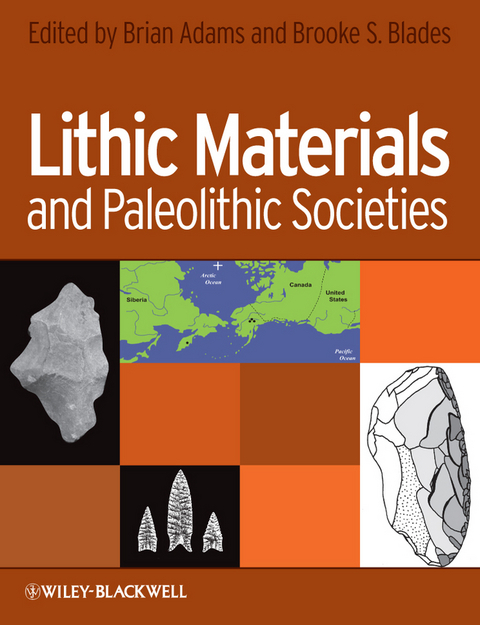
Lithic Materials and Paleolithic Societies (eBook)
312 Seiten
John Wiley & Sons (Verlag)
978-1-4443-1196-9 (ISBN)
detailed examination of the Paleolithic procurement and utilization
of the most durable material in the worldwide archaeological
record. The volume addresses sites ranging in age from some of the
earliest hominin occupations in eastern and southern Africa to late
Pleistocene and post-Pleistocene occupations in North American and
Australia. The Early Paleolithic in India and the Near East, the
Middle Paleolithic in Europe, and the Late Paleolithic in Europe
and eastern Asia are also considered.
The authors include established researchers who provide
important synthetic statements updated with new information. Recent
data are reported, often by younger scholars who are becoming
respected members of the international research community. The
authors represent research traditions from nine countries and
therefore provide insight into the scholarly present as well as the
Paleolithic past. Attempts are frequently made to relate lithic
procurement and utilization to the organization of societies and
even broader concerns of hominin behaviour. The volume re-evaluates
existing interpretations- in some instances by updating
previous work of the authors -and offers provocative new
interpretations that at times call into question some basic
assumptions of the Paleolithic.
This book will be invaluable reading for advanced students and
researchers in the fields of palaeolithic archaeology,
geoarchaeology, and anthropology.
Brooke Blades has conducted archaeological research and excavations for more than three decades in various temporal and geographic contexts in eastern North America and in western Europe. He held a Fulbright-Hayes Fellowship to conduct archaeological research in Northern Ireland in 1979-80. His research in western Europe has been generously supported by the American Philosophical Society, International Relations and Exchanges Board (IREX), the National Science Foundation, and New York University. Brian Adams is currently Assistant Director of the Public Service Archaeology & Architecture Program in the Anthropology Department of the University of Illinois at Urbana-Champaign. His research interests include lithic analysis, microwear analysis of lithic artifacts, hunter-gatherer adaptations, and the Middle to Upper Palaeolithic transition in Europe. He has conducted research at Palaeolithic sites in Central Europe and Egypt, as well as prehistoric and early historic sites in the Midwest USA.
Part I: Regional Landscape Perspectives.
1. Raw materials and techno-economic behaviors at Oldowan and
Acheulean sites in the West Turkana region, Kenya (Sonia
Harmand).
2. Patterns of lithic material procurement and transformation
during the Middle Paleolithic in western Europe (Liliane Meignen,
Anne Delagnes, and Laurence Bourguignon).
3. Revisiting European Upper Paleolithic raw material transfers:
the demise of the cultural ecological paradigm? (Jehanne
Féblot-Augustins).
4. Raw materials for chipped stone artifacts: state of the art
in the Carpathian Basin of central Europe (Kati Biró).
5. Upper Paleolithic toolstone procurement and selection across
Beringia (Kelly Graf and Ted Goebel).
6. Reduction, recycling, and raw material procurement in western
Arnhem Land, Australia (Peter Hiscock).
Part II: Technological and Assemblage Variability.
7. Paleolithic exploitation of rounded and sub-angular
quartzites in the Indian Subcontinent (Parth Chauhan).
8. Filling the void: lithic raw material utilization during the
Hungarian Gravettian (Viola Dobosi).
9. Technological efficiency as adaptive behavior among
Paleolithic hunter-gatherers: evidence from la-Côte, Caminade
Est, and le Flageolet I, France (Stephen Cole).
10. Trash: the structure of Great Basin Paleoarchaic debitage
assemblages in western North America (Rebecca Kessler, Charlotte
Beck, and George Jones).
Part III: Micro-landscape Perspectives.
11. Reconstructing landscape use and mobility in the Namibian
Early Stone Age using operations analysis (Grant McCall).
12. Changing the face of the earth: human behavior at Sede Ilan,
an extensive Lower-Middle Paleolithic quarry site in Israel (Ran
Barkai and Avi Gopher).
13. Aurignacian core reduction and landscape utilization in the
vicinity of la Ferrassie, France (Brooke Blades).
14. Oblazowa and Hlomcza: two Paleolithic sites in the
North Carpartians Province of southern Poland (Pawel
Valde-Nowak).
15. Raw material economy and technological organization at
Solvieux, France (Linda Grimm and Todd Koetje).
Part IV: Hominid Cognition, Adaptation, and Cultural
Chronology.
16. Inferring aspects of Acheulean sociality and cognition from
biface technology in the Hunsgi-Baichbal valley of India (Ceri
Shipton, Michael Petraglia, and K. Paddayya).
17. Quina procurement and tool production (Peter Hiscock, Alain
Turq, Jean-Philippe Faivre, and Laurence Bouguignon).
18. The impact of lithic raw material quality and
post-depositional processes on cultural/chronological
classification: the Hungarian Szeletian case (Brian Adams).
19. Raw material durability, function, and retouch in the Upper
Paleolithic of the Transbaikal region (Karisa Terry, William
Andrefsky, and Mikhail Konstantinov).
20. Clovis and Dalton: unbounded and bounded systems in the
Midcontinent of North America (Brad Koldehoff and Thomas
Loebel).
| Erscheint lt. Verlag | 6.5.2009 |
|---|---|
| Sprache | englisch |
| Themenwelt | Geisteswissenschaften ► Archäologie |
| Geschichte ► Allgemeine Geschichte ► Vor- und Frühgeschichte | |
| Naturwissenschaften ► Geowissenschaften ► Geologie | |
| Technik | |
| Schlagworte | Bodenkunde, Geoarchäologie • Bodenkunde, Geoarchäologie • earth sciences • Geowissenschaften • Soil Science & Geoarchaeology |
| ISBN-10 | 1-4443-1196-4 / 1444311964 |
| ISBN-13 | 978-1-4443-1196-9 / 9781444311969 |
| Informationen gemäß Produktsicherheitsverordnung (GPSR) | |
| Haben Sie eine Frage zum Produkt? |
 PDF (Adobe DRM)
Kopierschutz: Adobe-DRM
Adobe-DRM ist ein Kopierschutz, der das eBook vor Mißbrauch schützen soll. Dabei wird das eBook bereits beim Download auf Ihre persönliche Adobe-ID autorisiert. Lesen können Sie das eBook dann nur auf den Geräten, welche ebenfalls auf Ihre Adobe-ID registriert sind.
Details zum Adobe-DRM
Dateiformat: PDF (Portable Document Format)
Mit einem festen Seitenlayout eignet sich die PDF besonders für Fachbücher mit Spalten, Tabellen und Abbildungen. Eine PDF kann auf fast allen Geräten angezeigt werden, ist aber für kleine Displays (Smartphone, eReader) nur eingeschränkt geeignet.
Systemvoraussetzungen:
PC/Mac: Mit einem PC oder Mac können Sie dieses eBook lesen. Sie benötigen eine
eReader: Dieses eBook kann mit (fast) allen eBook-Readern gelesen werden. Mit dem amazon-Kindle ist es aber nicht kompatibel.
Smartphone/Tablet: Egal ob Apple oder Android, dieses eBook können Sie lesen. Sie benötigen eine
Geräteliste und zusätzliche Hinweise
Buying eBooks from abroad
For tax law reasons we can sell eBooks just within Germany and Switzerland. Regrettably we cannot fulfill eBook-orders from other countries.
aus dem Bereich