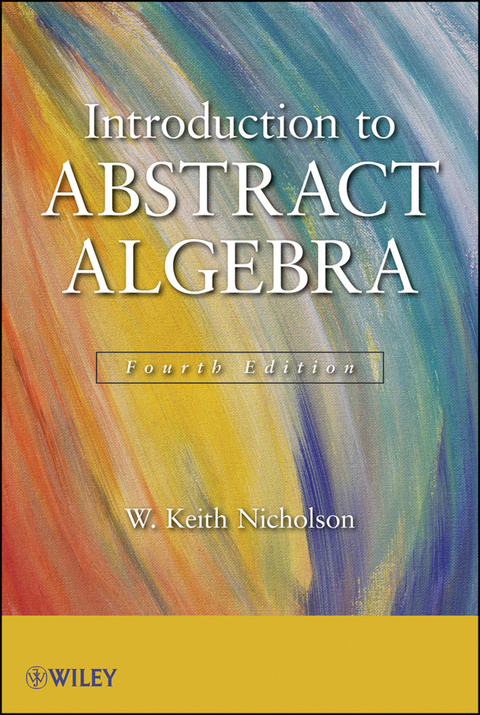
Introduction to Abstract Algebra (eBook)
John Wiley & Sons (Verlag)
978-1-118-31173-8 (ISBN)
Praise for the Third Edition
'. . . an expository masterpiece of the highest didactic value that has gained additional attractivity through the various improvements . . .'-Zentralblatt MATH
The Fourth Edition of Introduction to Abstract Algebra continues to provide an accessible approach to the basic structures of abstract algebra: groups, rings, and fields. The book's unique presentation helps readers advance to abstract theory by presenting concrete examples of induction, number theory, integers modulo n, and permutations before the abstract structures are defined. Readers can immediately begin to perform computations using abstract concepts that are developed in greater detail later in the text.
The Fourth Edition features important concepts as well as specialized topics, including:
-
The treatment of nilpotent groups, including the Frattini and Fitting subgroups
-
Symmetric polynomials
-
The proof of the fundamental theorem of algebra using symmetric polynomials
-
The proof of Wedderburn's theorem on finite division rings
-
The proof of the Wedderburn-Artin theorem
Throughout the book, worked examples and real-world problems illustrate concepts and their applications, facilitating a complete understanding for readers regardless of their background in mathematics. A wealth of computational and theoretical exercises, ranging from basic to complex, allows readers to test their comprehension of the material. In addition, detailed historical notes and biographies of mathematicians provide context for and illuminate the discussion of key topics. A solutions manual is also available for readers who would like access to partial solutions to the book's exercises.
Introduction to Abstract Algebra, Fourth Edition is an excellent book for courses on the topic at the upper-undergraduate and beginning-graduate levels. The book also serves as a valuable reference and self-study tool for practitioners in the fields of engineering, computer science, and applied mathematics.
W. KEITH NICHOLSON, PhD, is Professor in the Department of Mathematics and Statistics at the University of Calgary, Canada. He has published extensively in his areas of research interest, which include clean rings, morphic rings and modules, and quasi-morphic rings. Dr. Nicholson is the coauthor of Modern Algebra with Applications, Second Edition, also published by Wiley.
Praise for the Third Edition "e;. . . an expository masterpiece of the highest didactic value that has gained additional attractivity through the various improvements . . ."e; Zentralblatt MATH The Fourth Edition of Introduction to Abstract Algebra continues to provide an accessible approach to the basic structures of abstract algebra: groups, rings, and fields. The book's unique presentation helps readers advance to abstract theory by presenting concrete examples of induction, number theory, integers modulo n, and permutations before the abstract structures are defined. Readers can immediately begin to perform computations using abstract concepts that are developed in greater detail later in the text. The Fourth Edition features important concepts as well as specialized topics, including: The treatment of nilpotent groups, including the Frattini and Fitting subgroups Symmetric polynomials The proof of the fundamental theorem of algebra using symmetric polynomials The proof of Wedderburn's theorem on finite division rings The proof of the Wedderburn-Artin theorem Throughout the book, worked examples and real-world problems illustrate concepts and their applications, facilitating a complete understanding for readers regardless of their background in mathematics. A wealth of computational and theoretical exercises, ranging from basic to complex, allows readers to test their comprehension of the material. In addition, detailed historical notes and biographies of mathematicians provide context for and illuminate the discussion of key topics. A solutions manual is also available for readers who would like access to partial solutions to the book's exercises. Introduction to Abstract Algebra, Fourth Edition is an excellent book for courses on the topic at the upper-undergraduate and beginning-graduate levels. The book also serves as a valuable reference and self-study tool for practitioners in the fields of engineering, computer science, and applied mathematics.
W. KEITH NICHOLSON, PhD, is Professor in the Department of Mathematics and Statistics at the University of Calgary, Canada. He has published extensively in his areas of research interest, which include clean rings, morphic rings and modules, and quasi-morphic rings. Dr. Nicholson is the coauthor of Modern Algebra with Applications, Second Edition, also published by Wiley.
PREFACE ix
ACKNOWLEDGMENTS xvii
NOTATION USED IN THE TEXT xix
A SKETCH OF THE HISTORY OF ALGEBRA TO 1929 xxiii
0 Preliminaries 1
0.1 Proofs / 1
0.2 Sets / 5
0.3 Mappings / 9
0.4 Equivalences / 17
1 Integers and Permutations 23
1.1 Induction / 24
1.2 Divisors and Prime Factorization / 32
1.3 Integers Modulo n / 42
1.4 Permutations / 53
1.5 An Application to Cryptography / 67
2 Groups 69
2.1 Binary Operations / 70
2.2 Groups / 76
2.3 Subgroups / 86
2.4 Cyclic Groups and the Order of an Element / 90
2.5 Homomorphisms and Isomorphisms / 99
2.6 Cosets and Lagrange's Theorem / 108
2.7 Groups of Motions and Symmetries / 117
2.8 Normal Subgroups / 122
2.9 Factor Groups / 131
2.10 The Isomorphism Theorem / 137
2.11 An Application to Binary Linear Codes / 143
3 Rings 159
3.1 Examples and Basic Properties / 160
3.2 Integral Domains and Fields / 171
3.3 Ideals and Factor Rings / 180
3.4 Homomorphisms / 189
3.5 Ordered Integral Domains / 199
4 Polynomials 202
4.1 Polynomials / 203
4.2 Factorization of Polynomials Over a Field / 214
4.3 Factor Rings of Polynomials Over a Field / 227
4.4 Partial Fractions / 236
4.5 Symmetric Polynomials / 239
4.6 Formal Construction of Polynomials / 248
5 Factorization in Integral Domains 251
5.1 Irreducibles and Unique Factorization / 252
5.2 Principal Ideal Domains / 264
6 Fields 274
6.1 Vector Spaces / 275
6.2 Algebraic Extensions / 283
6.3 Splitting Fields / 291
6.4 Finite Fields / 298
6.5 Geometric Constructions / 304
6.6 The Fundamental Theorem of Algebra / 308
6.7 An Application to Cyclic and BCH Codes / 310
7 Modules over Principal Ideal Domains 324
7.1 Modules / 324
7.2 Modules Over a PID / 335
8 p-Groups and the Sylow Theorems 349
8.1 Products and Factors / 350
8.2 Cauchy's Theorem / 357
8.3 Group Actions / 364
8.4 The Sylow Theorems / 371
8.5 Semidirect Products / 379
8.6 An Application to Combinatorics / 382
9 Series of Subgroups 388
9.1 The Jordan-H¨older Theorem / 389
9.2 Solvable Groups / 395
9.3 Nilpotent Groups / 401
10 Galois Theory 412
10.1 Galois Groups and Separability / 413
10.2 The Main Theorem of Galois Theory / 422
10.3 Insolvability of Polynomials / 434
10.4 Cyclotomic Polynomials and Wedderburn's Theorem /
442
11 Finiteness Conditions for Rings and Modules 447
11.1 Wedderburn's Theorem / 448
11.2 The Wedderburn-Artin Theorem / 457
Appendices 471
Appendix A Complex Numbers / 471
Appendix B Matrix Algebra / 478
Appendix C Zorn's Lemma / 486
Appendix D Proof of the Recursion Theorem / 490
BIBLIOGRAPHY 492
SELECTED ANSWERS 495
INDEX 523
"This could also be an excellent adjunct to more
theoretically oriented textbooks used in more intensive
courses." (Computing Reviews, 5 November
2012)
Chapter 0
Preliminaries
The science of Pure Mathematics, in its modern development, may claim to be the most original creation of the human spirit.
—Alfred North Whitehead
This brief chapter contains background material needed in the study of abstract algebra and introduces terms and notations used throughout the book. Presenting all this information at the beginning is preferable, because its introduction at the point it is needed interrupts the continuity of the text. Moreover, we can include enough detail here to help those readers who may be less prepared or are using the book for self-study. However, much of this material may be familiar. If so, just glance through it quickly and begin with Chapter 1, referring to this chapter only when necessary.
0.1 Proofs
The essential quality of a proof is to compel belief.
—Pierre de Fermat
Logic plays a basic role in human affairs. Scientists use logic to draw conclusions from experiments, judges use it to deduce consequences of the law, and mathematicians use it to prove theorems. Logic arises in ordinary speech with assertions such as “ if John studies hard, he will pass the course,” or “ if an integer n is divisible by 6, then n is divisible by 3.” In each case, the aim is to assert that if a certain statement is true, then another statement must also be true. In fact, if p and q denote statements, 3 most theorems take the form of an implication: “ If p is true, then q is true.” We write this in symbols as
p ⇒ q
and read it as “ p implies q.” Here, p is the hypothesis and q the conclusion of the implication. Verification that p ⇒ q is valid is the proof of the implication. In this section, we examine the most common methods of proof1 and illustrate each technique with an example.
Method of Direct Proof. To prove p ⇒ q, demonstrate directly that q is true whenever p is true.
Example 1. If n is an odd integer, show that n2 is odd.
Solution. If n is odd, it has the form n = 2k + 1 for some integer k. Then n2 = 4k2 + 4k + 1 = 2(2k2 + 2k) + 1 is also odd because 2k2 + 2k is an integer.
Note that the computation n2 = 4k2 + 4k + 1 in Example 1 involves some simple properties of arithmetic that we did not prove. Actually, a whole body of mathematical information lies behind nearly every proof of any complexity, although this fact usually is not stated explicitly.
Suppose that you are asked to verify that n2 ≥ 0 for every integer n. This expression is an implication: If n is an integer, then n2 ≥ 0. To prove it, you might consider separately the cases that n > 0, n = 0, and n < 0 and then show that n2 ≥ 0 in each case. (You would have to invoke the fact that 02 = 0 and that the product of two positive, or two negative, integers is positive.) We formulate the general method as follows:
Method of Reduction to Cases. To prove p ⇒ q, show that p implies at least one of a list p1, p2, , pn of statements (the cases) and that pi ⇒ q for each i.
Example 2. If n is an integer, show that n2 − n is even.
Solution. Note that n2 − n = n(n − 1) is even if n or n − 1 is even. Hence, given n, we consider the two cases that n is even or odd. Because n − 1 is even in the second case, n2 − n is even in either case.
The statements used in mathematics must be true or false. This requirement leads to a proof technique that can mystify beginners. The method is a formal version of a debating strategy whereby the debater assumes the truth of an opponent's position and shows that it leads to an absurd conclusion.
Method of Proof by Contradiction. To prove p ⇒ q, show that the assumption that both p is true and q is false leads to a contradiction.
Example 3. If r is a rational number (fraction), show that r2 ≠ 2.
Solution. To argue by contradiction, we assume that r is a rational number and that r2 = 2 and show that this assumption leads to a contradiction. Let m and n be integers such that is in lowest terms (so, in particular, m and n are both not even). Then r2 = 2 gives m2 = 2n2, so m2 is even. This means m is even (Example 1), say m = 2k. But then 2n2 = m2 = 4k2, so n2 = 2k2 is even, and hence n is even. This shows that n and m are both even, contrary to the choice of n and m.
Example 4. If 2n − 1 is a prime number, show that n is a prime number. (Here, a prime number is an integer greater than 1 that cannot be factored as the product of two smaller positive integers.)
Solution. We must show that p ⇒ q, where p is “ 2n − 1 is a prime” and q is “ n is a prime.” Suppose that q is false so that n is not a prime, say n = ab, where a ≥ 2 and b ≥ 2 are integers. If we write 2a = x, then 2n = 2ab = (2a)b = xb. Hence,
As x ≥ 4, this factors 2n − 1 into smaller positive integers, a contradiction.
The next example exhibits one way to show that an implication is not valid.
Example 5. Show that the implication “ n is a prime ⇒ 2n − 1 is a prime” is false.
Solution. The first few primes are n = 2, 3, 5, 7, and the corresponding values 2n − 1 = 3, 7, 31, 127 are all prime, as the reader can verify. This observation seems to be evidence that the implication is true. However, the next prime is n = 11 and 211 − 1 = 2047 = 23 · 89 clearly is not a prime.
We say that n = 11 is a counterexample to the (proposed) implication in Example 5. Note that if you can find even one example for which an implication is not valid, the implication is false. Thus, disproving implications in a sense is easier than proving them.
The implications in Examples 4 and 5 are closely related: They have the form p ⇒ q and q ⇒ p, where p and q are statements. Each is called the converse of the other, and as the examples show, an implication can be valid even though its converse is not valid. If both p ⇒ q and q ⇒ p are valid, the statements p and q are called logically equivalent, which we write in symbols as
p q
and read “ p if and only if q. ” Many of the most satisfying theorems make the assertion that two statements, ostensibly quite different, are in fact logically equivalent.
Example 6. If n is an integer, show that “ n is odd n2 is odd.”
Solution. In Example 1, we proved the implication “ n is odd ⇒ n2 is odd.” Here, we prove the converse by contradiction. If n2 is odd, we assume that n is not odd. Then n is even, say n = 2k, so n2 = 4k2 is also even, a contradiction.
Many more examples of proofs can be found in this book and, although they are often more complex, most are based on one of these methods. In fact, abstract algebra is one of the best topics on which the reader can sharpen his or her skill at constructing proofs. Part of the reason for this is that much of abstract algebra is developed using the axiomatic method. That is, in the course of studying various examples, it is observed that they all have certain properties in common. Then when a general abstract system is studied in which these properties are assumed to hold (and are called axioms), statements (called theorems) are deduced from these axioms by using the methods presented in this section. These theorems will then be...
| Erscheint lt. Verlag | 23.2.2012 |
|---|---|
| Sprache | englisch |
| Themenwelt | Mathematik / Informatik ► Mathematik ► Algebra |
| Technik | |
| Schlagworte | Abstract algebra, abstract algebra guide, abstract algebra textbook, abstract algebra course book, abstract algebra applications • Abstrakte Algebra • Algebra • Angewandte Mathematik • Applied mathematics • Mathematics • Mathematik • Modern/Abstract Algebra • Moderne u. abstrakte Algebra |
| ISBN-10 | 1-118-31173-6 / 1118311736 |
| ISBN-13 | 978-1-118-31173-8 / 9781118311738 |
| Informationen gemäß Produktsicherheitsverordnung (GPSR) | |
| Haben Sie eine Frage zum Produkt? |
 EPUB (Adobe DRM)
Kopierschutz: Adobe-DRM
Adobe-DRM ist ein Kopierschutz, der das eBook vor Mißbrauch schützen soll. Dabei wird das eBook bereits beim Download auf Ihre persönliche Adobe-ID autorisiert. Lesen können Sie das eBook dann nur auf den Geräten, welche ebenfalls auf Ihre Adobe-ID registriert sind.
Details zum Adobe-DRM
Dateiformat: EPUB (Electronic Publication)
EPUB ist ein offener Standard für eBooks und eignet sich besonders zur Darstellung von Belletristik und Sachbüchern. Der Fließtext wird dynamisch an die Display- und Schriftgröße angepasst. Auch für mobile Lesegeräte ist EPUB daher gut geeignet.
Systemvoraussetzungen:
PC/Mac: Mit einem PC oder Mac können Sie dieses eBook lesen. Sie benötigen eine
eReader: Dieses eBook kann mit (fast) allen eBook-Readern gelesen werden. Mit dem amazon-Kindle ist es aber nicht kompatibel.
Smartphone/Tablet: Egal ob Apple oder Android, dieses eBook können Sie lesen. Sie benötigen eine
Geräteliste und zusätzliche Hinweise
Buying eBooks from abroad
For tax law reasons we can sell eBooks just within Germany and Switzerland. Regrettably we cannot fulfill eBook-orders from other countries.
aus dem Bereich