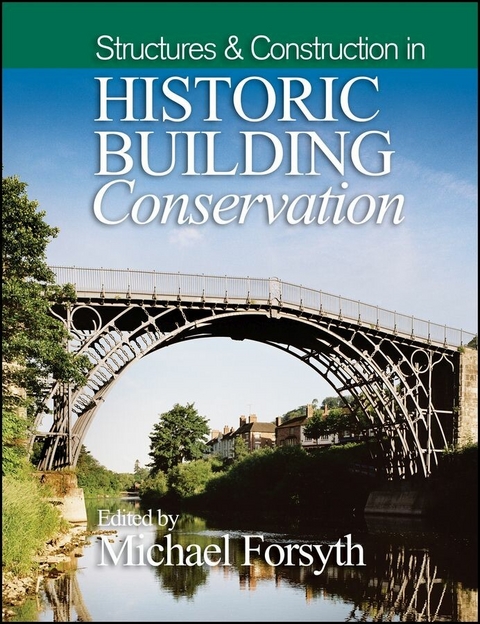
Structures and Construction in Historic Building Conservation (eBook)
John Wiley & Sons (Verlag)
978-0-470-69114-4 (ISBN)
- Understanding Historic Building Conservation
- Structures & Construction in Historic Building Conservation
- Materials & Skills for Historic Building Conservation
The series aims to introduce each aspect of conservation and to provide concise, basic and up-to-date knowledge for architects, surveyors and engineers as well as for commissioning client bodies, managers and advisors.
In each book, Michael Forsyth draws together chapters by leading architects, structural engineers and related professionals to reflect the interdisciplinary nature of conservation work. The books are structured to be of direct practical application, taking the reader through the process of historic building conservation and emphasising throughout the integrative teamwork involved.
This present volume - Structures & Construction in Historic Building Conservation - traces the history of structures in various materials and contains guidance on the survey, assessment and diagnosis of structures and the integration of building code requirements within the historic fabric.
It discusses conservation engineering philosophy, exposes the conflict between building codes and conservation legislation, and offers solutions. Leading-edge, on-site metric survey techniques are described and a range of structural advice is given, including methods of repair in relation to philosophical principles. Causes of induced movement in historic buildings are explained, together with basic soil mechanics and the assessment and diagnosis of structural failure. Chapters also cover the conservation of different types of construction: masonry, iron and steel, and concrete and reinforced concrete.
Fourteen chapters written by the experts present today's key issues in structures and construction for historic building conservation: Bill Blake, Michael Bussell, David Cook, Dina F. D'Ayala, Steve Emery, Michael Forsyth, Ian Hume, Peter Norris
Dr Michael Forsyth, Director of Studies in Historic Building Conservation, University of Bath, UK.
This book is the second in a series of volumes that combine conservation philosophy in the built environment with knowledge of traditional materials, and structural and constructional conservation techniques and technology: Understanding Historic Building Conservation Structures & Construction in Historic Building Conservation Materials & Skills for Historic Building Conservation The series aims to introduce each aspect of conservation and to provide concise, basic and up-to-date knowledge for architects, surveyors and engineers as well as for commissioning client bodies, managers and advisors. In each book, Michael Forsyth draws together chapters by leading architects, structural engineers and related professionals to reflect the interdisciplinary nature of conservation work. The books are structured to be of direct practical application, taking the reader through the process of historic building conservation and emphasising throughout the integrative teamwork involved. This present volume Structures & Construction in Historic Building Conservation - traces the history of structures in various materials and contains guidance on the survey, assessment and diagnosis of structures and the integration of building code requirements within the historic fabric. It discusses conservation engineering philosophy, exposes the conflict between building codes and conservation legislation, and offers solutions. Leading-edge, on-site metric survey techniques are described and a range of structural advice is given, including methods of repair in relation to philosophical principles. Causes of induced movement in historic buildings are explained, together with basic soil mechanics and the assessment and diagnosis of structural failure. Chapters also cover the conservation of different types of construction: masonry, iron and steel, and concrete and reinforced concrete. Fourteen chapters written by the experts present today's key issues in structures and construction for historic building conservation: Bill Blake, Michael Bussell, David Cook, Dina F. D'Ayala, Steve Emery, Michael Forsyth, Ian Hume, Peter Norris
Dr Michael Forsyth, Director of Studies in Historic Building Conservation, University of Bath, UK.
Preface vi
Contributors viii
1 What is conservation engineering? 1
Dina F. D'Ayala and Michael Forsyth
2 The philosophy of conservation engineering 12
Ian Hume
3 The Building Regulations and related legislation 19
Peter Norris
4 Metric survey techniques for historic buildings 41
Bill Blake
5 Investigating, monitoring and load testing historic structures 64
Ian Hume
6 Basic soil mechanics, foundations and repair of settlement damage 82
David Cook
7 Effects of induced movement 111
Michael Bussell
8 Repairs to historic structures 140
Ian Hume
9 Numerical modelling of masonry structures151
Dina F. D'Ayala
10 Use of iron and steel in buildings 173
Michael Bussell
11 Conservation of concrete and reinforced concrete 192
Michael Bussell
12 Fire safety and historic buildings 211
Steve Emery
13 The effects of road traffic vibration on historic buildings 223
Ian Hume
14 Scaffolding and temporary works for historic structures 226
Ian Hume
Index 232
"There are some excellent things in these volumes ... All very worthwhile stuff." (Context, September 2008)
| Erscheint lt. Verlag | 15.4.2008 |
|---|---|
| Reihe/Serie | Historic Building Conservation | Historic Building Conservation |
| Sprache | englisch |
| Themenwelt | Technik ► Architektur |
| Technik ► Bauwesen | |
| Schlagworte | Architecture • Architektur • Code • conflict between • conservation • conservation engineering • Construction • Denkmalpflege • Diagnosis • Historic • historic fabric • historic preservation • History • Integration • metric • Onsite • Range • Requirements • Structural • Structures • Survey • Survey Techniques • various materials |
| ISBN-10 | 0-470-69114-X / 047069114X |
| ISBN-13 | 978-0-470-69114-4 / 9780470691144 |
| Informationen gemäß Produktsicherheitsverordnung (GPSR) | |
| Haben Sie eine Frage zum Produkt? |
 PDF (Adobe DRM)
Kopierschutz: Adobe-DRM
Adobe-DRM ist ein Kopierschutz, der das eBook vor Mißbrauch schützen soll. Dabei wird das eBook bereits beim Download auf Ihre persönliche Adobe-ID autorisiert. Lesen können Sie das eBook dann nur auf den Geräten, welche ebenfalls auf Ihre Adobe-ID registriert sind.
Details zum Adobe-DRM
Dateiformat: PDF (Portable Document Format)
Mit einem festen Seitenlayout eignet sich die PDF besonders für Fachbücher mit Spalten, Tabellen und Abbildungen. Eine PDF kann auf fast allen Geräten angezeigt werden, ist aber für kleine Displays (Smartphone, eReader) nur eingeschränkt geeignet.
Systemvoraussetzungen:
PC/Mac: Mit einem PC oder Mac können Sie dieses eBook lesen. Sie benötigen eine
eReader: Dieses eBook kann mit (fast) allen eBook-Readern gelesen werden. Mit dem amazon-Kindle ist es aber nicht kompatibel.
Smartphone/Tablet: Egal ob Apple oder Android, dieses eBook können Sie lesen. Sie benötigen eine
Geräteliste und zusätzliche Hinweise
Buying eBooks from abroad
For tax law reasons we can sell eBooks just within Germany and Switzerland. Regrettably we cannot fulfill eBook-orders from other countries.
aus dem Bereich