Bias and Causation (eBook)
John Wiley & Sons (Verlag)
978-0-470-63109-6 (ISBN)
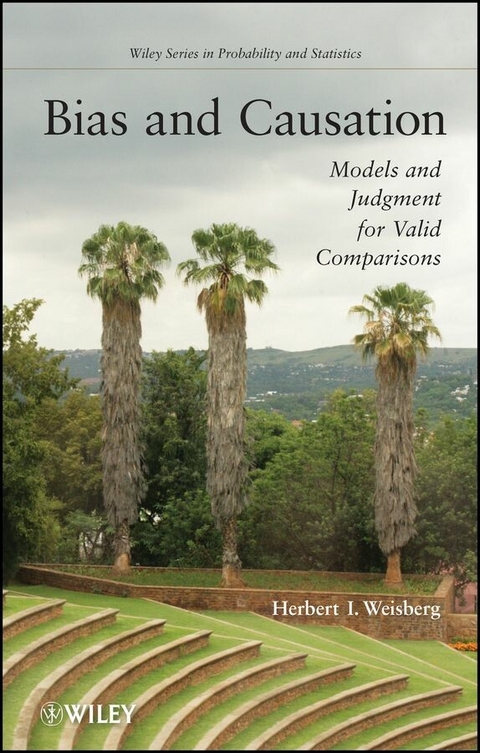
Do cell phones cause cancer? Can a new curriculum increase student achievement? Determining what the real causes of such problems are, and how powerful their effects may be, are central issues in research across various fields of study. Some researchers are highly skeptical of drawing causal conclusions except in tightly controlled randomized experiments, while others discount the threats posed by different sources of bias, even in less rigorous observational studies. Bias and Causation presents a complete treatment of the subject, organizing and clarifying the diverse types of biases into a conceptual framework. The book treats various sources of bias in comparative studies—both randomized and observational—and offers guidance on how they should be addressed by researchers.
Utilizing a relatively simple mathematical approach, the author develops a theory of bias that outlines the essential nature of the problem and identifies the various sources of bias that are encountered in modern research. The book begins with an introduction to the study of causal inference and the related concepts and terminology. Next, an overview is provided of the methodological issues at the core of the difficulties posed by bias. Subsequent chapters explain the concepts of selection bias, confounding, intermediate causal factors, and information bias along with the distortion of a causal effect that can result when the exposure and/or the outcome is measured with error. The book concludes with a new classification of twenty general sources of bias and practical advice on how mathematical modeling and expert judgment can be combined to achieve the most credible causal conclusions.
Throughout the book, examples from the fields of medicine, public policy, and education are incorporated into the presentation of various topics. In addition, six detailed case studies illustrate concrete examples of the significance of biases in everyday research.
Requiring only a basic understanding of statistics and probability theory, Bias and Causation is an excellent supplement for courses on research methods and applied statistics at the upper-undergraduate and graduate level. It is also a valuable reference for practicing researchers and methodologists in various fields of study who work with statistical data.
This book was selected as the 2011 Ziegel Prize Winner in Technometrics for the best book reviewed by the journal.
It is also the winner of the 2010 PROSE Award for Mathematics from The American Publishers Awards for Professional and Scholarly Excellence
HERBERT I. WEISBERG, PhD, is founder and President of Correlation Research Inc., a consulting firm that specializes in the application of statistics to various business and legal issues. Dr. Weisberg has over forty years of statistical consulting experience and has published numerous articles related to bias assessment and reduction.
A one-of-a-kind resource on identifying and dealing with bias in statistical research on causal effects Do cell phones cause cancer? Can a new curriculum increase student achievement? Determining what the real causes of such problems are, and how powerful their effects may be, are central issues in research across various fields of study. Some researchers are highly skeptical of drawing causal conclusions except in tightly controlled randomized experiments, while others discount the threats posed by different sources of bias, even in less rigorous observational studies. Bias and Causation presents a complete treatment of the subject, organizing and clarifying the diverse types of biases into a conceptual framework. The book treats various sources of bias in comparative studies both randomized and observational and offers guidance on how they should be addressed by researchers. Utilizing a relatively simple mathematical approach, the author develops a theory of bias that outlines the essential nature of the problem and identifies the various sources of bias that are encountered in modern research. The book begins with an introduction to the study of causal inference and the related concepts and terminology. Next, an overview is provided of the methodological issues at the core of the difficulties posed by bias. Subsequent chapters explain the concepts of selection bias, confounding, intermediate causal factors, and information bias along with the distortion of a causal effect that can result when the exposure and/or the outcome is measured with error. The book concludes with a new classification of twenty general sources of bias and practical advice on how mathematical modeling and expert judgment can be combined to achieve the most credible causal conclusions. Throughout the book, examples from the fields of medicine, public policy, and education are incorporated into the presentation of various topics. In addition, six detailed case studies illustrate concrete examples of the significance of biases in everyday research. Requiring only a basic understanding of statistics and probability theory, Bias and Causation is an excellent supplement for courses on research methods and applied statistics at the upper-undergraduate and graduate level. It is also a valuable reference for practicing researchers and methodologists in various fields of study who work with statistical data. This book was selected as the 2011 Ziegel Prize Winner in Technometrics for the best book reviewed by the journal. It is also the winner of the 2010 PROSE Award for Mathematics from The American Publishers Awards for Professional and Scholarly Excellence
HERBERT I. WEISBERG, PhD, is founder and President of Correlation Research Inc., a consulting firm that specializes in the application of statistics to various business and legal issues. Dr. Weisberg has over forty years of statistical consulting experience and has published numerous articles related to bias assessment and reduction.
Preface xi
1. What Is Bias? 1
1.1 Apples and Oranges, 2
1.2 Statistics vs. Causation, 3
1.3 Bias in the Real World, 6
Guidepost 1, 23
2. Causality and Comparative Studies 24
2.1 Bias and Causation, 24
2.2 Causality and Counterfactuals, 26
2.3 Why Counterfactuals? 32
2.4 Causal Effects, 33
2.5 Empirical Effects, 38
Guidepost 2, 46
3. Estimating Causal Effects 47
3.1 External Validity, 48
3.2 Measures of Empirical Effects, 50
3.3 Difference of Means, 52
3.4 Risk Difference and Risk Ratio, 55
3.5 Potential Outcomes, 57
3.6 Time-Dependent Outcomes, 60
3.7 Intermediate Variables, 63
3.8 Measurement of Exposure, 64
3.9 Measurement of the Outcome Value, 68
3.10 Confounding Bias, 70
Guidepost 3, 71
4. Varieties of Bias 72
4.1 Research Designs and Bias, 73
4.2 Bias in Biomedical Research, 81
4.3 Bias in Social Science Research, 85
4.4 Sources of Bias: A Proposed Taxonomy, 90
Guidepost 4, 92
5. Selection Bias 93
5.1 Selection Processes and Bias, 93
5.2 Traditional Selection Model: Dichotomous Outcome, 100
5.3 Causal Selection Model: Dichotomous Outcome, 102
5.4 Randomized Experiments, 104
5.5 Observational Cohort Studies, 108
5.6 Traditional Selection Model: Numerical Outcome, 111
5.7 Causal Selection Model: Numerical Outcome, 114
Guidepost 5, 121
Appendix, 122
6. Confounding: An Enigma? 126
6.1 What is the Real Problem? 127
6.2 Confounding and Extraneous Causes, 127
6.3 Confounding and Statistical Control, 131
6.4 Confounding and Comparability, 137
6.5 Confounding and the Assignment Mechanism, 139
6.6 Confounding and Model Specifi cation, 141
Guidepost 6, 144
7. Confounding: Essence, Correction, and Detection 145
7.1 Essence: The Nature of Confounding, 146
7.2 Correction: Statistical Control for Confounding, 172
7.3 Detection: Adequacy of Statistical Adjustment, 180
Guidepost 7, 191
Appendix, 192
8. Intermediate Causal Factors 195
8.1 Direct and Indirect Effects, 195
8.2 Principal Stratifi cation, 200
8.3 Noncompliance, 209
8.4 Attrition, 214
Guidepost 8, 215
9. Information Bias 217
9.1 Basic Concepts, 218
9.2 Classical Measurement Model: Dichotomous Outcome, 223
9.3 Causal Measurement Model: Dichotomous Outcome, 230
9.4 Classical Measurement Model: Numerical Outcome, 239
9.5 Causal Measurement Model: Numerical Outcome, 242
9.6 Covariates Measured with Error, 246
Guidepost 9, 250
10. Sources of Bias 252
10.1 Sampling, 254
10.2 Assignment, 260
10.3 Adherence, 266
10.4 Exposure Ascertainment, 269
10.5 Outcome Measurement, 273
Guidepost 10, 277
11. Contending with Bias 279
11.1 Conventional Solutions, 280
11.2 Standard Statistical Paradigm, 286
11.3 Toward a Broader Perspective, 288
11.4 Real-World Bias Revisited, 293
11.5 Statistics and Causation, 303
Glossary 309
Bibliography 321
Index 340
"The book combines a useful synthesis of the literature with an
original working through of issues related to bias and causal
inference. Anyone with a sustained interest in this topic will find
the book worth reading." (Journal of Educational and
Behavioral Statistics, May 2012)
"...the book provides a unified framework for understanding
issues of causal inference discussed differently across
disciplines...the book will also be of substantial interest to
methodologically minded readers working within specific disciplines
but interested in methodological literature from other
disciplines." (Journal of Educational and
Behavioral Statistics, May 2012)
"The book covers almost all the relevant biases that can be
present when designing and analyzing treatment effects in
comparative studies." (Journal of Biopharmaceutical
Statistics, January 2011)"A consultant who specializes in
applying statistics to various business and legal issues, Weisberg
explains approaches to bias and causal inference, a realm
statisticians have avoided until recently because it requires
intuitive skills beyond the pale of mathematics. He writes for
practicing researchers and methodologists and for students with a
reasonably solid grounding in basic statistics and research
methods." (SciTech Book News, December 2010)
| Erscheint lt. Verlag | 16.7.2010 |
|---|---|
| Reihe/Serie | Wiley Series in Probability and Statistics |
| Wiley Series in Probability and Statistics | Wiley Series in Probability and Statistics |
| Zusatzinfo | Drawings: 20 B&W, 0 Color; Tables: 0 B&W, 0 Color; Graphs: 0 B&W, 0 Color |
| Sprache | englisch |
| Themenwelt | Mathematik / Informatik ► Mathematik ► Statistik |
| Mathematik / Informatik ► Mathematik ► Wahrscheinlichkeit / Kombinatorik | |
| Technik | |
| Schlagworte | bias, bias and causation, bias of measurement, bias of sampling procedure, sources of bias, bias in statistics, statistical bias, causal analysis, how to minimize bias, how to eliminate bias, causal analysis, counterfactual thinking, randomized and observational bias • Biostatistics • Biostatistik • Mathematische Statistik • Methoden der Daten- u. Stichprobenerhebung • Probability & Mathematical Statistics • Statistics • Statistik • Survey Research Methods & Sampling • Wahrscheinlichkeitsrechnung u. mathematische Statistik |
| ISBN-10 | 0-470-63109-0 / 0470631090 |
| ISBN-13 | 978-0-470-63109-6 / 9780470631096 |
| Informationen gemäß Produktsicherheitsverordnung (GPSR) | |
| Haben Sie eine Frage zum Produkt? |
 PDF (Adobe DRM)
Kopierschutz: Adobe-DRM
Adobe-DRM ist ein Kopierschutz, der das eBook vor Mißbrauch schützen soll. Dabei wird das eBook bereits beim Download auf Ihre persönliche Adobe-ID autorisiert. Lesen können Sie das eBook dann nur auf den Geräten, welche ebenfalls auf Ihre Adobe-ID registriert sind.
Details zum Adobe-DRM
Dateiformat: PDF (Portable Document Format)
Mit einem festen Seitenlayout eignet sich die PDF besonders für Fachbücher mit Spalten, Tabellen und Abbildungen. Eine PDF kann auf fast allen Geräten angezeigt werden, ist aber für kleine Displays (Smartphone, eReader) nur eingeschränkt geeignet.
Systemvoraussetzungen:
PC/Mac: Mit einem PC oder Mac können Sie dieses eBook lesen. Sie benötigen eine
eReader: Dieses eBook kann mit (fast) allen eBook-Readern gelesen werden. Mit dem amazon-Kindle ist es aber nicht kompatibel.
Smartphone/Tablet: Egal ob Apple oder Android, dieses eBook können Sie lesen. Sie benötigen eine
Geräteliste und zusätzliche Hinweise
Buying eBooks from abroad
For tax law reasons we can sell eBooks just within Germany and Switzerland. Regrettably we cannot fulfill eBook-orders from other countries.
aus dem Bereich