Modeling and Simulation Fundamentals (eBook)
John Wiley & Sons (Verlag)
978-0-470-59061-4 (ISBN)
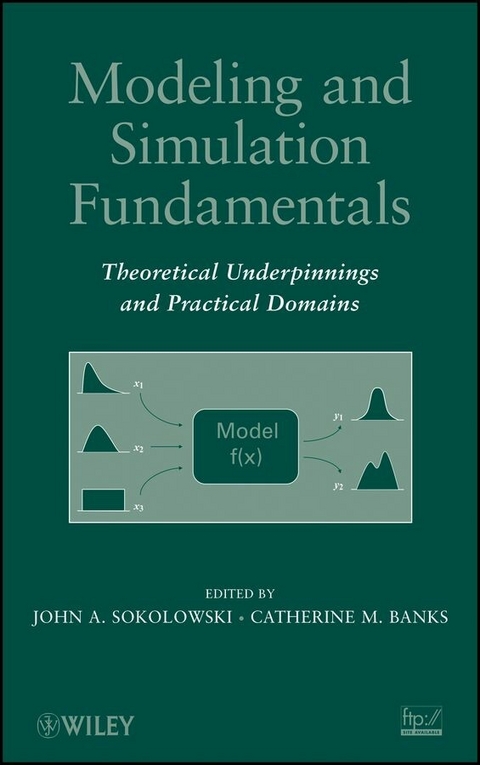
Modeling and simulation has become an integral part of research and development across many fields of study, having evolved from a tool to a discipline in less than two decades. Modeling and Simulation Fundamentals offers a comprehensive and authoritative treatment of the topic and includes definitions, paradigms, and applications to equip readers with the skills needed to work successfully as developers and users of modeling and simulation.
Featuring contributions written by leading experts in the field, the book's fluid presentation builds from topic to topic and provides the foundation and theoretical underpinnings of modeling and simulation. First, an introduction to the topic is presented, including related terminology, examples of model development, and various domains of modeling and simulation. Subsequent chapters develop the necessary mathematical background needed to understand modeling and simulation topics, model types, and the importance of visualization. In addition, Monte Carlo simulation, continuous simulation, and discrete event simulation are thoroughly discussed, all of which are significant to a complete understanding of modeling and simulation. The book also features chapters that outline sophisticated methodologies, verification and validation, and the importance of interoperability. A related FTP site features color representations of the book's numerous figures.
Modeling and Simulation Fundamentals encompasses a comprehensive study of the discipline and is an excellent book for modeling and simulation courses at the upper-undergraduate and graduate levels. It is also a valuable reference for researchers and practitioners in the fields of computational statistics, engineering, and computer science who use statistical modeling techniques.
JOHN A. SOKOLOWSKI, PhD, is Research Professor and Director of Research at the Virginia Modeling, Analysis and Simulation Center at Old Dominion University. He is the coeditor of Principles of Modeling and Simulation: A Multidisciplinary Approach and coauthor of Modeling and Simulation for Analyzing Global Events, both published by Wiley. Dr. Sokolowski currently focuses his research on computational modeling of human and social behavior.
CATHERINE M. BANKS, PhD, is Research Assistant Professor at the Virginia Modeling, Analysis and Simulation Center at Old Dominion University. She is the coeditor of Principles of Modeling and Simulation: A Multidisciplinary Approach and coauthor of Modeling and Simulation for Analyzing Global Events, both published by Wiley. Dr. Banks's current research interests include modeling states and their varied histories of revolution and insurgency, political economy and state volatility, and theoretical modeling concepts.
An insightful presentation of the key concepts, paradigms, and applications of modeling and simulation Modeling and simulation has become an integral part of research and development across many fields of study, having evolved from a tool to a discipline in less than two decades. Modeling and Simulation Fundamentals offers a comprehensive and authoritative treatment of the topic and includes definitions, paradigms, and applications to equip readers with the skills needed to work successfully as developers and users of modeling and simulation. Featuring contributions written by leading experts in the field, the book's fluid presentation builds from topic to topic and provides the foundation and theoretical underpinnings of modeling and simulation. First, an introduction to the topic is presented, including related terminology, examples of model development, and various domains of modeling and simulation. Subsequent chapters develop the necessary mathematical background needed to understand modeling and simulation topics, model types, and the importance of visualization. In addition, Monte Carlo simulation, continuous simulation, and discrete event simulation are thoroughly discussed, all of which are significant to a complete understanding of modeling and simulation. The book also features chapters that outline sophisticated methodologies, verification and validation, and the importance of interoperability. A related FTP site features color representations of the book's numerous figures. Modeling and Simulation Fundamentals encompasses a comprehensive study of the discipline and is an excellent book for modeling and simulation courses at the upper-undergraduate and graduate levels. It is also a valuable reference for researchers and practitioners in the fields of computational statistics, engineering, and computer science who use statistical modeling techniques.
JOHN A. SOKOLOWSKI, PhD, is Research Professor and Director of Research at the Virginia Modeling, Analysis and Simulation Center at Old Dominion University. He is the coeditor of Principles of Modeling and Simulation: A Multidisciplinary Approach and coauthor of Modeling and Simulation for Analyzing Global Events, both published by Wiley. Dr. Sokolowski currently focuses his research on computational modeling of human and social behavior. CATHERINE M. BANKS, PhD, is Research Assistant Professor at the Virginia Modeling, Analysis and Simulation Center at Old Dominion University. She is the coeditor of Principles of Modeling and Simulation: A Multidisciplinary Approach and coauthor of Modeling and Simulation for Analyzing Global Events, both published by Wiley. Dr. Banks's current research interests include modeling states and their varied histories of revolution and insurgency, political economy and state volatility, and theoretical modeling concepts.
Preface.
Contributors.
1 Introduction to Modeling and
Simulation (Catherine M. Banks).
M&S.
M&S Characteristics and Descriptors.
M&S Categories.
Conclusion.
References.
2 Statistical Concepts for Discrete Event
Simulation (Roland R. Mielke).
Probability.
Simulation Basics.
Input Data Modeling.
Output Data Analysis.
Conclusion.
References.
3 Discrete-Event Simulation (Rafael Diaz and
Joshua G. Behr).
Queuing System Model Components.
Simulation Methodology.
DES Example.
Hand Simulation--Spreadsheet Implementation.
Arena Simulation.
Conclusion.
References.
4 Modeling Continuous Systems (Wesley N.
Colley).
System Class.
Modeling and Simulation (M&S) Strategy.
Modeling Approach.
Model Examples.
Simulating Continuous Systems.
Simulation Implementation.
Conclusion.
References.
5 Monte Carlo Simulation (John A.
Sokolowski).
The Monte Carlo Method.
Sensitivity Analysis.
Conclusion.
References.
6 Systems Modeling: Analysis and Operations
Research (Frederic D. McKenziei).
System Model Types.
Modeling Methodologies and Tools.
Analysis of Modeling and Simulation (M&S).
OR Methods.
Conclusion.
References.
Further Readings.
7 Visualization (Yuzhong Shen).
Computer Graphics Fundamentals.
Visualization Software and Tools.
Case Studies.
Conclusion.
References.
8 M&S Methodologies: A Systems Approach to the Social
Sciences (Barry G. Silverman, Gnana K. Bharathy,
Benjamin Nye, G. Jiyun Kim, Mark Roddy, and Mjumbe Poe).
Simulating State and Substate Actors with CountrySim:
Synthesizing Theories Across the Social Sciences.
The CountrySim Application and Sociocultural Game Results.
Conclusions and the Way Forward.
References.
9 Modeling Human Behavior (Yiannis Papelis and
Poornima Madhavan).
Behavioral Modeling at the Physical Level.
Behavioral Modeling at the Tactical and Strategic Level.
Techniques for Human Behavior Modeling.
Human Factors.
Human-Computer Interaction.
Conclusion.
References.
10 Verifi cation, Validation, and
Accreditation (Mikel D. Petty).
Motivation.
Background Defi nitions.
VV&A Defi nitions.
V&V as Comparisons.
Performing VV&A.
V&V Methods.
VV&A Case Studies.
Conclusion.
Acknowledgments.
References.
11 An Introduction to Distributed
Simulation (Gabriel A. Wainer and Khaldoon
Al-Zoubi).
Trends and Challenges of Distributed Simulation.
A Brief History of Distributed Simulation.
Synchronization Algorithms for Parallel and Distributed
Simulation.
Distributed Simulation Middleware.
Conclusion.
References.
12 Interoperability and Composability (Andreas
Tolk).
Defining Interoperability and Composability.
Current Interoperability Standard Solutions.
Engineering Methods Supporting Interoperation and
Composition.
Conclusion.
References.
Further Readings.
Index.
"This text provides a well-designed overview of M&S as a
discipline useful for graduate students with engineering,
mathematics or computer science background and for specialists
interested in fundamental principles of M&S, its further
development and applications." (Zentralblatt MATH,
2010)
| Erscheint lt. Verlag | 13.7.2010 |
|---|---|
| Zusatzinfo | Charts: 44 B&W, 0 Color; Photos: 14 B&W, 0 Color; Drawings: 37 B&W, 0 Color; Screen captures: 15 B&W, 0 Color; Graphs: 65 B&W, 0 Color |
| Sprache | englisch |
| Themenwelt | Mathematik / Informatik ► Mathematik ► Angewandte Mathematik |
| Mathematik / Informatik ► Mathematik ► Statistik | |
| Mathematik / Informatik ► Mathematik ► Wahrscheinlichkeit / Kombinatorik | |
| Technik | |
| Schlagworte | Computational & Graphical Statistics • Electrical & Electronics Engineering • Elektrotechnik u. Elektronik • Mathematical Modeling • Mathematics • Mathematik • Mathematische Modellierung • modeling, simulation, modeling and simulation, modeling paradigms, simulation paradigms, modeling applications, simulation applications, Visualization • Modell (Math.) • Rechnergestützte u. graphische Statistik • Rechnergestützte u. graphische Statistik • Statistics • Statistik • Systems Engineering & Management • Systemtechnik u. -management • Verification, Validation, and Accreditation, human behavior modeling, time advance strategies, agent-based modeling, visualization techniques and tools, spreadsheet simulation, Discrete Event Simulation, Continuous Simulation |
| ISBN-10 | 0-470-59061-0 / 0470590610 |
| ISBN-13 | 978-0-470-59061-4 / 9780470590614 |
| Informationen gemäß Produktsicherheitsverordnung (GPSR) | |
| Haben Sie eine Frage zum Produkt? |
 PDF (Adobe DRM)
Kopierschutz: Adobe-DRM
Adobe-DRM ist ein Kopierschutz, der das eBook vor Mißbrauch schützen soll. Dabei wird das eBook bereits beim Download auf Ihre persönliche Adobe-ID autorisiert. Lesen können Sie das eBook dann nur auf den Geräten, welche ebenfalls auf Ihre Adobe-ID registriert sind.
Details zum Adobe-DRM
Dateiformat: PDF (Portable Document Format)
Mit einem festen Seitenlayout eignet sich die PDF besonders für Fachbücher mit Spalten, Tabellen und Abbildungen. Eine PDF kann auf fast allen Geräten angezeigt werden, ist aber für kleine Displays (Smartphone, eReader) nur eingeschränkt geeignet.
Systemvoraussetzungen:
PC/Mac: Mit einem PC oder Mac können Sie dieses eBook lesen. Sie benötigen eine
eReader: Dieses eBook kann mit (fast) allen eBook-Readern gelesen werden. Mit dem amazon-Kindle ist es aber nicht kompatibel.
Smartphone/Tablet: Egal ob Apple oder Android, dieses eBook können Sie lesen. Sie benötigen eine
Geräteliste und zusätzliche Hinweise
Buying eBooks from abroad
For tax law reasons we can sell eBooks just within Germany and Switzerland. Regrettably we cannot fulfill eBook-orders from other countries.
aus dem Bereich