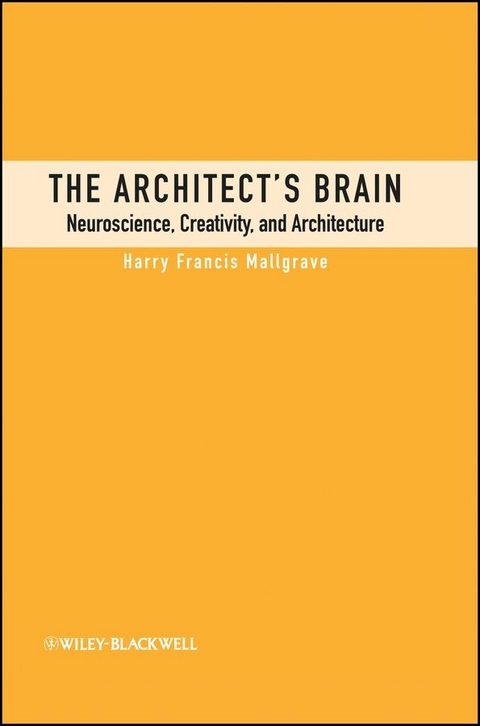
The Architect's Brain (eBook)
John Wiley & Sons (Verlag)
978-1-4443-1728-2 (ISBN)
- Explores various moments of architectural thought over the last 500 years as a cognitive manifestation of philosophical, psychological, and physiological theory
- Looks at architectural thought through the lens of the remarkable insights of contemporary neuroscience, particularly as they have advanced within the last decade
- Demonstrates the neurological justification for some very timeless architectural ideas, from the multisensory nature of the architectural experience to the essential relationship of ambiguity and metaphor to creative thinking
Harry Francis Mallgrave is a professor of architecture at Illinois Institute of Technology and has enjoyed a distinguished career as an award-winning scholar, translator, and architect. His most recent publications include Modern Architectural Theory: A Historical Survey, 1673–1968, and the two-volume Architectural Theory: An Anthology from Vitruvius to 2005 (Wiley-Blackwell 2008). His forthcoming Introduction to Architectural Theory: 1968 to the Present. A Critical History will be published by Wiley-Blackwell in 2010.
The Architect's Brain: Neuroscience, Creativity, and Architecture is the first book to consider the relationship between the neurosciences and architecture, offering a compelling and provocative study in the field of architectural theory. Explores various moments of architectural thought over the last 500 years as a cognitive manifestation of philosophical, psychological, and physiological theory Looks at architectural thought through the lens of the remarkable insights of contemporary neuroscience, particularly as they have advanced within the last decade Demonstrates the neurological justification for some very timeless architectural ideas, from the multisensory nature of the architectural experience to the essential relationship of ambiguity and metaphor to creative thinking
Harry Francis Mallgrave is a professor of architecture at Illinois Institute of Technology and has enjoyed a distinguished career as an award-winning scholar, translator, and architect. His most recent publications include Modern Architectural Theory: A Historical Survey, 1673-1968, and the two-volume Architectural Theory: An Anthology from Vitruvius to 2005 (Wiley-Blackwell 2008). His forthcoming Introduction to Architectural Theory: 1968 to the Present. A Critical History will be published by Wiley-Blackwell in 2010.
Introduction
Part One: Historical Essays
1. The Humanist Brain (Alberti, Vitruvius, and
Leonardo).
2. The Enlightened Brain (Perrault, Laugier, and Le
Roy).
3. The Sensational Brain (Burke, Price, and Knight).
4. The Transcendental Brain (Kant and Schopenhauer).
5. The Animate Brain (Schinkel, Bötticher, and
Semper).
6. The Empathetic Brain (Vischer, Wölfflin, and
Göller).
7. The Gestalt Brain (The Dynamics of the Sensory
Field).
8. The Neurological Brain (Hayek, Hebb, and Neutra).
9. The Phenomenal Brain (Merleau-Ponty, Rasmussen, and
Pallasmaa).
Part Two: Neuroscience and Architecture.
10. Anatomy: Architecture of the Brain.
11. Ambiguity: Architecture of Vision.
12. Metaphor: Architecture of Embodiment.
13. Hapticity: Architecture of the Senses.
14. Epilogue: The Architect's Brain.
Endnotes.
Bibliography.
Index.
"Hence these two books from the same publisher and by the same
author, Harry Francis Mallgrave, sole writer of the former and
co-author with David Goodman of the second book, make a valuable
contribution to this growing field of knowledge." (Architectural
Review, 1 July 2011)
"Since I studied architecture ... I always heard the diatribe
about if architecture is an art or a science, I personally believe
is both. If you're interested in both architecture and
science be sure to grab a copy of this interesting book."
(Eclectic Me Blog, April 2010)
"A gripping interpretation of how the latest advances in
neuroscience enlarge our understanding of architecture from
Alberti's belief that a building is a 'form of
body' to the computer whose dominance in architecture
Mallgrave challenges." David Watkin, University of Cambridge
| Erscheint lt. Verlag | 19.1.2010 |
|---|---|
| Sprache | englisch |
| Themenwelt | Technik ► Architektur |
| Schlagworte | Architect • architectural theory • Architecture • Architektur • Architektur / Theorie • Basis • biological • brain • Classical • compelling suggestions • Design • FACT • Foundation • highly • Issue • Neuroscience • New • offered • perspectivesthe • Phenomenal • possess • Renaissance • richly • specialized • Study • Today |
| ISBN-10 | 1-4443-1728-8 / 1444317288 |
| ISBN-13 | 978-1-4443-1728-2 / 9781444317282 |
| Informationen gemäß Produktsicherheitsverordnung (GPSR) | |
| Haben Sie eine Frage zum Produkt? |
 PDF (Adobe DRM)
Kopierschutz: Adobe-DRM
Adobe-DRM ist ein Kopierschutz, der das eBook vor Mißbrauch schützen soll. Dabei wird das eBook bereits beim Download auf Ihre persönliche Adobe-ID autorisiert. Lesen können Sie das eBook dann nur auf den Geräten, welche ebenfalls auf Ihre Adobe-ID registriert sind.
Details zum Adobe-DRM
Dateiformat: PDF (Portable Document Format)
Mit einem festen Seitenlayout eignet sich die PDF besonders für Fachbücher mit Spalten, Tabellen und Abbildungen. Eine PDF kann auf fast allen Geräten angezeigt werden, ist aber für kleine Displays (Smartphone, eReader) nur eingeschränkt geeignet.
Systemvoraussetzungen:
PC/Mac: Mit einem PC oder Mac können Sie dieses eBook lesen. Sie benötigen eine
eReader: Dieses eBook kann mit (fast) allen eBook-Readern gelesen werden. Mit dem amazon-Kindle ist es aber nicht kompatibel.
Smartphone/Tablet: Egal ob Apple oder Android, dieses eBook können Sie lesen. Sie benötigen eine
Geräteliste und zusätzliche Hinweise
Buying eBooks from abroad
For tax law reasons we can sell eBooks just within Germany and Switzerland. Regrettably we cannot fulfill eBook-orders from other countries.
aus dem Bereich