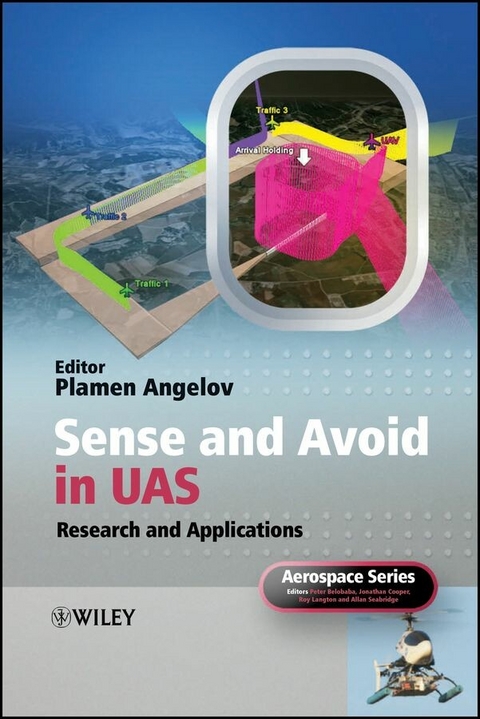
Sense and Avoid in UAS (eBook)
John Wiley & Sons (Verlag)
978-1-119-96784-2 (ISBN)
There is increasing interest in the potential of UAV (Unmanned Aerial Vehicle) and MAV (Micro Air Vehicle) technology and their wide ranging applications including defence missions, reconnaissance and surveillance, border patrol, disaster zone assessment and atmospheric research. High investment levels from the military sector globally is driving research and development and increasing the viability of autonomous platforms as replacements for the remotely piloted vehicles more commonly in use.
UAV/UAS pose a number of new challenges, with the autonomy and in particular collision avoidance, detect and avoid, or sense and avoid, as the most challenging one, involving both regulatory and technical issues.
Sense and Avoid in UAS: Research and Applications covers the problem of detect, sense and avoid in UAS (Unmanned Aircraft Systems) in depth and combines the theoretical and application results by leading academics and researchers from industry and academia.
Key features:
- Presents a holistic view of the sense and avoid problem in the wider application of autonomous systems
- Includes information on human factors, regulatory issues and navigation, control, aerodynamics and physics aspects of the sense and avoid problem in UAS
- Provides professional, scientific and reliable content that is easy to understand, and
- Includes contributions from leading engineers and researchers in the field
There is increasing interest in the potential of UAV (Unmanned Aerial Vehicle) and MAV (Micro Air Vehicle) technology and their wide ranging applications including defence missions, reconnaissance and surveillance, border patrol, disaster zone assessment and atmospheric research. High investment levels from the military sector globally is driving research and development and increasing the viability of autonomous platforms as replacements for the remotely piloted vehicles more commonly in use. UAV/UAS pose a number of new challenges, with the autonomy and in particular collision avoidance, detect and avoid, or sense and avoid, as the most challenging one, involving both regulatory and technical issues. Sense and Avoid in UAS: Research and Applications covers the problem of detect, sense and avoid in UAS (Unmanned Aircraft Systems) in depth and combines the theoretical and application results by leading academics and researchers from industry and academia. Key features: Presents a holistic view of the sense and avoid problem in the wider application of autonomous systems Includes information on human factors, regulatory issues and navigation, control, aerodynamics and physics aspects of the sense and avoid problem in UAS Provides professional, scientific and reliable content that is easy to understand, and Includes contributions from leading engineers and researchers in the field Sense and Avoid in UAS: Research and Applications is an invaluable source of original and specialised information. It acts as a reference manual for practising engineers and advanced theoretical researchers and also forms a useful resource for younger engineers and postgraduate students. With its credible sources and thorough review process, Sense and Avoid in UAS: Research and Applications provides a reliable source of information in an area that is fast expanding but scarcely covered.
Plamen Parvanov Angelov, Lancaster University, UK Plamen Parvanov is a senior lecturer in the School of Computing and Communications at Lancaster University. He is an Associate Editor of three international journals and the founding co-Editor-in-Chief of the Springer journal Evolving Systems. He is also the Vice Chair of the Technical Committee on Standards, Computational Intelligence Society, IEEE and co-Chair of several IEEE conferences. His research in UAV/UAS is often publicised in external publications, e.g. the prestigious Computational Intelligence Magazine; Aviation Week, Flight Global, Airframer, Flight International, etc. His research focuses on computational intelligence and evolving systems, and his research in to autonomous systems has received worldwide recognition. As the Principle Investigator at Lancaster University for a team working on UAV Sense and Avoid fortwo projects of ASTRAEA his work was recognised by 'The Engineer Innovation and Technology 2008 Award in two categories: i) Aerospace and Defence and ii) The Special Award which is an outstanding achievement.
"This book is a good introductory book for anyone
interested in unmanned aerial systems and presents in a very
comprehensive manner the challenges associated with the basic task
of sense and avoid." (The
Aeronautical Journal, 1 January
2014)
About the Contributors
Chris Baber
Chris Baber is the Chair of Pervasive and Ubiquitous Computing at the University of Birmingham. His research interests focus on the many ways in which computing and communications technologies are becoming embedded in the environment around us and the things we use on a daily basis. Not only do we have significant computing power in the mobile phone in our pocket, but, increasingly, other domestic and personal products are gaining similar capabilities. Chris is interested in how such technologies will develop and how they will share the information they collect, and also in how these developments will affect human behaviour.
Cristina Barrado
Cristina Barrado was born in Barcelona in 1965 and is a computer science engineer from the Barcelona School of Informatics, which belongs to the Technical University of Catalonia (UPC). She also holds a PhD in Computer Architecture from the same university. Dr Barrado has been working with UPC since 1989 and is currently an associate professor at the School of Telecommunications and Aerospace Engineering of Castelldefels (Escola d'Enginyeria de Telecommunicació i Aeroespacial de Castelldefels, EETAC). Her current research interests are in the area of the UAS civil mission, including payload processing, avionics CNS capabilities and non-segregated airspace integration.
Richard Baumeister
Richard Baumeister from the Boeing Company has over 30 years' experience performing system engineering and management of complex missile and space programs. From 1979 to 1982 Rich was the lead mission planner and orbital/software analyst for the F-15 ASAT Program. In 1982--1986 Rich helped supervise the integration and operations of the Prototype Mission Operations Center into the NORAD Cheyenne Mountain Complex.
From 1987 to 1995 Rich was the Systems Engineering Manager for a classified complex national space system. During this period Rich oversaw the successful development of innovative techniques for the detection and resolution of system anomalies.
From 1996 to 2004 Rich was Director of Product Development for RESOURCE21 LLC, a Boeing-funded joint venture. Rich led the technical research and development of aerial and space-based remote sensing-based algorithms and associated information products for Production Agriculture, Commodities, Crop Insurance, and Forestry markets. He directed and participated in the creation of numerous proprietary research papers/presentations dealing with the detection of various crop stresses using multi-spectral imagery. Rich successfully managed the development of an atmospheric correction process and decision support tools in support of a commercial collection campaign.
From 2005 to the present Rich has been supporting automated air traffic control concepts and algorithms, and was the lead engineer for Boeing on the recently completed Smart Skies program.
Rich received his PhD in Mathematics/Physics from the University of Arizona in 1977 and was an Assistant Professor of Mathematics at Arizona State University prior to joining the Boeing company.
Marie Cahillane
Marie received her first degree, majoring in psychology, in 2003 from Bath Spa University and an MSc in research methods in psychology in 2005 from the University of Bristol. Marie was awarded her PhD in cognitive psychology in 2008, from the University of the West of England. Whilst conducting her doctoral research she lectured in psychology at Bath Spa University. Marie's research interests and expertise are in cognition and perception and her teaching specialisms include research methods in psychology, in particular quantitative methods and experimental design. Marie joined Cranfield Defence and Security as a Research Fellow in 2008 and is now a Lecturer in Applied Cognitive Psychology. At Cranfield Defence and Security, Marie leads several human factors research projects within the military domain. Research includes the acquisition and retention of skills required to operate systems and human interaction with complex systems.
Luis Delgado
Luis Delgado is an aeronautical engineer from the National School for Civil Aviation (École Nationale de l'Aviation Civile or ENAC) in Toulouse, France. He also holds a degree in Computer Science Engineering from the Barcelona School of Informatics (Facultat d'Informàtica de Barcelona, FIB) which belongs to the Technical University of Catalonia (Universitat Politècnica de Catalunya, UPC). He earned both degrees in 2007. His research interests include improving the performance and efficiency of the air traffic management (ATM) system and flexible, reliable and cost-efficient unmanned aircraft systems (UAS) operations in civil airspace.
He has been working with UPC since 2007 and currently is an assistant professor at EETAC. He is also a PhD student of the Aerospace Science and Technology doctorate program from UPC and expects to graduate in 2012.
Jason J. Ford
Jason J. Ford was born in Canberra, Australia in 1971. He received the BSc and BE degrees in 1995 and a PhD in 1998 from the Australian National University, Canberra. He was appointed a research scientist at the Australian Defence Science and Technology Organisation in 1998, and then promoted to a senior research scientist in 2000. He has held research fellow positions at the University of New South Wales, at the Australian Defence Force Academy in 2004 and at the Queensland University of Technology in 2005. He has held an academic appointment at the Queensland University of Technology since 2007. He has had academic visits to the Information Engineering Department at the Chinese University of Hong Kong in 2000 and to the University of New South Wales at the Australian Defence Force Academy from 2002 to 2004. He was awarded the 2011 Spitfire Memorial Defence Fellowship. His interests include signal processing and control for aerospace.
Štpán Kopiva
Štpán Kopiva is a researcher and PhD student at the Agent Technology Center of the Gerstner Laboratory, Department of Cybernetics, Czech Technical University. Štpán graduated in 2009 from Imperial College London with an MSc degree in Advanced Computing. Prior to his current position, he worked as a programmer for the major POS systems manufacturer and researcher ATG.
Štpǎn currently works on the AgentFly project -- large-scale simulation and control in the air-traffic domain. His main research interests are logics and formal methods for multi-agent systems, classical planning, and large-scale simulations.
John Lai
John Lai was born in Taipei, Taiwan, in 1984. He received the BE (First Class Honours) degree in Aerospace Avionics in 2005 and a PhD in 2010, both from the Queensland University of Technology (QUT), Brisbane, Australia. Since obtaining his PhD, he has held a research fellow position at the Australian Research Centre for Aerospace Automation (ARCAA) -- a joint research collaboration between the Commonwealth Scientific and Industrial Research Organisation (CSIRO) and QUT.
Juan Manuel Lema
Juan Manuel Lema was born in Montevideo, Uruguay in 1985 and is a technical telecommunications engineer from EETAC. He also holds a Master of Science in Telecommunications Engineering and Management. Mr Lema began his collaboration with the ICARUS group in January 2007, where he is a junior researcher. Currently he is a PhD student in the Computer Architecture doctoral program about UAS mission management.
George Limnaios
George Limnaios is a Major(Eng) at Hellenic Airforce. Since 1996 when he graduated from Hellenic Airforce Academy as an Avionics and Telecommunications Engineer he has been involved in the maintenance and support of A-7 and F-16 aircrafts serving the latter as a Technical Advisor and head of Quality Assurance Department. He is on educational leave seeking a post-graduate degree at the Technical University of Crete (Department of Electronic and Computer Engineering). His research interests include Renewable Energy Systems, Fault Tolerant Control, Fault Detection and Isolation and Unmanned Systems.
Luis Mejias
Luis Mejias received a degree in Electronic Engineering in November 1999 from UNEXPO (Venezuela), an MSc in Network and Telecommunication Systems from ETSIT-Universidad Politecnica de Madrid and a PhD from ETSII-Universidad Politecnica de Madrid. He has gained extensive experience with UAVs, investigating computer vision techniques for control and navigation. Currently, he is a lecturer in Aerospace Avionics at Queensland University of Technology, and a researcher at ARCAA.
Caroline Morin
Caroline obtained an M.A. and a Ph.D. in cognitive psychology from Laval University (Canada). She moved to the UK to take up a research fellowship at the University of Warwick where she was looking at the interaction between time and memory. In 2008, Caroline joined Cranfield University as a Research Fellow where she is leading a number of projects on Human Factors with a military population. Caroline's expertise is in human memory, categorization, time perception, decision making and human factors.
Peter O’Shea
Peter O'Shea is a Professor of Electrical Engineering at the Queensland University of Technology (QUT), Australia. He received the BE, DipEd and PhD from the University of Queensland, and then worked as an engineer at the Overseas Telecommunications Commission for three years. He has held...
| Erscheint lt. Verlag | 16.3.2012 |
|---|---|
| Reihe/Serie | Aerospace Series |
| Aerospace Series (PEP) | Aerospace Series (PEP) |
| Mitarbeit |
Herausgeber (Serie): Peter Belobaba, Jonathan Cooper, Roy Langton, Allan Seabridge |
| Sprache | englisch |
| Themenwelt | Technik ► Fahrzeugbau / Schiffbau |
| Technik ► Luft- / Raumfahrttechnik | |
| Technik ► Maschinenbau | |
| Schlagworte | Aeronautic & Aerospace Engineering • drone • drones • Luft- u. Raumfahrttechnik • Maschinenbau • mechanical engineering • Statistics • Statistics for Social Sciences • Statistik • Statistik in den Sozialwissenschaften • UAV • Unbemanntes Luftfahrzeug • Unmanned Aerial Vehicles |
| ISBN-10 | 1-119-96784-8 / 1119967848 |
| ISBN-13 | 978-1-119-96784-2 / 9781119967842 |
| Informationen gemäß Produktsicherheitsverordnung (GPSR) | |
| Haben Sie eine Frage zum Produkt? |
 EPUB (Adobe DRM)
Kopierschutz: Adobe-DRM
Adobe-DRM ist ein Kopierschutz, der das eBook vor Mißbrauch schützen soll. Dabei wird das eBook bereits beim Download auf Ihre persönliche Adobe-ID autorisiert. Lesen können Sie das eBook dann nur auf den Geräten, welche ebenfalls auf Ihre Adobe-ID registriert sind.
Details zum Adobe-DRM
Dateiformat: EPUB (Electronic Publication)
EPUB ist ein offener Standard für eBooks und eignet sich besonders zur Darstellung von Belletristik und Sachbüchern. Der Fließtext wird dynamisch an die Display- und Schriftgröße angepasst. Auch für mobile Lesegeräte ist EPUB daher gut geeignet.
Systemvoraussetzungen:
PC/Mac: Mit einem PC oder Mac können Sie dieses eBook lesen. Sie benötigen eine
eReader: Dieses eBook kann mit (fast) allen eBook-Readern gelesen werden. Mit dem amazon-Kindle ist es aber nicht kompatibel.
Smartphone/Tablet: Egal ob Apple oder Android, dieses eBook können Sie lesen. Sie benötigen eine
Geräteliste und zusätzliche Hinweise
Buying eBooks from abroad
For tax law reasons we can sell eBooks just within Germany and Switzerland. Regrettably we cannot fulfill eBook-orders from other countries.
aus dem Bereich