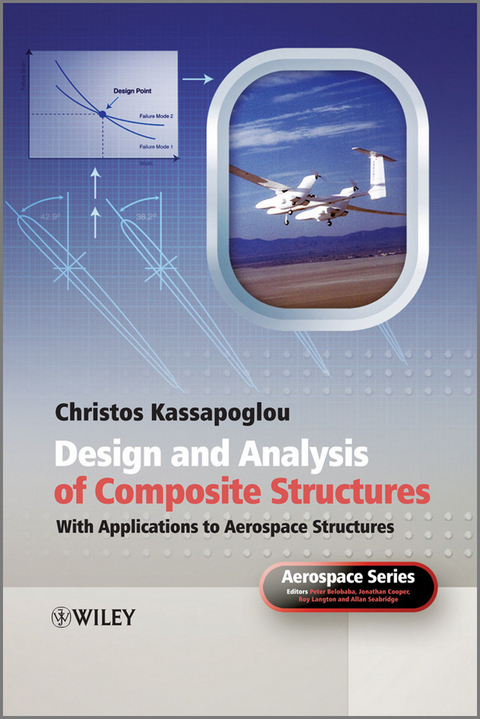
Design and Analysis of Composite Structures (eBook)
314 Seiten
Wiley (Verlag)
978-1-119-95706-5 (ISBN)
Starting with basic mathematical derivation followed by simplifications used in real-world design, Design and Analysis of Composite Structures presents the level of accuracy and range of applicability of each method. Examples taken from actual applications are worked out in detail to show how the concepts are applied, solving the same design problem with different methods based on different drivers (e.g. cost or weight) to show how the final configuration changes as the requirements and approach change.
- Provides a toolkit of analysis and design methods to most situations encountered in practice, as well as analytical frameworks and the means to solving them for tackling less frequent problems.
- Presents solutions applicable to optimization schemes without having to run finite element models at each iteration, speeding up the design process and allowing examination of several more alternatives than traditional approaches.
- Includes guidelines showing how decisions based on manufacturing considerations affect weight and how weight optimization may adversely affect the cost.
- Accompanied by a website at www.wiley.com/go/kassapoglou hosting lecture slides and solutions to the exercises for instructors.
Preface
1. Applications of advanced composites in aircraft structures
References
2. Cost of Composites- A qualitative discussion
2.1 Recurring cost
2.2 Non-recurring cost
2.3 Technology selection
2.4 Summary and conclusions
Exercises
References
3. Review of Classical Laminated-Plate Theory
3.1 Composite Materials - Definitions, symbology and terminology
3.2 Constitutive equations in three dimensions
3.3 Constitutive equations in two dimensions - Plane stress
Exercises
References
4. Review of laminate strength and failure criteria
4.1 Maximum stress failure theory
4.2 Maximum strain failure theory
4.3 Tsai-Hill failure theory
4.4 Tsai-Wu failure theory
4.5 Other failure theories
References
5. Composite structural components and mathematical formulation
5.1 Overview of composite airframe
5.2 Governing equations
5.3 Reductions of governing equations - Applications to specific problems
5.4 Energy methods
Exercises
References
6. Buckling of composite plates
6.1 Buckling of rectangular composite plate under biaxial loading
6.2 Buckling of rectangular composite plate under uniaxial compression
6.3 Buckling of rectangular composite plate under shear
6.4 Buckling of long rectangular composite plates under shear
6.5 Buckling of rectangular composite plates under combined loads
6.6 Design equations for different boundary conditions and load combinations
Exercises
References
7. Post-buckling
7.1 Post-buckling analysis of composite panels under compression
7.2 Post-buckling analysis of composite plates under shear
Exercises
References
8. Design and analysis of composite beams
8.1 Cross-section definition based on design guidelines
8.2 Cross-sectional properties
8.3 Column buckling
8.4 Beam on elastic foundation under compression
8.5 Crippling
8.6 Importance of radius regions at flange intersections
8.7 Inter-rivet buckling of stiffener flanges
8.8 Application - Analysis of stiffener in a stiffened panel under compression
Exercises
References
9. Skin-stiffened structure
9.1 Smearing of stiffness properties (equivalent stiffness)
9.2 Failure modes of a stiffened panel
9.3 Additional considerations of stiffened panels
Exercises
References
10. Sandwich structure
10.1 Sandwich bending stiffness
10.2 Buckling of sandwich structure
10.3 Sandwich wrinkling
10.4 Sandwich crimping
10.5 Sandwich intra-cellular buckling (dimpling) under compression
10.6 Attaching sandwich structures
Exercises
References
11. Good Design practices and Design "rules of thumb"
Exercises
References
Index
Preface
This book is a compilation of analysis and design methods for structural components made of advanced composites. The term ‘advanced composites’ is used here somewhat loosely and refers to materials consisting of a high-performance fiber (graphite, glass, Kevlar®, etc) embedded in a polymeric matrix (epoxy, bismaleimide, PEEKetc). The material in this book is the product of lecture notes used in graduate-levelclasses in Advanced Composites Design and Optimization courses taught at the Delft University of Technology.
The book is aimed at fourth year undergraduate or graduate level students and starting engineering professionals in the composites industry. The reader is expected to be familiar with classical laminated-plate theory (CLPT) and first ply failure criteria. Also, some awareness of energy methods, and Rayleigh–Ritz approaches will make following some of the solution methods easier. In addition, basic applied mathematics knowledge such as Fourier series, simple solutions of partial differential equations, and calculus of variations are subjects that the reader should have some familiarity with.
A series of attractive properties of composites such as high stiffness and strength-to-weight ratios, reduced sensitivity to cyclic loads, improved corrosion resistance, and, above all, the ability to tailor the configuration (geometry and stacking sequence) to specific loading conditions for optimum performance has made them a prime candidate material for use in aerospace applications. In addition, the advent of automated fabrication methods such as advanced fiber/tow placement, automated tape laying, filament winding, etc. has made it possible to produce complex components at costs competitive with if not lower than metallic counterparts. This increase in the use of composites has brought to the forefront the need for reliable analysis and design methods that can assist engineers in implementing composites in aerospace structures. This book is a small contribution towards fulfilling that need.
The objective is to provide methodology and analysis approaches that can be used in preliminary design. The emphasis is on methods that do not use finite elements or other computationally expensive approaches in order to allow the rapid generation of alternative designs that can be traded against each other. This will provide insight in how different design variables and parameters of a problem affect the result.
The approach to preliminary design and analysis may differ according to the application and the persons involved. It combines a series of attributessuch as experience, intuition, inspiration and thorough knowledge of the basics. Of these, intuition and inspiration cannot be captured in the pages of a book or itemized in a series of steps. For the first attribute, experience, an attempt can be made to collect previous best practices which can serve as guidelines for future work. Only the last attribute, knowledge of the basics, can be formulated in such away that the reader can learn and understand them and then apply them to his/her own applications. And doing that is neither easy nor guaranteed to be exhaustive. The wide variety of applications and the peculiarities that each may require in the approach, preclude any complete and in-depth presentation of the material. It is only hoped that the material presented here will serve as a starting point for most types of design and analysis problems.
Given these difficulties, the material covered in this book is an attempt to show representative types of composite structure and some of the approaches that may be used in determining the geometry and stacking sequences that meet applied loads without failure. It should be emphasized that not all methods presented here are equally accurate nor do they have the same range of applicability. Every effort has been made to present, along with each approach, its limitations. There are many more methods than the ones presented here and they vary in accuracy and range of applicability. Additional references are given where some of these methods can be found.
These methods cannot replace thorough finite element analyses which, when properly set up, will be more accurate than most of the methods presented here. Unfortunately, the complexity of some of the problems and the current (and foreseeable) computational efficiency in implementing finite element solutions precludes their extensive use during preliminary design or, even, early phases of the detailed design. There is not enough time to trade hundreds or thousands of designs in an optimization effort to determine the ‘best’ design if the analysis method is based on detailed finite elements. On the other hand, once the design configuration has been finalized or a couple of configurations have been down-selected using simpler, more efficient approaches, detailed finite elements can and should be used to provide accurate predictions for the performance, point to areas where revisions of the design are necessary, and, eventually, provide supporting analysis for the certification effort of a product.
Some highlights of composite applications from the 1950s to today are given in Chapter 1 with emphasis on nonmilitary applications. Recurring and nonrecurring cost issues that may affect design decisions are presented in Chapter 2 for specific fabrication processes. Chapter 3 provides a review of CLPT and Chapter 4 summarizes strength failure criteria for composite plates; these two chapters are meant as a quick refresher of some of the basic concepts and equations that will be used in subsequent chapters.
Chapter 5 presents the governing equations for anisotropic plates. It includes the von Karman large-deflection equations that are used later to generate simple solutions for postbuckled composite plates under compression. These are followed by a presentation of the types of composite parts found in aerospace structures and the design philosophy typically used to come up with a geometric shape. Design requirements and desired attributes are also discussed. This sets the stage for quantitative requirements that address uncertainties during the design and during service of a fielded structure. Uncertainties in applied loads, and variations in usage from one user to another are briefly discussed. A more detailed discussion about uncertainties in material performance (material scatter) leads to the introduction of statistically meaningful (A- and B-basis) design values or allowables. Finally, sensitivity to damage and environmental conditions is discussed and the use of knockdown factors for preliminary design is introduced.
Chapter 6 contains a discussion of buckling of composite plates. Plates are introduced first and beams follow (Chapter 8) because failure modes of beams such as crippling can be introduced more easily as special cases of plate buckling and post-buckling. Buckling under compression is discussed first, followed by buckling under shear. Combined load cases are treated next and a table including different boundary conditions and load cases is provided.
Post-buckling under compression and shear is treated in Chapter 7. For applied compression, an approximate solution to the governing (von Karman) equations for large deflections of plates is presented. For applied shear, an approach that is a modification of the standard approach for metals undergoing diagonal tension is presented. A brief section follows suggesting how post-buckling under combined compression and shear could be treated.
Design and analysis of composite beams (stiffeners, stringers, panel breakers, etc.) are treated in Chapter 8. Calculation of equivalent membrane and bending stiffnesses for cross-sections consisting of members with different layups are presented first. These can be used with standard beam design equations and some examples are given. Buckling of beams and beams on elastic foundations is discussed next. This does not differentiate between metals and composites. The standard equations for metals can be used with appropriate (re)definition of terms such as membrane and bending stiffness. The effect of different end-conditions is also discussed. Crippling, or collapse after very-short-wavelength buckling, is discussed in detail deriving design equations from plate buckling presented earlier and from semi-empirical approaches. Finally, conditions for inter-rivet buckling are presented.
The two constituents, plates and beams are brought together in Chapter 9 where stiffened panels are discussed. The concept of smeared stiffness is introduced and its applicability discussed briefly. Then, special design conditions such as the panel breaker condition and failure modes such as skin-stiffener separation are analyzed in detail, concluding with design guidelines for stiffened panels derived from the previous analyses.
Sandwich structure is treated in Chapter 10. Aspects of sandwich modeling, in particular the effect of trans verses hear on buckling, are treated first. Various failure modes such as wrinkling, crimping, and intracellular buckling are then discussed with particular emphasis on wrinkling with and without waviness. Interaction equations are introduced for analyzing sandwich structure under combined loading. A brief discussion on attachments including ramp-downs and associated design guidelines close this chapter.
The final chapter, Chapter 11, summarizes design guidelines and rules presented throughout the previous chapters. It also includes some additional rules, presented for the first time in this book, that have been found to be useful in designing composite structures.
To facilitate material coverage and in order to avoid having to read some chapters that may be considered of lesser interest or not directly...
| Erscheint lt. Verlag | 5.7.2011 |
|---|---|
| Sprache | englisch |
| Themenwelt | Technik ► Luft- / Raumfahrttechnik |
| Technik ► Maschinenbau | |
| ISBN-10 | 1-119-95706-0 / 1119957060 |
| ISBN-13 | 978-1-119-95706-5 / 9781119957065 |
| Informationen gemäß Produktsicherheitsverordnung (GPSR) | |
| Haben Sie eine Frage zum Produkt? |
 EPUB (Adobe DRM)
Größe: 10,6 MB
Kopierschutz: Adobe-DRM
Adobe-DRM ist ein Kopierschutz, der das eBook vor Mißbrauch schützen soll. Dabei wird das eBook bereits beim Download auf Ihre persönliche Adobe-ID autorisiert. Lesen können Sie das eBook dann nur auf den Geräten, welche ebenfalls auf Ihre Adobe-ID registriert sind.
Details zum Adobe-DRM
Dateiformat: EPUB (Electronic Publication)
EPUB ist ein offener Standard für eBooks und eignet sich besonders zur Darstellung von Belletristik und Sachbüchern. Der Fließtext wird dynamisch an die Display- und Schriftgröße angepasst. Auch für mobile Lesegeräte ist EPUB daher gut geeignet.
Systemvoraussetzungen:
PC/Mac: Mit einem PC oder Mac können Sie dieses eBook lesen. Sie benötigen eine
eReader: Dieses eBook kann mit (fast) allen eBook-Readern gelesen werden. Mit dem amazon-Kindle ist es aber nicht kompatibel.
Smartphone/Tablet: Egal ob Apple oder Android, dieses eBook können Sie lesen. Sie benötigen eine
Geräteliste und zusätzliche Hinweise
Buying eBooks from abroad
For tax law reasons we can sell eBooks just within Germany and Switzerland. Regrettably we cannot fulfill eBook-orders from other countries.
aus dem Bereich