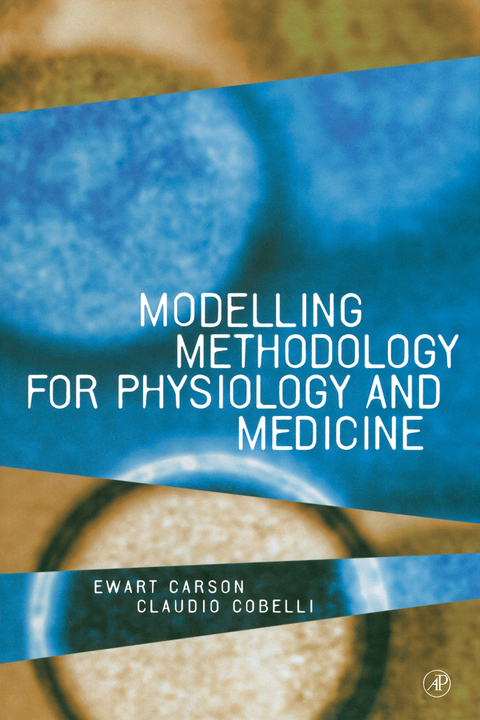
Modelling Methodology for Physiology and Medicine (eBook)
421 Seiten
Elsevier Science (Verlag)
978-0-08-051190-0 (ISBN)
* Builds upon and enhances the readers existing knowledge of modelling methodology and practice
* Editors are internationally renowned leaders in their respective fields
Modelling Methodology for Physiology and Medicine offers a unique approach and an unprecedented range of coverage of the state-of-the-art, advanced modelling methodology that is widely applicable to physiology and medicine. The book opens with a clear and integrated treatment of advanced methodology for developing mathematical models of physiology and medical systems. Readers are then shown how to apply this methodology beneficially to real-world problems in physiology and medicine, such as circulation and respiration. - Builds upon and enhances the readers existing knowledge of modelling methodology and practice- Editors are internationally renowned leaders in their respective fields
Cover 1
Contents 6
List of Contributors 12
Preface 14
Chapter 1. An Introduction to Modelling Methodology 16
1.1 Introduction 16
1.2 The Need for Models 17
1.3 Approaches to Modelling 19
1.4 Simulation 22
1.5 Model Identification 23
1.6 Model Validation 26
1.7 Reference 28
Chapter 2. Control in Physiology And Medicine 30
2.1 Introduction 30
2.2 A Systems and Control Approach 30
2.3 Control Mechanisms in Physiology 32
2.4 Control System Representations of the Clinical Process 39
2.5 Control System Approaches to Drug Therapy Planning and Administration 50
2.6 Conclusions 57
2.7 References 58
Chapter 3. Deconvolution 60
3.1 Introduction 60
3.2 Problem Statement 61
3.3 Difficulty of the Deconvolution Problem 64
3.4 The Regularization Method 69
3.5 Other Deconvolution Methods 83
3.6 Conclusions 86
3.7 Acknowledgements 87
3.8 References 87
Chapter 4. A priori Identifiability of Physiological Parametric Models 92
4.1 Introduction 92
4.2 The System-Experiment Model 94
4.3 A Priori Identifiability 95
4.4 Available Methods 97
4.5 An Identifiability Algorithm for Nonlinear Models 100
4.6 An Identifiability Algorithm for Linear Compartmental Models 108
4.7 Conclusions 116
4.8 References 116
Appendix A: The Characteristic Set 118
Appendix B: THE Gröbner Basis 119
Chapter 5. Parameter Estimation 122
5.1 Introduction 122
5.2 Least Squares and Maximum Likelihood Estimators 123
5.3 Bayesian Estimator 141
5.4 Population Kinetic Analysis 151
5.5 Acknowledgement 163
5.6 References 163
Chapter 6. Tracer Experiment Design for Metabolic Fluxes Estimation in Steady and Nonsteady State 168
6.1 Introduction 168
6.2 Fundamentals 168
6.3 Accessible-Pool and System Fluxes 171
6.4 The Tracer Probe 173
6.5 Estimation of Tracee Fluxes in Steady State 175
6.6 Estimation of Nonsteady-State Fluxes 180
6.7 Conclusions 192
6.8 References 192
Chapter 7. Physiological Modelling of Positron Emission Tomography Images 194
7.1 Introduction 194
7.2 Modeling Strategies 195
7.3 Positron Emission Tomography Measurement Error 197
7.4 Models of Regional Glucose Metabolism 200
7.5 Models of [15O]H2O Kinetics to Assess Blood Flow 210
7.6 Models of the Ligand-Receptor System 215
7.7 Conclusions 222
7.8 References 223
Chapter 8. Identification and Physiological Interpretation of Aortic Impedance in Modelling 228
8.1 Introduction 228
8.2 The Modelling Process and Related Problems of Identifiability and Determinacy 231
8.3 Vascular Impedance 233
8.4 Data-Driven Models of Vascular Impedance (Frequency Response Technique) 236
8.5 Historical Development of Windkessel Models 239
8.6 Where Windkessel Models' Identification Meets Physiological Interpretation 243
8.7 Contradictions in Clinically Oriented Compliance Estimation Methods (How the Viscoelastic Windkessel Resolves Them) 247
8.8 Distributed Description of Linear Arterial Systems to Infer Aortic Wave Reflection 251
8.9 Identifiability: A Key Issue in the Assessment of Physiological Relevance of T-Tube Model 257
8.10 Conclusions 262
8.11 References 263
Chapter 9. Mathematical Modelling of Pulmonary Gas Exchange 268
9.1 Standard Equations Used to Describe Gas Transport in the Lungs 268
9.2 Models of Diffusion Limitation 273
9.3 Models of Ventilation Perfusion Mismatch 281
9.4 Application of Mathematical Models of Ventilation, Perfusion, and Diffusion 284
9.5 References 288
Appendix A. GLossary 291
Appendix B. Calculations Necessary to Convert Inspired Gas at ATPD to BTPS 292
Chapter 10. Mathematical Models of Respiratory Mechanics 294
10.1 Introduction 294
10.2 Breathing Mechanics: Basic Concepts 295
10.3 First-Order Models 297
10.4 Second-Order Models 304
10.5 Respiratory Oscillation Mechanics 307
10.6 Simulation Models of Breathing Mechanics 310
10.7 Conclusions 315
10.8 References 316
Chapter 11. Insulin Modelling 320
11.1 Introduction 320
11.2 Models of Whole-body Insulin Kinetics 321
11.3 An Organ Model of Insulin Secretion 325
11.4 Estimation of Insulin Secretion by Deconvolution 335
11.5 A Structural Model to Estimate Insulin Secretion and Secretory Indices 336
11.6 Estimation of Hepatic Insulin Extraction 344
11.7 Conclusions 346
11.8 References 348
Chapter 12. Glucose Modeling 352
12.1 Introduction 352
12.2 Models of Whole-body Kinetics in Steady State 352
12.3 Models of Regional Kinetics in Steady State 361
12.4 Models of Whole-body Kinetics in Nonsteady State 366
12.5 Models of Glucose and Insulin Control on Glucose Metabolism 374
12.6 Simulation Models 381
12.7 Conclusions 384
12.8 References 385
Chapter 13. Blood-Tissue Exchange Modelling 388
13.1 Introduction 388
13.2 Experimental Approaches 390
13.3 Models of Blood-Tissue Exchange 392
13.4 Conclusions 412
13.5 References 412
Index 418
| Erscheint lt. Verlag | 31.12.2000 |
|---|---|
| Mitarbeit |
Herausgeber (Serie): Joseph Bronzino |
| Sprache | englisch |
| Themenwelt | Mathematik / Informatik ► Informatik |
| Mathematik / Informatik ► Mathematik ► Algebra | |
| Mathematik / Informatik ► Mathematik ► Angewandte Mathematik | |
| Medizin / Pharmazie ► Physiotherapie / Ergotherapie ► Orthopädie | |
| Studium ► 1. Studienabschnitt (Vorklinik) ► Physiologie | |
| Naturwissenschaften ► Biologie ► Zoologie | |
| Naturwissenschaften ► Chemie ► Technische Chemie | |
| Technik ► Bauwesen | |
| Technik ► Medizintechnik | |
| Technik ► Umwelttechnik / Biotechnologie | |
| ISBN-10 | 0-08-051190-2 / 0080511902 |
| ISBN-13 | 978-0-08-051190-0 / 9780080511900 |
| Informationen gemäß Produktsicherheitsverordnung (GPSR) | |
| Haben Sie eine Frage zum Produkt? |
 PDF (Adobe DRM)
Kopierschutz: Adobe-DRM
Adobe-DRM ist ein Kopierschutz, der das eBook vor Mißbrauch schützen soll. Dabei wird das eBook bereits beim Download auf Ihre persönliche Adobe-ID autorisiert. Lesen können Sie das eBook dann nur auf den Geräten, welche ebenfalls auf Ihre Adobe-ID registriert sind.
Details zum Adobe-DRM
Dateiformat: PDF (Portable Document Format)
Mit einem festen Seitenlayout eignet sich die PDF besonders für Fachbücher mit Spalten, Tabellen und Abbildungen. Eine PDF kann auf fast allen Geräten angezeigt werden, ist aber für kleine Displays (Smartphone, eReader) nur eingeschränkt geeignet.
Systemvoraussetzungen:
PC/Mac: Mit einem PC oder Mac können Sie dieses eBook lesen. Sie benötigen eine
eReader: Dieses eBook kann mit (fast) allen eBook-Readern gelesen werden. Mit dem amazon-Kindle ist es aber nicht kompatibel.
Smartphone/Tablet: Egal ob Apple oder Android, dieses eBook können Sie lesen. Sie benötigen eine
Geräteliste und zusätzliche Hinweise
Buying eBooks from abroad
For tax law reasons we can sell eBooks just within Germany and Switzerland. Regrettably we cannot fulfill eBook-orders from other countries.
aus dem Bereich