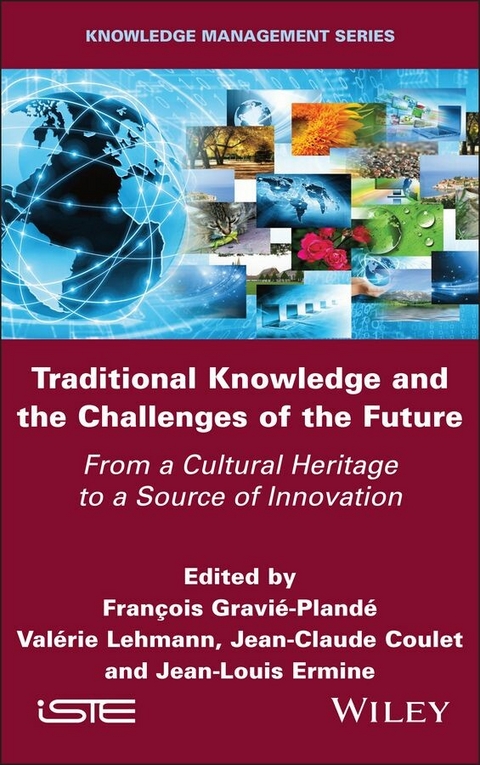
Traditional Knowledge and the Challenges of the Future (eBook)
479 Seiten
Wiley-Iste (Verlag)
978-1-394-41791-9 (ISBN)
This book is based on a four-year series of seminars attended by professionals and academics from several disciplines. It looks at the issue of traditional knowledge from a variety of perspectives - economic, historical, pedagogical, financial, institutional, technological and managerial - and is based on concrete experiences in several French countries and regions.
Traditional Knowledge and the Challenges of the Future, which is both informed by firsthand accounts and forward-looking reflections, offers an original perspective on the relationship between cultural heritage and innovation. It offers researchers, practitioners and decision-makers a fresh perspective on the potential of traditional knowledge in a changing world.
François Gravié-Plandé is a lecturer at the University of Limoges (IAE Limoges) and a researcher at CREOP, France. His research includes territorial entrepreneurship and the valorization of traditional knowledge.
Valérie Lehmann is full Professor at the Université du Québec à Montréal, Canada, and a part time professor at Sciences Po Lyon, France. She is an expert in participative projects and open innovation, and a facilitator in change management.
Jean-Claude Coulet is an honorary teacher-researcher in psychology, specializing in individual and collective skills, and their development in training and organizations.
Jean-Louis Ermine is Professor Emeritus at the Institut Mines-Télécom Business School, France, and a researcher and expert consultant for companies in the field of knowledge management.
1
Developing Competence in Traditional Occupations: The Example of Documentary Filmmaking
1.1. Introduction
It is difficult to address the question of competence in “traditional occupations” without pointing out the importance of both continuities and ruptures that characterize historical developments in the organization of activities in human societies. Whether we consider the ways in which techniques have spread, from flintknapping in prehistoric times1, to the ways in which work was reorganized when, for example, the guilds of the Middle Ages gave way to factories and then modern industry (Jorda 2006), we are constantly in a dialectic between the cumulative perpetuation of traditions and the development of innovations.
Over the millennia, innumerable competences have been developed, passed on and capitalized on (Lahire 2023)2 from generation to generation, while others have disappeared, even though some of them are now proving highly useful, if not crucial, in meeting the challenges we are currently facing. For example, the Paris Agreement states:
Parties acknowledge that adaptation action should follow a country- driven, gender-responsive, participatory and fully transparent approach, taking into consideration vulnerable groups, communities and ecosystems, and should be based on and guided by the best available science and, as appropriate, traditional knowledge, knowledge of indigenous peoples and local knowledge systems, (Article 7-5 of the United Nations Framework Convention on Climate Change 2015).
However, it is only fairly recently that the notion of competence has come into its own in the fields of work and training, giving rise to an abundance of professional and scientific literature. However, despite the fact that mastery of this notion is a major asset in training and management, analysis of the processes involved in building and implementing competence remains virtually absent from this literature.
In this chapter, we propose to show how theoretical analysis of the processes at play in the construction and mobilization of individual and collective competencies can help to foster their development, and more specifically, in the context of traditional occupations, given their particular features: a very pervasive local culture, a very high proportion of oral transmission, a strong emotional investment (Lambert 2019) and, above all, a great deal implicit in the gestures produced. We begin by justifying our choice to approach the question of traditional knowledge from the angle of competence development in traditional occupations. We will then propose a theoretical framework that defines the notion of competence, describes the mobilization and construction processes at play when competence is mobilized within the organization of a situational activity and describe the processes that articulate individual and collective competencies. Finally, we will show how an understanding of all these processes offers an extremely rich toolbox for designing and implementing concrete training programs. We will do this using the example of documentary films made by trainees and argue that this can be a very fruitful way of developing professional competence, particularly within traditional occupations.
1.2. Why focus on competence building in traditional occupations?
While the development of competence is now an integral part of all training objectives (see, for France, the ministerial texts concerning the “common base of knowledge, competence and culture”3), or those advocating the skills-based approach (SBA), particularly at the university level), it has to be said that the implementation of this objective in practice is far from living up to expectations. The heterogeneous nature of the many definitions of the notion of competence in the literature, and the vagueness that remains in official definitions, no doubt represents the main explanation for the difficulties in operationalizing it in training, which is still strongly oriented by programs based on “knowledges” to be “taught”. In this respect, the title of the Common Base, which juxtaposes (but does not articulate) knowledge, competence and culture, is highly indicative of the fact that competence does not appear to integrate both knowledge and culture (we will return to this point in section 1.3.1, when we present a theoretical model of competence).
This time, when we look at training for traditional occupations, the picture is quite different: even if the notion of competence is not always explicitly emphasized, it is in fact competence that apprentices are expected to develop, even when this is only done “on the job”, as in the case of the salt workers referred to by Delbos and Jorion (1984). In fact, traditional occupations have generally developed within small cultural groups and rely on relatively nonformalized knowledge and know-how (Delbos and Jorion 1984), constituting numerous competence that have been incorporated over a long period of time (Nonaka and Takeuchi 1995; Leplat 2005), which are difficult to acquire and, above all, involving lots of essential, intrinsic movements. In other words, approaching the question of training in these professions with all these specific features in mind can be very useful in understanding the singular difficulties it encounters. It is hardly surprising, then, that an apprenticeship, as an original form of transmission, compared to conventional training, has historically been the learning process within traditional occupations.
For masters, the main emphasis is on the need to transmit “their craft to apprentices, so that they acquire a form of unity between their hands and their minds” (Meurger 2006, p. 16, author’s translation). In other words, for them, learning an occupation cannot be conceived of as anything other than the perfectly unified development of these two aspects of competence, unfolding both towards a task (that what needs to be done), towards others (because “action is always addressed” (Clot and Faïta 2000, p. 16, author’s translation) and towards ourselves (investment in and construction of experience). As Vadcard (2022) points out, despite the importance of the technical aspect of the work, the master–apprentice relationship within a professional body plays a fundamental role in the transmission that takes place, with a joint (master–apprentice) commitment to a training project. The relationship with others and the relationship with ourselves is therefore of the utmost importance, closely associated with the execution of technical movements.
Without in any way calling into question the widely acknowledged value of these “apprenticeship” practices, listed as part of humanity’s intangible cultural heritage by UNESCO and the source of profound reflections nourished by centuries of experience (see Chapter 12), the aim here is to show how theoretical models, based in particular on activity theories and designed to explain the many processes at play in the development of competence, can open the way to other types of training systems, or even play a role in structuring these occupations.
1.3. The contribution of theory
By striving to get to the heart of the matter, our aim here is to highlight the main processes at work in the mobilization and construction of competence, first and foremost by adopting the point of view of an individual faced with a given task, in a given situation. We will do this on the basis of the MADDEC model we have proposed (Coulet 2011). Then, in the second step, we will consider that all individual competencies necessarily derive from their relationship with those of others, and that, consequently, it is the processes of articulation between individual and collective competencies that must also be taken into account. To this end, we will draw on the SECI model developed by Nonaka and Takeuchi (1995) and Nonaka and von Krogh (2009).
1.3.1. The dynamics of individual competence
As we pointed out in the introduction, a simple review of the literature (Tardif and Desbien 2014; Coulet 2016) is enough to show that, despite the interest it has aroused for several decades, the notion of competence remains highly polysemic and struggles to be grasped in terms of the organizing processes of activity in a situation. However, the contributions of activity theories, essentially in the tradition of the work of Piaget (1896–1980) and Vygotsky (1896–1934), have enabled progress to be made on this issue. On the basis of this work, we first proposed to define competence as “a dynamic organization of activity, mobilized and regulated by a subject to cope with a given task, in a given situation” (Coulet 2011, p. 17, author’s translation). We have also considered that this “organization of activity” can be described by distinguishing (Samurçay and Rabardel 2004) two sides of an activity: “productive” (of a result) and “constructive” (of the individual).
On the productive side, with reference to Vergnaud (1990) and in line with Piaget’s contributions, we have considered that the mobilization of a competence can be likened to the activation of a scheme (according to Vergnaud: “an invariant organization of conduct for a given class of situations”, author’s translation). For him, a scheme is made up of four components: “operative invariants”,...
| Erscheint lt. Verlag | 24.10.2025 |
|---|---|
| Reihe/Serie | ISTE Invoiced |
| Sprache | englisch |
| Themenwelt | Sozialwissenschaften ► Soziologie ► Allgemeines / Lexika |
| Schlagworte | ancestral practices • cultural heritage • Ecological ecosystems • economic ecosystems • Innovation • sustainability |
| ISBN-10 | 1-394-41791-8 / 1394417918 |
| ISBN-13 | 978-1-394-41791-9 / 9781394417919 |
| Informationen gemäß Produktsicherheitsverordnung (GPSR) | |
| Haben Sie eine Frage zum Produkt? |
 EPUB (Adobe DRM)
Kopierschutz: Adobe-DRM
Adobe-DRM ist ein Kopierschutz, der das eBook vor Mißbrauch schützen soll. Dabei wird das eBook bereits beim Download auf Ihre persönliche Adobe-ID autorisiert. Lesen können Sie das eBook dann nur auf den Geräten, welche ebenfalls auf Ihre Adobe-ID registriert sind.
Details zum Adobe-DRM
Dateiformat: EPUB (Electronic Publication)
EPUB ist ein offener Standard für eBooks und eignet sich besonders zur Darstellung von Belletristik und Sachbüchern. Der Fließtext wird dynamisch an die Display- und Schriftgröße angepasst. Auch für mobile Lesegeräte ist EPUB daher gut geeignet.
Systemvoraussetzungen:
PC/Mac: Mit einem PC oder Mac können Sie dieses eBook lesen. Sie benötigen eine
eReader: Dieses eBook kann mit (fast) allen eBook-Readern gelesen werden. Mit dem amazon-Kindle ist es aber nicht kompatibel.
Smartphone/Tablet: Egal ob Apple oder Android, dieses eBook können Sie lesen. Sie benötigen eine
Geräteliste und zusätzliche Hinweise
Buying eBooks from abroad
For tax law reasons we can sell eBooks just within Germany and Switzerland. Regrettably we cannot fulfill eBook-orders from other countries.
aus dem Bereich