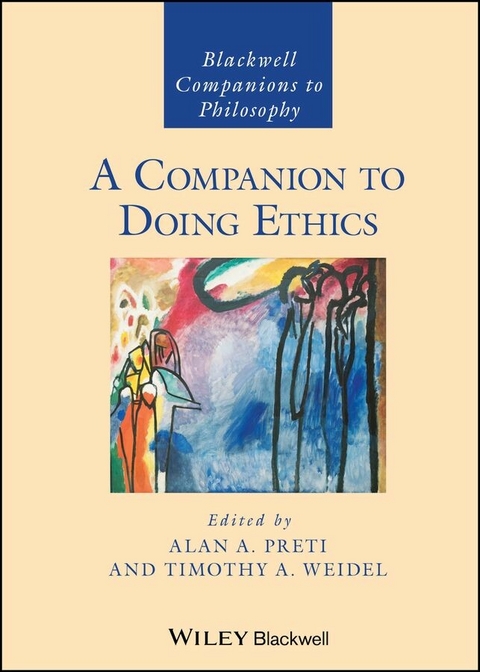
A Companion to Doing Ethics (eBook)
958 Seiten
Wiley-Blackwell (Verlag)
978-1-394-25187-2 (ISBN)
A comprehensive guide to practicing ethics across disciplines and contexts in the 21st century
In an era of rapid technological advancements and complex societal challenges, A Companion to Doing Ethics is a vital resource for understanding and navigating the multifaceted role of ethics today. Edited by Alan A. Preti and Timothy A. Weidel, this timely volume explores how ethics has evolved from traditional academic theory into a multidisciplinary practice with real-world applications. Contributions from leading scholars and professionals working in diverse fields, including healthcare, business, public policy, and education, illuminate the dynamic ways ethics is applied in modern contexts.
Whether an ethicist working in a university, a member of a hospital ethics board, or a leader at an applied humanities center, the Companion is your indispensable reference and guide. In-depth chapters address a broad range of vital topics-from the role of public philosophy to the need for ethics education in shaping responsible decision making-while offering a rich, interdisciplinary perspective on the challenges and responsibilities of ethical work.
Providing insights into what it means to practice ethics in today's world by those actively engaged in the field, A Companion to Doing Ethics:
- Explores the expanding role of ethics across academic, professional, and public contexts
- Highlights non-Western and global approaches to ethical practice
- Examines the function and impact of ethics centers and applied humanities institutions
- Offers insights into the integration of ethics education across diverse curricula
- Features multidisciplinary case studies illustrating real-world ethical applications
Part of the prestigious Blackwell Companions to Philosophy series, A Companion to Doing Ethics is essential reading for advanced undergraduate and graduate courses in ethics, applied philosophy, and public policy. It is also an invaluable resource for ethics center directors, healthcare ethics board members, business leaders, and educators seeking to deepen their understanding of contemporary ethical practice.
ALAN A. PRETI is an Associate Professor of Philosophy at Rosemont College and a seasoned scholar in applied ethics and ethics pedagogy. He has contributed to several edited volumes, including Developing Moral Sensitivity and Ethics Across the Curriculum-Pedagogical Perspectives.
TIMOTHY A. WEIDEL is an Associate Professor in the Department of Philosophy at Gonzaga University. His research on global justice and applied ethics has been featured in numerous prestigious journals, including Environmental Ethics and Ethical Theory and Moral Practice.
A comprehensive guide to practicing ethics across disciplines and contexts in the 21st century In an era of rapid technological advancements and complex societal challenges, A Companion to Doing Ethics is a vital resource for understanding and navigating the multifaceted role of ethics today. Edited by Alan A. Preti and Timothy A. Weidel, this timely volume explores how ethics has evolved from traditional academic theory into a multidisciplinary practice with real-world applications. Contributions from leading scholars and professionals working in diverse fields, including healthcare, business, public policy, and education, illuminate the dynamic ways ethics is applied in modern contexts. Whether an ethicist working in a university, a member of a hospital ethics board, or a leader at an applied humanities center, the Companion is your indispensable reference and guide. In-depth chapters address a broad range of vital topics from the role of public philosophy to the need for ethics education in shaping responsible decision making while offering a rich, interdisciplinary perspective on the challenges and responsibilities of ethical work. Providing insights into what it means to practice ethics in today's world by those actively engaged in the field, A Companion to Doing Ethics: Explores the expanding role of ethics across academic, professional, and public contexts Highlights non-Western and global approaches to ethical practice Examines the function and impact of ethics centers and applied humanities institutions Offers insights into the integration of ethics education across diverse curricula Features multidisciplinary case studies illustrating real-world ethical applications Part of the prestigious Blackwell Companions to Philosophy series, A Companion to Doing Ethics is essential reading for advanced undergraduate and graduate courses in ethics, applied philosophy, and public policy. It is also an invaluable resource for ethics center directors, healthcare ethics board members, business leaders, and educators seeking to deepen their understanding of contemporary ethical practice.
Editor Biographies and Notes on Contributors
Alan A. Preti is Associate Professor of Philosophy at Rosemont College. He has published articles on applied ethics and ethics pedagogy in various journals and contributed chapters to several edited collections including Developing Moral Sensitivity (2015) and Ethics Across the Curriculum—Pedagogical Perspectives (2018).
Timothy A. Weidel is Associate Professor in the Department of Philosophy at Gonzaga University. His works on global justice and applied ethics have been published in venues such as the Journal of Social Philosophy, Environmental Ethics, the Journal of Human Development and Capabilities, and Ethical Theory and Moral Practice.
Joel D. Alvarez is pursuing a PhD in philosophy at the University of South Florida. He has contributed pieces on indigenous philosophy to two collections, Ways of Being in the World: An Introduction to Indigenous Philosophies of Turtle Island (2023) and Pantheism and Ecology: Cosmological, Philosophical, and Theological Perspectives (2023).
Christopher Arroyo is Professor of Philosophy at Providence College. His scholarship focuses on Philippa Foot's ethical naturalism and Catholic sexual ethics. He is the author of Kant's Ethics and the Same‐Sex Marriage Debate: An Introduction (2017). His work has appeared in Philosophy and Problems in Applied Ethics (forthcoming).
Jonathan Beever is Associate Professor of Philosophy at the University of Central Florida (UCF) and founding director of the UCF Center for Ethics. His interdisciplinary research engages intersections of ethics, technology, and environments. More about his work can be found at jonathan.beever.org.
Keith Begley is a Teaching Fellow in the Department of Philosophy at Durham University (UK). He has published on philosophy of computer science and artificial intelligence; philosophy of language and linguistics; epistemology in health care; and history of philosophy, especially on Heraclitus, Wittgenstein, and Jerrold J. Katz.
Abram L. Brummett is Assistant Professor of Medical Humanities and Clinical Bioethics at Oakland University William Beaumont School of Medicine. He also works as a clinical ethics consultant for Corewell Health William Beaumont University Hospital. He publishes on topics of ethics expertise, clinician conscience, neuroethics, and deception in health care.
Michael Burroughs is Executive Director of Organizational Change at the University of Southern California (USC). He collaborates with faculty, staff, and student stakeholders to support, assess, and catalyze values and culture initiatives across USC. He has published over 25 articles and chapters in the areas of ethics, education, and leadership and has worked extensively as an ethics consultant in healthcare, law enforcement, and nonprofit contexts.
Jeffrey Byrnes is Associate Professor of Philosophy at Grand Valley State University and a Clinical Ethics Advisor at Corewell Health Systems. He earned his PhD in philosophy from the University of Essex (UK). His current research examines clinical ethics, conscientious objection, AI in health care, and public health issues.
Chuanfei Chin is a philosopher and educator based in London, where he also works with marginalized populations in community mental health. He has created interdisciplinary courses in moral philosophy and applied and professional ethics, and trained other educators in transforming pedagogical practices. His current research interests combine philosophical and psychoanalytical understandings of ethics. He has published papers in History and Theory, Studies in the History and Philosophy of Science, Journal of the Philosophy of History, and Journal of Contemporary Asia.
John Corvino is Dean of the Irvin D. Reid Honors College and Professor of Philosophy at Wayne State University in Detroit. He is the author or coauthor of three books, most recently Debating Religious Liberty and Discrimination (with counterpoint by Ryan T. Anderson and Sherif Girgis).
Michael A. DeWilde is Director of the Koeze Business Ethics Initiative at the Seidman College of Business at Grand Valley State University, where he is also a professor in the Management Department. For the past eight years, he has been affiliated with Corewell Health, the largest integrated healthcare system in Michigan, where his work focuses on the culture of the operating room and the development of leaders. His work has been featured in the New York Times and Inc. Magazine, among other places, and his most recent articles on business ethics pedagogy have appeared in BizEd magazine, Teaching Ethics, and the Seidman Business Review.
Deni Elliott is Project Co‐director for the National Ethics Project. She held the endowed Poynter Jamison Chair in Media Ethics and Press Policy from 2003 to 2023 and is now Professor Emeritus in the Department of Journalism and Digital Communication at the University of South Florida. Deni is the author of more than 200 articles and book chapters for the scholarly, trade, and lay press, and is the sole author of 11 books.
Elaine E. Englehardt is Professor of Philosophy Emerita and Distinguished Professor of Ethics at Utah Valley University. She is a past president of the Society for Ethics Across the Curriculum. She is author or coauthor of over 15 books and numerous journal articles. Interdisciplinary ethics is part of her specialties.
Nicole Fice is Assistant Professor of Philosophy at Trent University (Ontario, Canada). Her research lies at the intersection of feminist philosophy and biomedical ethics, especially public health ethics, and covers topics like privilege, autonomy, vaccine hesitancy, and homelessness. More information on her research can be found at nicolefice.com.
Dane C. Joseph is Associate Professor of Educational Leadership at George Fox University. He is an evaluation methodologist and studies educational programs and assessment practices to understand why they succeed or fail, and how to improve them. His work has been published in Bottlecap Press, Journal of Humanistic Mathematics, Journal of Effective Teaching in Higher Education, Assessment Update, and The International Journal of Society and Sport, among others.
Maria J. Kulp is Associate Professor of Philosophy at Gonzaga University. Her areas of research include end‐of‐life ethics, public health ethics, and philosophies of suicide. Her most recent work has been published in Bioethics, The International Journal of Feminist Approaches to Bioethics, and Teaching Philosophy.
Christopher Meyers is Professor Emeritus of Philosophy and Director Emeritus of the Kegley Institute of Ethics, California State University, Bakersfield. He has authored three books and over 60 academic articles. He is also an engaged public scholar who regularly writes editorial columns and provides consulting to a wide range of organizations, most notably in health care.
Deborah S. Mower is the Founding Director of The Center for Practical Ethics and the Mr. and Mrs. Alfred Hume Bryant Associate Professor of Ethics in the Department of Philosophy and Religion at the University of Mississippi. She specializes in moral psychology, applied ethics and public policy, and moral education, and is the recent past President of the Society for Ethics Across the Curriculum (SEAC).
Daryl Ooi is Lecturer at the National University of Singapore. He has designed and taught interdisciplinary courses combining ethical and epistemological discussions with research in the social sciences and in medicine. His current research interests include educational ethics, social epistemology, the history of philosophy (early modern and Confucian) and care ethics. He has published papers in journals such as Synthese, Episteme, Philosophy Compass, Philosophy East and West, Dao, Hume Studies, Journal of Scottish Philosophy, Australasian Philosophical Review, and Journal of Didactics of Philosophy.
David Ozar is Professor Emeritus in the Department of Philosophy at Loyola University Chicago, where he taught ethics, social philosophy, and applied ethics, especially healthcare ethics and professional ethics, for 43 years. He has also served on the Healthcare Ethics Committee of NorthShore University Health System, now a division of Endeavor Health, in Evanston, Illinois, since 1989.
Lisa S. Parker is the Dickie, McCamey & Chilcote Professor of Bioethics at the University of Pittsburgh where she directs the Center for Bioethics & Health Law and the Master of Arts in Bioethics Program, as well as the Research, Ethics and Society Initiative of the Office of Research. Her research focuses on ethics of genomic research and feminist approaches in bioethics.
Anna L. Peterson is Professor of Religion at the University of Florida. Her teaching and research interests include social and environmental ethics, religion and politics, and animal studies. Her most recent books include Works Righteousness: Material Practice in Ethical Theory (2021), Cats and Conservationists: The Debate over Who Owns the Outdoors, with Dara Wald (2021), and With God on Our Side: Religion, Social Movements, and Social Change (2024).
Mark Piper is Professor of Philosophy at James Madison University working in normative ethics and the philosophy of education. Some of his recent publications can be found...
| Erscheint lt. Verlag | 25.7.2025 |
|---|---|
| Reihe/Serie | Blackwell Companions to Philosophy |
| Sprache | englisch |
| Themenwelt | Geisteswissenschaften ► Philosophie ► Ethik |
| Sozialwissenschaften | |
| Schlagworte | PERMA+4 positive psychology • positive psychology guide • positive psychology mental health • positive psychology personal growth • positive psychology science • positive psychology strategies • well-being evidence-based interventions • Well-being guide |
| ISBN-10 | 1-394-25187-4 / 1394251874 |
| ISBN-13 | 978-1-394-25187-2 / 9781394251872 |
| Informationen gemäß Produktsicherheitsverordnung (GPSR) | |
| Haben Sie eine Frage zum Produkt? |
 EPUB (Adobe DRM)
Kopierschutz: Adobe-DRM
Adobe-DRM ist ein Kopierschutz, der das eBook vor Mißbrauch schützen soll. Dabei wird das eBook bereits beim Download auf Ihre persönliche Adobe-ID autorisiert. Lesen können Sie das eBook dann nur auf den Geräten, welche ebenfalls auf Ihre Adobe-ID registriert sind.
Details zum Adobe-DRM
Dateiformat: EPUB (Electronic Publication)
EPUB ist ein offener Standard für eBooks und eignet sich besonders zur Darstellung von Belletristik und Sachbüchern. Der Fließtext wird dynamisch an die Display- und Schriftgröße angepasst. Auch für mobile Lesegeräte ist EPUB daher gut geeignet.
Systemvoraussetzungen:
PC/Mac: Mit einem PC oder Mac können Sie dieses eBook lesen. Sie benötigen eine
eReader: Dieses eBook kann mit (fast) allen eBook-Readern gelesen werden. Mit dem amazon-Kindle ist es aber nicht kompatibel.
Smartphone/Tablet: Egal ob Apple oder Android, dieses eBook können Sie lesen. Sie benötigen eine
Geräteliste und zusätzliche Hinweise
Buying eBooks from abroad
For tax law reasons we can sell eBooks just within Germany and Switzerland. Regrettably we cannot fulfill eBook-orders from other countries.
aus dem Bereich