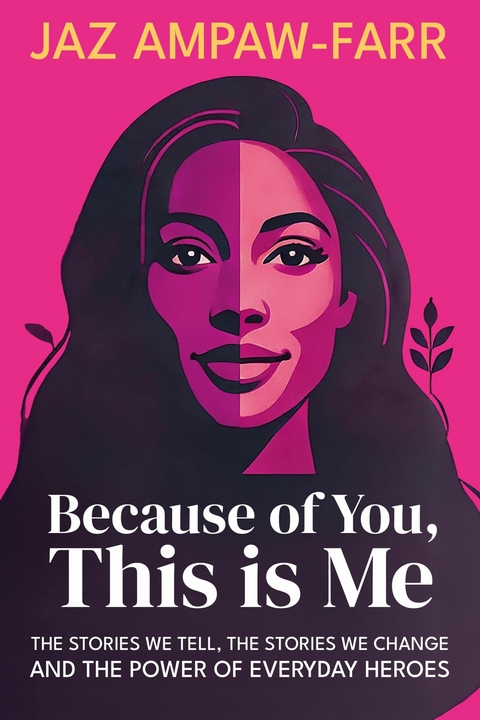
Because of You, This is Me (eBook)
176 Seiten
Crown House Publishing (Verlag)
978-1-78135-321-9 (ISBN)
Jaz Ampaw-Farr is a writer, international speaker and self-described 'resilience ninja' whose enthusiasm is both infectious and hugely motivating. Her background as a stand-up comedian and teacher, combined with her commitment to empowering teachers, makes her talks both engaging and resourceful. Named 'The British Oprah' by US audiences and a three-time winner of Speaker of the Year, Jaz's raw honesty and humour have already inspired millions through her viral TED talk and headline keynotes for organisations from Google to Gucci.
Growing up in poverty, and neglected and abused by her own mother and stepfather, Jaz Ampaw-Farr was destined to become a statistic. Her story was changed, however, by five teachers who made a point of putting human connection first, despite the challenges of the education system. Because of these people, Jaz went on to become a teacher, writer and award-winning international speaker who, through celebration and provocation, engages educators and galvanises them into embracing the difference that they can make when they, too, put being a human first. In Because of You, This is Me Jaz shares her story - often harrowing but always uplifting - to show how the everyday heroes in our schools can transform the lives of the children who need their help the most. It's easy to feel disillusioned in an exhausting education system, but Jaz's celebration of teachers is a tangible reminder that their small actions have a profound impact on the students in their care. With practical tools and thoughtful reflection points, this remarkable book will help teachers stay energised and focused and reinvigorate their passion for education. Essential reading for all educators. **Trigger Warning:** This book addresses themes of child abuse and neglect, which may be upsetting or triggering for some readers. If you or someone you know has been affected by similar issues, please take care when reading and consider seeking support.
I’d spent a fair amount of the eight years I’d been on the planet being ill, but I could not remember experiencing anything like this. My head throbbed and I was throwing up so much that I couldn’t get to the end of my bed, let alone school – even for Mr William’s fantastical classes. A visit to the doctor was rare as it meant giving outsiders a window into our world so, instead, my stepfather put a sick bucket next to the mattress on the floor that was my bed. I used it so much it was half-full and stank, but he didn’t come back to empty it. The flip side of that was that he stayed away from my room at night as well.
With me out of action, there was no one to take my brother to school, which meant he spent the week at home too. Even though Paul had seen me do it every day, he struggled to run the military operation required to get a baby and a toddler up, dressed and fed in the morning. I simultaneously loved him as a brother whilst hating him for being only six and useless without my help. After hearing him crying in distress downstairs, even though I still felt dizzy and faint, I had no choice but to get up and resume my caregiving duties.
In the front room, the TV blared loudly as usual. My biological mother sat on the sofa surrounded by ashtrays and half-drunk abandoned mugs of tea from previous days. Her friend sat next to her. Every time I’d seen the friend, she was either spaced out or had already left the planet entirely. They both sat staring at the TV, smoking, drinking and oblivious to the crying baby and toddler my six-year-old brother was struggling to pacify.
My biological mother didn’t seem to notice me arrive, or that I was quite ill, and instructed me to bring a less full ashtray over to her. I was slower than usual and the friend, seeing how sick I was, advised my biological mother that I should be given bread soaked in milk to settle my stomach. Finding a few slices of slightly mouldy Mother’s Pride in the kitchen, she cut off the crusts and soaked them in a saucer of milk – milk that had been left out of the fridge and was past its best. The saucer was placed on the floor for me to eat.
Even in my headache haze, I knew this lady had confused caring for a sick child with the advice that Blue Peter had mistakenly given for feeding hedgehogs.1 I refused. My capacity for putting up with crap from adults was massively reduced by the throbbing in my head, the churning in my stomach and the thought of kneeling on the filthy floor to eat wet bread. In a flash, my biological mother lurched towards me, her cigarette bobbing from the side of her mouth as she spat out a familiar tirade of insults, ‘You ungrateful little …’ I felt her nails press into my skin as she grabbed the scruff of my neck and pressed me downward towards the floor, forcing my face into the mixture.
Sour milk slime seeped into my nostrils. Face down and too weak to struggle I could hear the sound of both women laughing. Somewhere in the house a baby was crying. Paul. Where was he? If he saw this he’d be even more scared and I didn’t have the strength to reassure him.
Fighting the urge to pass out I turned my head to see the sight that extinguished the last bit of hope and fight I had left in me: my baby brother trying to keep hold of a screaming and wriggling toddler and looking at me in pure horror with silent tears streaming down his cheeks.
The Weirdo from Wales
In my expert opinion, Mr Williams was a liar.
An enthusiastically sweaty and definitely weird Welsh liar.
Within the first few seconds of meeting him, and before the fateful day with the cricket bat, I had Mr Williams down as a Category 3 adult. Not dangerous at all but, on a scale of one to ten, he was off the shizang. He had the energy of a caffeinated squirrel, a booming voice and wore jackets that didn’t quite fit with sleeves that were two to three business days away from his actual wrists.
But like so many things I believed, I was totally wrong about him.
About the same height as the tallest eleven-year-olds in our school, Mr Williams had a wiry ball of mostly-brown-but-with-grey-tips hair. Not an Afro but certainly Afro-adjacent. He’d presumably grown it out in an attempt to add a few inches of height. His eyes were mostly covered by an untamable fringe that he constantly tried to control by blowing upwards out of the corner of his mouth. And, because having a barnet that meant you had to go through doors sideways wasn’t enough hair, he finished off the look with a moustache and beard combo so huge it required its own passport.
He always wore a jacket, shirt and tie, which made him stand out from the other teachers, who favoured the un-ironed-chic look, and his booming voice and energetic style of teaching meant he would end up with extremely noticeable sweat marks at the armpits. On top of all that, his jacket was too tight and his trousers were too short. I tried to help by giving him the fashion advice I’d heard my nan dish out to people: ‘Hey, sir, you should put some jam on your shoes and invite your trousers down for tea!’
Depending on how bad things were at home, I arrived at school as a reluctant Jekyll and Hyde character. I silently hated the abusive adults at home, but somehow only allowed the fume to seep out at school against the nurturing adults. I felt guilty all the time for that, but I felt like my school adults were lulling me into a false and temporary sense of security during the day. No matter how positive they were, I still had to return back to hell at 3.15pm every day.
My inability to self-regulate, and the rollercoaster up-and-down behaviour traits this caused, landed me in a special class. An environment designed for children who benefit from a little extra input. It was basically a nurture group before nurture groups were called nurture groups. The Annexe Class was full of kids who were experienced chaos navigators. Days were one long riot with a bit of teaching thrown in if there was ever a lull and a teacher who we hadn’t already exhausted.
Our classroom was on a ground-floor annexe just off the dining hall. This arrangement meant that the noise we made didn’t disturb anyone and we had space to run around when the need arose, as it often did. An added bonus, it also meant that we were always first in the dinner queue. It was here that the eight-year-old firecracker I was met Mr Williams, a phenomenal human male who lived under the misapprehension that he had any chance of being in charge of the class. We clashed immediately. What’s more, he was an easy target as there was so much about his appearance that invited constructive criticism. In contrast to Mrs Cook being a 1970s style queen, Mr Williams’ stylist clearly secretly hated him. His outfits and general way of being earned him the nickname the Weirdo from Wales.
I don’t remember much about the academic work we did, apart from the fact that I had not yet received my Times Table Certificate from the head so had to endure extra maths, which Mr Williams tried to make more exciting by turning multiplication into dragon-counting games. I preferred to sit for hours sorting the huge box of mismatched Scottish Maths Project cards into colours and number order rather than completing any of the activities on them. However, when it came to anything to do with storytelling or drama, I shone.
The knight who rescued the princess
Mr Williams had two passions: teaching and being Welsh. Everything we learned was related back to Wales, in some way connected to Welsh values or had been invented in Wales. Also, he was always banging on about dragons and had a bright red Welsh one on his pencil tin and mug.
He was excited about our learning and quick to praise us when we persevered. He was the first adult to tell me that I had a ‘vivid imagination’ and that, if I used it, I could ‘do something great in the world’. It connected with Mrs Cook’s pipedream of becoming a teacher. He often encouraged us to make up and act out our own stories based on one stimulus or another (either dragons, knights or dragons with knights) and then got us to write them down as plays or narratives.
All of the scripts and stories I wrote were finished with the only ending I could imagine happening – everyone dying at the end. Mr Williams was a firm believer in the whole teacher as Devil’s advocate thing and asked me what would happen if all the characters lived instead. He often told us no question was stupid, so even though this one clearly was, I thought about it, and replied with something I thought was reserved for ‘proper’ stories in books. ‘Living happily ever after?’ He raised his substantial eyebrows in a way that said ‘You’re onto something there. What would that be like?’ Not demanding, not correcting – inviting me to imagine a different possibility. His questions weren’t about changing my stories, they were about showing me I had the power to write new endings.
And there it was again, that disconnect. My home life told me that I was unlikely to live past primary school. That seems horrific to write but the true...
| Erscheint lt. Verlag | 7.7.2025 |
|---|---|
| Sprache | englisch |
| Themenwelt | Sozialwissenschaften ► Pädagogik ► Allgemeines / Lexika |
| ISBN-10 | 1-78135-321-2 / 1781353212 |
| ISBN-13 | 978-1-78135-321-9 / 9781781353219 |
| Informationen gemäß Produktsicherheitsverordnung (GPSR) | |
| Haben Sie eine Frage zum Produkt? |
 EPUB (Wasserzeichen)
DRM: Digitales Wasserzeichen
Dieses eBook enthält ein digitales Wasserzeichen und ist damit für Sie personalisiert. Bei einer missbräuchlichen Weitergabe des eBooks an Dritte ist eine Rückverfolgung an die Quelle möglich.
Dateiformat: EPUB (Electronic Publication)
EPUB ist ein offener Standard für eBooks und eignet sich besonders zur Darstellung von Belletristik und Sachbüchern. Der Fließtext wird dynamisch an die Display- und Schriftgröße angepasst. Auch für mobile Lesegeräte ist EPUB daher gut geeignet.
Systemvoraussetzungen:
PC/Mac: Mit einem PC oder Mac können Sie dieses eBook lesen. Sie benötigen dafür die kostenlose Software Adobe Digital Editions.
eReader: Dieses eBook kann mit (fast) allen eBook-Readern gelesen werden. Mit dem amazon-Kindle ist es aber nicht kompatibel.
Smartphone/Tablet: Egal ob Apple oder Android, dieses eBook können Sie lesen. Sie benötigen dafür eine kostenlose App.
Geräteliste und zusätzliche Hinweise
Buying eBooks from abroad
For tax law reasons we can sell eBooks just within Germany and Switzerland. Regrettably we cannot fulfill eBook-orders from other countries.
aus dem Bereich