Fundamental Archaeological Concepts
Bloomsbury Academic (Verlag)
979-8-216-19622-8 (ISBN)
- Titel nicht im Sortiment
- Artikel merken
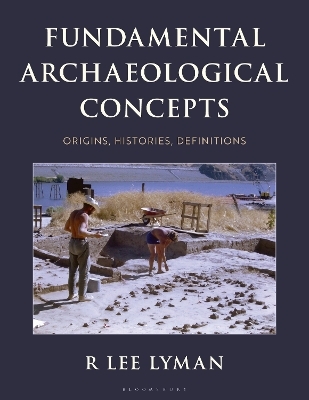
Modern archaeology includes a number of fundamental concepts. This volume compiles in one place the origins, developmental histories, and definitions of more than two dozen of archaeology’s most fundamental concepts. Concepts discussed include artifact, assemblage, association, context, ecofact, feature, industry, in situ, period, provenience, site, stage, tool kit, and type/index fossil.
The volume is neither a dictionary nor an encyclopedia. Its goals are:
1) to document the origin and history of each of the terms/concepts,
2) to present many of the definitions of each of the terms/concepts, and
3) to document the variability in definitions of each term/concept. Two sources of ‘formal’ data are reviewed.
All sources were searched for the 27 concepts, and data recorded regarding (1) whether or not a term/concept appeared in each piece of literature, (2) the appearance of a particular concept without its associated term in each piece of literature, (3) the appearance of a particular term without definition or discussion of its associated concept in each piece of literature, and (4) the appearance of a particular term with an included definition and presenting the definition from each piece of literature. These formal data are supplemented with information on concepts encountered while reading other literature not included in the ‘formal’ samples of early literature and introductory textbooks.
This book is unique among the archaeological literature for its synopses of much of the literature, coverage of the history and meanings of archaeological concepts used in fieldwork and analysis is thorough, and the varied definitions of concepts are summarized and easily consulted.
R. Lee Lyman is Professor Emeritus in the Department of Anthropology at the University of Missouri. He is author of Vertebrate Taphonomy (1994), Quantitative Paleozoology (2008), Theodore E. White and the Development of Zooarchaeology in North America (2016), Graphing Culture Change in North American Archaeology: A History of Graph Types (2021), and co-author of Paleozoology and Paleoenvironments: Fundamentals, Assumptions, and Techniques (2019). His research interests include zooarchaeology, the history of archaeology, and conservation paleozoology.
Preface
Part I. Why a Book on Archaeological Concepts?
Introduction
Part II. The Fundamental Concepts
A. Activity area
B. Archaeological culture
C. Artifact
D. Assemblage
E. Association
F. Cache
G. Component
H. Context
I. Cultural process
J. Ecofact
K. Feature
L. Horizon
M. In situ
N. Industry
O. Manuport
P. Material culture
Q. Mental template
R. Midden
S. Period
T. Phase
U. Provenience
V. Site
W. Site structure
X. Stage
Y. Tool kit
Z. Tradition
AA. Type/index fossil
Appendix 1. List of introductory archaeology textbooks surveyed.
Appendix 2. List of dictionaries and encyclopedias surveyed.
Appendix 3. Early archaeological literature examined for occurrence of terms used.
| Erscheint lt. Verlag | 8.1.2026 |
|---|---|
| Zusatzinfo | 26 bw illus |
| Verlagsort | New York |
| Sprache | englisch |
| Maße | 215 x 280 mm |
| Themenwelt | Schulbuch / Wörterbuch ► Lexikon / Chroniken |
| Geisteswissenschaften ► Archäologie | |
| Sozialwissenschaften | |
| ISBN-13 | 979-8-216-19622-8 / 9798216196228 |
| Zustand | Neuware |
| Informationen gemäß Produktsicherheitsverordnung (GPSR) | |
| Haben Sie eine Frage zum Produkt? |
aus dem Bereich