


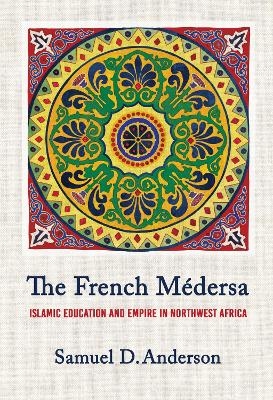
The French Médersa
Islamic Education and Empire in Northwest Africa
Seiten
2026
Cornell University Press (Verlag)
978-1-5017-8461-3 (ISBN)
Cornell University Press (Verlag)
978-1-5017-8461-3 (ISBN)
- Lieferbar (Termin unbekannt)
- Versandkostenfrei
- Auch auf Rechnung
- Artikel merken
The French Médersa explores how the French state pursued a century-long project of bicultural "Franco-Muslim" education in its northwest African colonies, resulting in a new type of school, the médersa, that combined French and Islamic curricula. French officials frequently described these schools and their students as hyphens, drawing connections between larger French and Islamic forces. Samuel D. Anderson highlights this hyphenating idea, situating Franco-Muslim education between ideas about not only France and Islam but also about tradition and modernity, and about North and West Africa.
The médersa project had two goals: to create an elite class of Muslims friendly to the French imperial project and, subsequently, to mold Islam into a form that could be more easily controlled. A total of ten médersas opened across Algeria, Senegal, French Soudan, and Mauritania and closed only in the 1950s. The graduates of these schools, the medérsiens, went on to shape their societies profoundly, but not always in the ways the French anticipated.
Drawing on archival and oral sources from Algeria, Mauritania, Senegal, and France, The French Médersa proposes new ways to approach trans-Saharan history. Anderson argues that across northwest Africa, and for more than a century, Franco-Muslim education was central to the history of French empire and Islamic education alike.
The médersa project had two goals: to create an elite class of Muslims friendly to the French imperial project and, subsequently, to mold Islam into a form that could be more easily controlled. A total of ten médersas opened across Algeria, Senegal, French Soudan, and Mauritania and closed only in the 1950s. The graduates of these schools, the medérsiens, went on to shape their societies profoundly, but not always in the ways the French anticipated.
Drawing on archival and oral sources from Algeria, Mauritania, Senegal, and France, The French Médersa proposes new ways to approach trans-Saharan history. Anderson argues that across northwest Africa, and for more than a century, Franco-Muslim education was central to the history of French empire and Islamic education alike.
Samuel D. Anderson is a history teacher at Polytechnic School in Pasadena, California.
| Erscheinungsdatum | 03.12.2025 |
|---|---|
| Zusatzinfo | 7 b&w halftones, 3 maps - 3 Maps - 7 Halftones, black and white |
| Verlagsort | Ithaca |
| Sprache | englisch |
| Maße | 152 x 229 mm |
| Gewicht | 907 g |
| Themenwelt | Geisteswissenschaften ► Geschichte ► Regional- / Ländergeschichte |
| Geschichte ► Teilgebiete der Geschichte ► Kulturgeschichte | |
| Sozialwissenschaften ► Pädagogik ► Allgemeines / Lexika | |
| ISBN-10 | 1-5017-8461-7 / 1501784617 |
| ISBN-13 | 978-1-5017-8461-3 / 9781501784613 |
| Zustand | Neuware |
| Informationen gemäß Produktsicherheitsverordnung (GPSR) | |
| Haben Sie eine Frage zum Produkt? |
Mehr entdecken
aus dem Bereich



aus dem Bereich
Die Revolution des Gemeinen Mannes
Buch | Softcover (2024)
C.H.Beck (Verlag)
CHF 16,80
Eine Geschichte des Geschmacks
Buch | Hardcover (2025)
C.H.Beck (Verlag)
CHF 49,95


