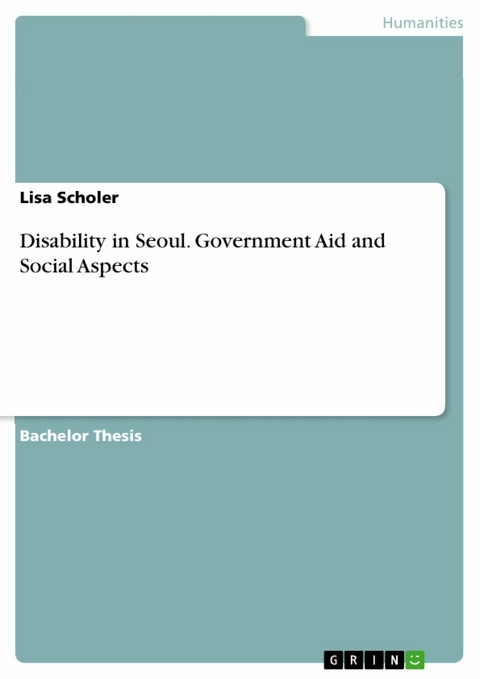
The following disorders are all categorised as disabilities regardless of whether they are temporary or permanent: vision impairment, deafness or partial deafness, mental health conditions, intellectual disability, acquired brain injury, autism spectrum disorder, physical disability, as well as, epileptic disorder, facial disability. However, due to the limitations of this paper, mainly aspects concerning wheelchair users and blind people will be discussed. Other invisible disabilities like deafness, muteness, autism, ADHD or mental health illnesses will not be covered in this paper because these disabilities or mental health issues are not perceivable by outsiders at first glance and require the analysis of specific aspects, such as, for example, the education of affected children, discrimination, judgmental conceptions of parents or legal guardian as well as other social factors and specific intricacies.
Currently, 2.6 million South Korean citizens are registered as having one or multiple disabilities, which amounts to 5% of the total South Korean population of approximately 51,368,000 people.
The number of disabled people doubled over a span of 10 years, whereas the total population only increased by approximately 5%. In 2020 also around 5% of the South Korean population were registered as having a disability, which amounts to 2,526,201 people. Therefore, it is interesting to analyze which steps have been taken to help the growing number of disabled people with the challenges that they face in their everyday lives.
When strolling in Seoul, people with disability are rarely seen, considering that 5% of the population is disabled. This phenomenon raises the question whether and how far disability-friendly Seoul actually is and whether there are some underlying problems invisible at first sight. It is important to keep in mind that disability-friendliness isn’t only represented by the governmentally and privately given facilities but also by the support or lack thereof of non-disabled citizens. The opinion of the affected minority group is essential in finding out whether the given support is sufficient, lacking or faulty since outsiders might not have the much-needed insight.
| Erscheint lt. Verlag | 17.5.2023 |
|---|---|
| Verlagsort | München |
| Sprache | englisch |
| Themenwelt | Sozialwissenschaften ► Soziologie |
| Schlagworte | Disability • Seoul • Society • South Korea |
| ISBN-10 | 3-346-87405-2 / 3346874052 |
| ISBN-13 | 978-3-346-87405-4 / 9783346874054 |
| Informationen gemäß Produktsicherheitsverordnung (GPSR) | |
| Haben Sie eine Frage zum Produkt? |
 PDF (Ohne DRM)
Digital Rights Management: ohne DRM
Dieses eBook enthält kein DRM oder Kopierschutz. Eine Weitergabe an Dritte ist jedoch rechtlich nicht zulässig, weil Sie beim Kauf nur die Rechte an der persönlichen Nutzung erwerben.
Dateiformat: PDF (Portable Document Format)
Mit einem festen Seitenlayout eignet sich die PDF besonders für Fachbücher mit Spalten, Tabellen und Abbildungen. Eine PDF kann auf fast allen Geräten angezeigt werden, ist aber für kleine Displays (Smartphone, eReader) nur eingeschränkt geeignet.
Systemvoraussetzungen:
PC/Mac: Mit einem PC oder Mac können Sie dieses eBook lesen. Sie benötigen dafür einen PDF-Viewer - z.B. den Adobe Reader oder Adobe Digital Editions.
eReader: Dieses eBook kann mit (fast) allen eBook-Readern gelesen werden. Mit dem amazon-Kindle ist es aber nicht kompatibel.
Smartphone/Tablet: Egal ob Apple oder Android, dieses eBook können Sie lesen. Sie benötigen dafür einen PDF-Viewer - z.B. die kostenlose Adobe Digital Editions-App.
Buying eBooks from abroad
For tax law reasons we can sell eBooks just within Germany and Switzerland. Regrettably we cannot fulfill eBook-orders from other countries.
aus dem Bereich