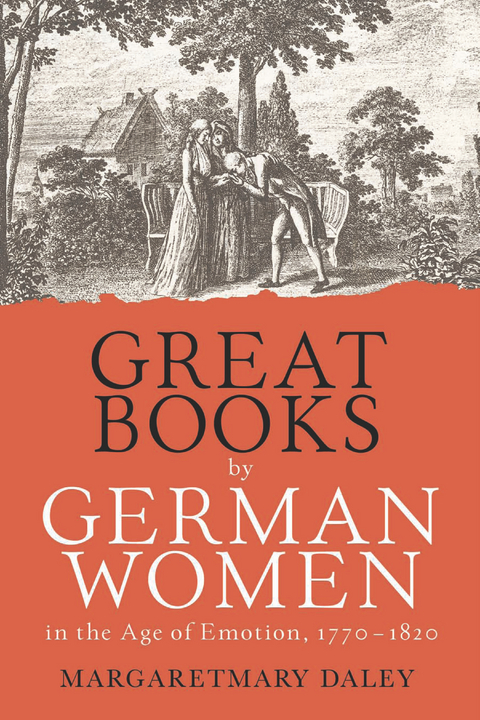
Great Books by German Women in the Age of Emotion, 1770-1820 (eBook)
310 Seiten
Boydell & Brewer (Verlag)
978-1-80010-514-0 (ISBN)
Introduction: Passion and Prejudice: Toward a New Literary Canon for the German Novel
1: An Anglophile Fräulein and Her Epistolary Emotions: Die Geschichte des Fräuleins von Sternheim (1771) by Sophie von La Roche
2: Reading for Pleasure vs. Reading for Pain: Julchen Grünthal: Eine Pensionsgeschichte (1784) by Friederike Unger
3: Sympathy for the Sublime: Das Blütenalter der Empfindung (1794) by Sophie Mereau
4: The Legitimacy of Passionate Narrative and the Metanarrative of Anonymity: Agnes von Lilien (1796) by Caroline von Wolzogen
5: Monstrous Pathos and the Agony of Female Influence: Die Honigmonathe(1804) by Caroline Fischer
6: Adultery Rewarded: Women's Emotions and Men's Indignity in Frauenwürde (1818) by Caroline Pichler
Conclusion: Great Books, Or: The Laurel Wreath as a Mixed Blessing
Appendix A: Publication Information and Plot Summaries, Chronologically Listed
Appendix B: Biographies of the Novelists
Bibliography
Index
| Erscheint lt. Verlag | 15.4.2022 |
|---|---|
| Reihe/Serie | Women and Gender in German Studies | Women and Gender in German Studies |
| Verlagsort | Rochester |
| Sprache | englisch |
| Maße | 150 x 150 mm |
| Themenwelt | Literatur ► Essays / Feuilleton |
| Geisteswissenschaften ► Archäologie | |
| Geschichte ► Allgemeine Geschichte ► Neuzeit (bis 1918) | |
| Geisteswissenschaften ► Sprach- / Literaturwissenschaft ► Anglistik / Amerikanistik | |
| Geisteswissenschaften ► Sprach- / Literaturwissenschaft ► Literaturwissenschaft | |
| Sozialwissenschaften ► Soziologie ► Gender Studies | |
| Schlagworte | age of emotion • Emotion • emotion portrayal • German-language novels • German Literature • German novels • German women authors • Literary Canon • literary interpretation • Women's Lives • women's roles |
| ISBN-10 | 1-80010-514-2 / 1800105142 |
| ISBN-13 | 978-1-80010-514-0 / 9781800105140 |
| Informationen gemäß Produktsicherheitsverordnung (GPSR) | |
| Haben Sie eine Frage zum Produkt? |
 EPUB (Adobe DRM)
Kopierschutz: Adobe-DRM
Adobe-DRM ist ein Kopierschutz, der das eBook vor Mißbrauch schützen soll. Dabei wird das eBook bereits beim Download auf Ihre persönliche Adobe-ID autorisiert. Lesen können Sie das eBook dann nur auf den Geräten, welche ebenfalls auf Ihre Adobe-ID registriert sind.
Details zum Adobe-DRM
Dateiformat: EPUB (Electronic Publication)
EPUB ist ein offener Standard für eBooks und eignet sich besonders zur Darstellung von Belletristik und Sachbüchern. Der Fließtext wird dynamisch an die Display- und Schriftgröße angepasst. Auch für mobile Lesegeräte ist EPUB daher gut geeignet.
Systemvoraussetzungen:
PC/Mac: Mit einem PC oder Mac können Sie dieses eBook lesen. Sie benötigen eine
eReader: Dieses eBook kann mit (fast) allen eBook-Readern gelesen werden. Mit dem amazon-Kindle ist es aber nicht kompatibel.
Smartphone/Tablet: Egal ob Apple oder Android, dieses eBook können Sie lesen. Sie benötigen eine
Geräteliste und zusätzliche Hinweise
Buying eBooks from abroad
For tax law reasons we can sell eBooks just within Germany and Switzerland. Regrettably we cannot fulfill eBook-orders from other countries.
aus dem Bereich