


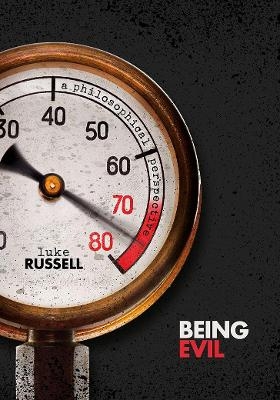
Being Evil
A Philosophical Perspective
Seiten
2020
Oxford University Press (Verlag)
978-0-19-886207-9 (ISBN)
Oxford University Press (Verlag)
978-0-19-886207-9 (ISBN)
With the media bringing us constant tales of terrorism and violence, questions regarding the nature of evil are highly topical. Luke Russell explores the philosophical thinking and psychological evidence behind evil, alongside portrayals of fictional villains, considering why people are evil, and how it goes beyond the normal realms of what is bad.
We regularly encounter appalling wrongdoing, with the media offering a depressing parade of violent assault, rape, and murder. Yet sometimes even the cynical and world-weary amongst us are taken aback. Sometimes we confront a crime so terrible, so horrendous, so deeply wrong, that we reach for the word 'evil'. The 9/11 terrorist attacks were not merely wrong, but evil. A serial killer who tortures their victims is not merely a bad person. They are evil. And as the Holocaust showed us, we must remain vigilant against the threat of evil. But what exactly is it? If we use the word 'evil', are we buying into a naive Manichean worldview, in which two cosmic forces of good and evil are pitted against one another? Are we guilty of demonizing our enemies? How does 'evil' go beyond what is merely bad or wrong?
This book explores the answers that philosophers have offered to these questions. Luke Russell discusses why some philosophers think that evil is a myth or a fantasy, while others think that evil is real, and is a concept that plays an important role in contemporary secular morality. Along the way he asks whether evil is always horrific and incomprehensible, or if it can be banal. Considering if there is a special psychological hallmark that sets the evildoers apart from the rest of us, Russell also engages with ongoing discussions over psychopathy and empathy, analysing the psychology behind evildoing.
We regularly encounter appalling wrongdoing, with the media offering a depressing parade of violent assault, rape, and murder. Yet sometimes even the cynical and world-weary amongst us are taken aback. Sometimes we confront a crime so terrible, so horrendous, so deeply wrong, that we reach for the word 'evil'. The 9/11 terrorist attacks were not merely wrong, but evil. A serial killer who tortures their victims is not merely a bad person. They are evil. And as the Holocaust showed us, we must remain vigilant against the threat of evil. But what exactly is it? If we use the word 'evil', are we buying into a naive Manichean worldview, in which two cosmic forces of good and evil are pitted against one another? Are we guilty of demonizing our enemies? How does 'evil' go beyond what is merely bad or wrong?
This book explores the answers that philosophers have offered to these questions. Luke Russell discusses why some philosophers think that evil is a myth or a fantasy, while others think that evil is real, and is a concept that plays an important role in contemporary secular morality. Along the way he asks whether evil is always horrific and incomprehensible, or if it can be banal. Considering if there is a special psychological hallmark that sets the evildoers apart from the rest of us, Russell also engages with ongoing discussions over psychopathy and empathy, analysing the psychology behind evildoing.
Luke Russell is Associate Professor in the Department of Philosophy at the University of Sydney, where he teaches ethics and critical thinking. Luke has written on various topics in the field of moral philosophy, including evil, forgiveness, virtue, and vice, and is the author of Evil: A Philosophical Investigation (OUP, 2014).
1: The philosophical puzzle of evil
2: The horror and incomprehensibility of evil
3: The psychological hallmark of evil
4: The banality of evil
5: An evil person
6: Are you evil? Is anyone evil?
Index
Further Reading
| Erscheinungsdatum | 10.08.2020 |
|---|---|
| Verlagsort | Oxford |
| Sprache | englisch |
| Maße | 129 x 178 mm |
| Gewicht | 248 g |
| Themenwelt | Geisteswissenschaften ► Philosophie ► Ethik |
| Sozialwissenschaften ► Soziologie | |
| ISBN-10 | 0-19-886207-5 / 0198862075 |
| ISBN-13 | 978-0-19-886207-9 / 9780198862079 |
| Zustand | Neuware |
| Informationen gemäß Produktsicherheitsverordnung (GPSR) | |
| Haben Sie eine Frage zum Produkt? |
Mehr entdecken
aus dem Bereich



aus dem Bereich
Buch | Hardcover (2025)
Suhrkamp (Verlag)
CHF 32,15


