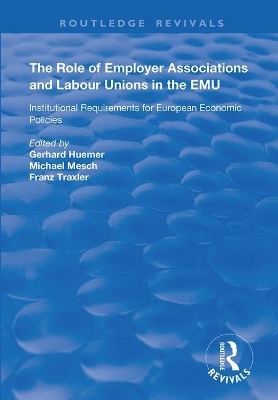
The Role of Employer Associations and Labour Unions in the EMU
Routledge (Verlag)
978-1-138-36938-2 (ISBN)
First published in 1999, this volume recognises that in the course of European integration, national economic policy makers lose some effective policy instruments. Contributors to this omnibus volume analyse the 'room for maneuvering' available to national and EU economic and social policies under the conditions of the Economic and Monetary Union (EMU). They explore the possibilities for European coordination and discuss the tasks of employers’ associations and labour unions on the national and EU level in wage, employment and macroeconomic policies. Section 1 of the book deals with the strengths and weaknesses of the EU in the context of global competition. In spite of national differences, many of the EU member countries share important characteristics. Section 2 addresses the need for and the feasibility of policy coordination in the EMU. With the start of the EMU, wage policy will have to bear the main burden of absorbing asymmetrical economic shocks. The authors from the DIW argue that a wage policy favourable to economic growth, employment and convergence has to be guided by the inflation target set by the European Central Bank (ECB) and by the long-term increase of productivity in individual countries. A precondition for this kind of wage policy is coordination between the main actors of EU economic policy (ECB, EcoFin, social partners).
Gerhard Huemer, Franz Traxler, MichaelMesch
1. Does a European Social Model Exist and Can It Survive? Bernhard Ebbinghaus. 2. Adapting the European Model: the Role of Employers’ Associations and Trade Unions. Colin Crouch. 3. European Macro-Economic Policy. Summary of a Presentation by Ludwig Schubert. 4. Is There a Need for a Co-ordinated European Wage and Labour Market Policy? Ulrich Fritsche, Gustav A. Horn, Wolfgang Scheremet, Rudolf Zwiener. 5. Societal Support for Social Dialogue. Europe’s Trade Unions and Employers’ Associations. Jelle Visser. 6. Wage-Setting Institutions and European Monetary Union. Franz Traxler. 7. Reforming the Channels of Representation for an Eventual Euro-Democracy. Philippe C. Schmitter. 8. The Role of the Associations in a European Constitution. Justin Greenwood. 9. Summary of the Conference. Michael Mesch, Clarisse Pásztory, Thomas Zotter. 10. Conclusions by the Arbeitskreis für Ökonomische und Soziologische Studien.
| Erscheinungsdatum | 16.01.2021 |
|---|---|
| Reihe/Serie | Routledge Revivals |
| Verlagsort | London |
| Sprache | englisch |
| Maße | 152 x 219 mm |
| Gewicht | 410 g |
| Themenwelt | Sozialwissenschaften ► Politik / Verwaltung |
| Sozialwissenschaften ► Soziologie | |
| Wirtschaft ► Volkswirtschaftslehre | |
| ISBN-10 | 1-138-36938-1 / 1138369381 |
| ISBN-13 | 978-1-138-36938-2 / 9781138369382 |
| Zustand | Neuware |
| Informationen gemäß Produktsicherheitsverordnung (GPSR) | |
| Haben Sie eine Frage zum Produkt? |
aus dem Bereich