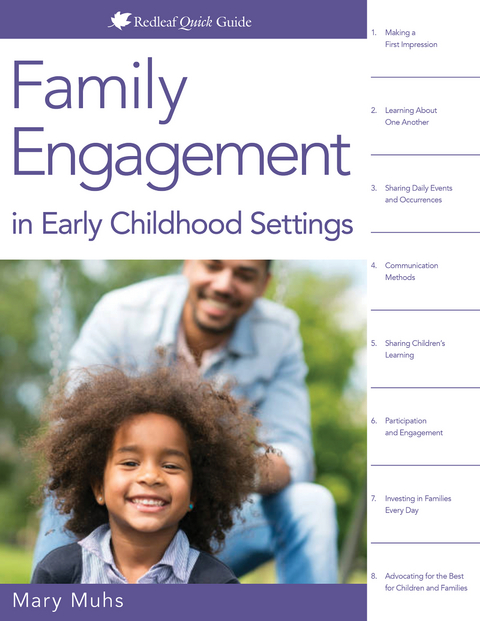
Working with parents and families can be a challenge, especially when there are contradicting expectations. However, it can also be a joyful and empowering experience for both the program and the family if partnering with families is built into the program's culture. Following a strengths-based approach, Family Engagement in Early Childhood Settings offers all programs, including family child care, center-based and school-based programs, strategies for building or enhancing interactions, engagement, expectations, communication and participation with families.This Redleaf Quick Guide provides clear information of what to do as well as what not to do when encouraging family engagement in early care and education programs. Readers will find helpful information on making the best first impressions with parents in-person and online, establishing effective and supportive intake meetings for both parents and program, setting expectations from both perspectives, two-way communication strategies including daily conversations, verbal and technological methods, conferences and documenting learning, and creating a culture of family engagement embedded into every part of your program.
Mary Muhs is the department chair for early childhood education at Rasmussen College. She graduated with a master’s degree in early childhood administration from National Louis University, maintains a Level 3 IL Director Credential and is currently pursuing an EdD in early childhood education from Walden University. Mary is also busy as a CDA credential PD specialist, an infant/toddler and health and safety coach for the Center for Inclusive Child Care, a NAEYC higher education peer reviewer and is an active trainer both in-person and online. Her almost 30 years of experience has helped her develop perspectives from all parts of the early care and education field.
Introduction: A Culture of Family EngagementChapter One: Making a First ImpressionFirst ImpressionsWebsitesSocial MediaEmailsPhone CallsOpen Door Policy for All FamiliesChapter Two: Learning About Each OtherIntake Meetings and ExperiencesSetting and Establishing ExpectationsFeedback Loops: Surveys, Parent GroupsParent Education Opportunities: Lunch and Learns—Ten Lunch and Learn Topics, Curriculum Nights—Five Curriculum Night Ideas, Educational Webinars—Ten Webinar TopicsChapter Three: Give and Take of CommunicationConfidentiality and EthicsIns and outs of sharing daily events and occurrencesTiming: Drop- off, Nap Time, Pick-up, Pre-arranged MeetingsVerbal Communication: Verbal Communication Strategies, Three Pluses and a Wish, The SandwichTechnological Communication: Texting, Phone, Happy Calls/Good News Calls, EmailInteractive Daily Communication AppsNewslettersDocumentation of LearningConferences and MeetingsChallenges with Conferences: Parents who do not attend, Delivering sensitive or constructive information, Parents who are opposed to program policy or curriculum goals, Delivering information about developmental concernsChapter Four: Participation and EngagementMeet families where they areEmbed engagement opportunities in the learning environment: Guests, Meals and snacks, Everyday activities, Special Events and experiences, Holidays and BirthdaysAppendix A: Family Visit RecordAppendix B: Intake Interview Questions to AskAppendix C : Newsletter TemplatesAppendix D : Conference Questions
| Erscheint lt. Verlag | 20.11.2018 |
|---|---|
| Reihe/Serie | Redleaf Quick Guide |
| Sprache | englisch |
| Themenwelt | Sachbuch/Ratgeber ► Freizeit / Hobby ► Sammeln / Sammlerkataloge |
| Sachbuch/Ratgeber ► Gesundheit / Leben / Psychologie ► Familie / Erziehung | |
| Sozialwissenschaften ► Pädagogik ► Vorschulpädagogik | |
| Schlagworte | Communication • Communication Strategies • Engagement • enhancing interactions • establishing relationships • Expectations • overcoming communication challenges • parent engagement • parent participation • Participation • Strengths-based Approach • technological communication • two-way communication strategies |
| ISBN-10 | 1-60554-606-2 / 1605546062 |
| ISBN-13 | 978-1-60554-606-3 / 9781605546063 |
| Informationen gemäß Produktsicherheitsverordnung (GPSR) | |
| Haben Sie eine Frage zum Produkt? |
 EPUB (Adobe DRM)
Kopierschutz: Adobe-DRM
Adobe-DRM ist ein Kopierschutz, der das eBook vor Mißbrauch schützen soll. Dabei wird das eBook bereits beim Download auf Ihre persönliche Adobe-ID autorisiert. Lesen können Sie das eBook dann nur auf den Geräten, welche ebenfalls auf Ihre Adobe-ID registriert sind.
Details zum Adobe-DRM
Dateiformat: EPUB (Electronic Publication)
EPUB ist ein offener Standard für eBooks und eignet sich besonders zur Darstellung von Belletristik und Sachbüchern. Der Fließtext wird dynamisch an die Display- und Schriftgröße angepasst. Auch für mobile Lesegeräte ist EPUB daher gut geeignet.
Systemvoraussetzungen:
PC/Mac: Mit einem PC oder Mac können Sie dieses eBook lesen. Sie benötigen eine
eReader: Dieses eBook kann mit (fast) allen eBook-Readern gelesen werden. Mit dem amazon-Kindle ist es aber nicht kompatibel.
Smartphone/Tablet: Egal ob Apple oder Android, dieses eBook können Sie lesen. Sie benötigen eine
Geräteliste und zusätzliche Hinweise
Buying eBooks from abroad
For tax law reasons we can sell eBooks just within Germany and Switzerland. Regrettably we cannot fulfill eBook-orders from other countries.
aus dem Bereich