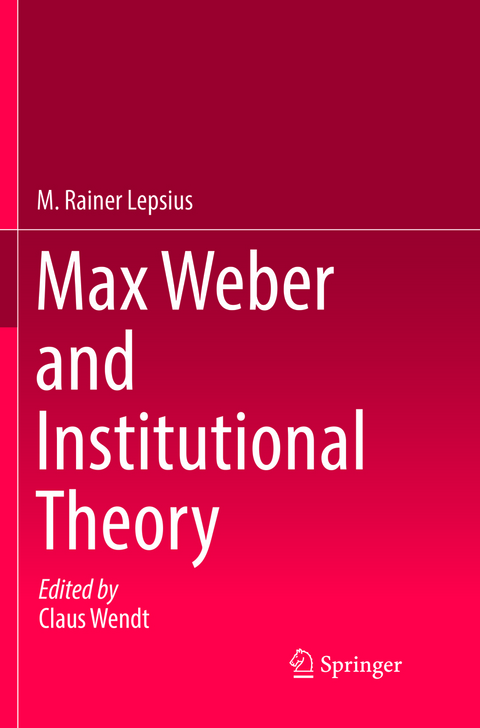
Max Weber and Institutional Theory
Springer International Publishing (Verlag)
978-3-319-83116-9 (ISBN)
M. Rainer Lepsius, 1928 (Buenos Aires) - 2014 (Heidelberg), was a German sociologist with great influence on the development of German post-war sociology. He was professor of sociology at the Universities Mannheim and Heidelberg and held guest professorships at the universities of Hong Kong, Pittsburgh, Princeton, Stanford, and New York. His work, based on the writing of Max Weber, has a long-lasting influence on German sociology, political science, and history. Today, much of the work of younger social scientists working on institutional theory, on the European Union, German Unification, German democracy, and National Socialism are directly or indirectly influenced and informed by Lepsius. The editor, Claus Wendt, M.A., Ph.D., a 2008-09 Harkness/Bosch Fellow of Health Policy & Practice at Harvard School of Public Health and J. F. Kennedy Fellow at Harvard's Center for European Studies, is professor of sociology at Siegen University. Wendt's research interests include institutional theory, political sociology, international comparisons of welfare states and healthcare systems, and the sociology of health. He has written and edited more than ten books, e.g. with T. Marmor two volumes on Reforming Healthcare Systems (Edward Elgar, 2011) and with E. Kuhlmann, R. H. Blank, and I. L. Bourgeault The Palgrave International Handbook of Healthcare Policy and Governance (Palgrave, 2015), and has written more than 50 peer-reviewed journal articles.
Preface.- 1 Introduction to Lepsius' Concept of Institutional Theory.- 2 Interests and Ideas. Max Weber's Allocation Problem.- 3 The Institutionalization and Deinstitutionalization of Rationality Criteria.- 4 Institutional Analysis and Institutional Policy.- 5 The Institutionalization of Rationality Criteria and the Role of Intellectuals.- 6 Modernization Policy and Institution Building: Criteria of Institutional Differentiation.- 7 Trust in Institutions.- 8 Max Weber's Concept of Charismatic Authority and Its Applicability to Adolf Hitler's "Führerstaat".- 9 From Fragmented Party Democracy to Government by Emergency Decree and National Socialist Takeover: Germany.- 10 Extreme Nationalism. Structural Conditions of National Socialist Seizure of Power.- 11 The "Ethics" of Institutions.- 12 The Legacy of Two Dictatorships for the Political Culture of United Germany.- 13 The Formation of German Political Culture by Institutional Orders.
| Erscheinungsdatum | 05.03.2022 |
|---|---|
| Zusatzinfo | VII, 221 p. 2 illus. |
| Verlagsort | Cham |
| Sprache | englisch |
| Maße | 155 x 235 mm |
| Gewicht | 3577 g |
| Themenwelt | Sozialwissenschaften ► Politik / Verwaltung ► Politische Theorie |
| Sozialwissenschaften ► Soziologie ► Allgemeines / Lexika | |
| Sozialwissenschaften ► Soziologie ► Spezielle Soziologien | |
| Schlagworte | Democratization • German Unification • Institutional Change • institutionalization • Institutional Theory • Max Weber • National Socialism • Political culture |
| ISBN-10 | 3-319-83116-X / 331983116X |
| ISBN-13 | 978-3-319-83116-9 / 9783319831169 |
| Zustand | Neuware |
| Informationen gemäß Produktsicherheitsverordnung (GPSR) | |
| Haben Sie eine Frage zum Produkt? |
aus dem Bereich