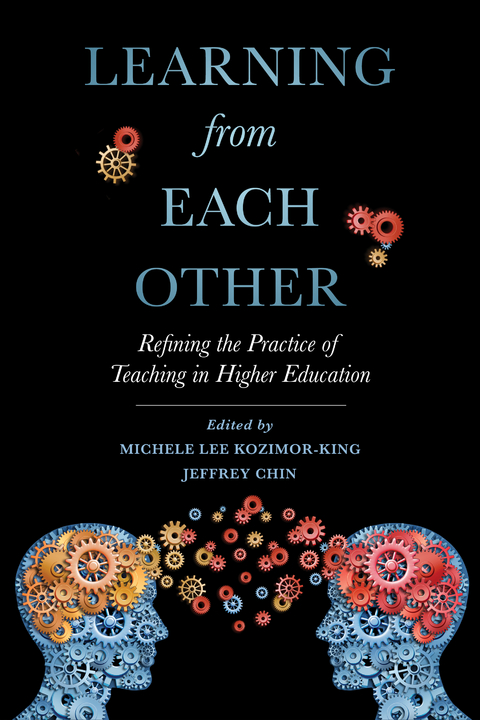
Learning from Each Other (eBook)
336 Seiten
University of California Press (Verlag)
978-0-520-96903-2 (ISBN)
- employing the science of learning in a social science context
- understanding the effects of a flipped classroom on student success
- pedagogical techniques to create a community of inquiry in online learning environments
- the risks and rewards of co-teaching
- reaching and teaching "non-traditional" students
- facilitating learning and leadership in student team projects
- connecting students with the community through research
- issues of assessment, including backward design, developing and using rubrics, and defining and implementing the scholarship of teaching and learning
Through Learning from Each Other, all faculty who care about their teaching, but especially faculty in the social sciences, can successfully employ curricular innovations, classroom techniques, and advances in assessment to create better learning environments for their students.
Acknowledgments
Foreword by Michael Reder
Introduction
Michele Lee Kozimor-King and Jeffrey Chin
Part I. Curricular Innovations
1. The Science of Learning in a Social Science Context
Melinda Messineo
2. Pedagogical Techniques for Creating a Community of Inquiry in Online Learning Environments
Andrea N. Hunt
3. Co-Teaching: Risks and Rewards
Renee Monson and Kristy Kenyon
4. A Collaborative Aff air: Connecting Students with the Community through Research
Michele Lee Kozimor-King and Barbara Prince
5. Strategies and Resources for Internationalizing the Curriculum
Christine K. Oakley
6. Flipping Out: Understanding the Effects of a General Education Flipped Classroom on Student Success
Craig Douglas Albert, Stacie K. Pettit, and Christopher Terry
7. Reaching and Teaching “Nontraditional” Students in Community Colleges and Beyond
Sara Parker
8. Addressing Learner Variability on Campus through Universal Design for Learning
Shannon Haley-Mize
Part II. Classroom Techniques
9. Without Apology: Reclaiming the Lecture
Diane L. Pike
10. Scribes in the Classroom: Effectively Using PowerPoint to Enhance the Classroom Experience
Monica R. Sylvia and Brenda J. Kirby
11. Discussion in the Social Science Classroom
Jay R. Howard
12. Facilitating Learning and Leadership in Student Team Projects
Dennis O’Connor
13. Courting Controversy and Allowing for Awkward: Strategies for Teaching Difficult Topics
Mari Plikuhn
14. Becoming a Culturally Inclusive Educator
Dena R. Samuels
15. The Value of Games and Simulations in the Social Sciences
Amanda M. Rosen
16. Putting the Student at the Center: Contemplative Practices as Classroom Pedagogy
Tracey Wenger Sadd
Part III. Out-of-class Situations
17. Student Reading Compliance and Learning in the Social Sciences
Jay R. Howard
18. Cultivating Engagement and Deepening Understanding While Leaving the Textbook Behind
Robin G. Isserles
Part IV. Assessment
19. (Re-)Creating Your Course: Backward Design and Assessment
Melinda Messineo
20. “Am I Grading Consistently and Effectively?”: Developing and Using Rubrics
Shirley A. Jackson
21. Defining and Implementing the Scholarship of Teaching and Learning
Jeffrey Chin
Contributors
Index
| Erscheint lt. Verlag | 21.8.2018 |
|---|---|
| Sprache | englisch |
| Themenwelt | Sozialwissenschaften ► Pädagogik ► Erwachsenenbildung |
| Sozialwissenschaften ► Soziologie | |
| Schlagworte | backward design • Community Colleges • Co teaching • cultivating engagement • curricular innovations • faculty • faculty professional development • four year institutions • graduate students • interests of faculty • learning • Learning and leadership • non traditional students • Online learning environments • professors • research intensive universities • rubrics • science of learning • Social Science • Teaching |
| ISBN-10 | 0-520-96903-0 / 0520969030 |
| ISBN-13 | 978-0-520-96903-2 / 9780520969032 |
| Informationen gemäß Produktsicherheitsverordnung (GPSR) | |
| Haben Sie eine Frage zum Produkt? |
 EPUB (Adobe DRM)
Kopierschutz: Adobe-DRM
Adobe-DRM ist ein Kopierschutz, der das eBook vor Mißbrauch schützen soll. Dabei wird das eBook bereits beim Download auf Ihre persönliche Adobe-ID autorisiert. Lesen können Sie das eBook dann nur auf den Geräten, welche ebenfalls auf Ihre Adobe-ID registriert sind.
Details zum Adobe-DRM
Dateiformat: EPUB (Electronic Publication)
EPUB ist ein offener Standard für eBooks und eignet sich besonders zur Darstellung von Belletristik und Sachbüchern. Der Fließtext wird dynamisch an die Display- und Schriftgröße angepasst. Auch für mobile Lesegeräte ist EPUB daher gut geeignet.
Systemvoraussetzungen:
PC/Mac: Mit einem PC oder Mac können Sie dieses eBook lesen. Sie benötigen eine
eReader: Dieses eBook kann mit (fast) allen eBook-Readern gelesen werden. Mit dem amazon-Kindle ist es aber nicht kompatibel.
Smartphone/Tablet: Egal ob Apple oder Android, dieses eBook können Sie lesen. Sie benötigen eine
Geräteliste und zusätzliche Hinweise
Buying eBooks from abroad
For tax law reasons we can sell eBooks just within Germany and Switzerland. Regrettably we cannot fulfill eBook-orders from other countries.
aus dem Bereich