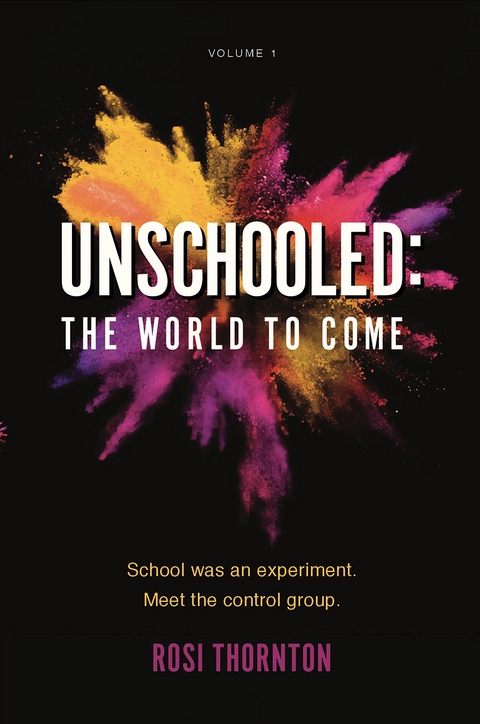
Unschooled (eBook)
348 Seiten
Efa Rosina Thornton (Verlag)
978-1-9164159-1-1 (ISBN)
IntroductionChapter 1, THE EXPERIMENT, looks at the origins of schooling, the benefits, the beginnings of doubt in the sixties as to the effects on children, problems with schooling, school as a commodity, and the way school affects society.Chapter 2, THE CONTROL GROUP, describes the rise of home education in America and Britain, the impact and benefits of unschooling, how unschooling works, and what we need from education in the future.Chapter 3, HOW SCHOOL HINDERS, asks if school is really improving society. Who benefits, citizen or state? Is it preparing us for the future, or keeping us in the past? How changing schooling can change society.Chapter 4, FINNISH LESSONS, focuses on the successful Finnish education system. The parallels between the Finnish system and unschooling are discussed.Chapter 5, LAND RIGHTS AND SCHOOLING, investigates the relationship between land and education, including enforced schooling; the impact of losing our connection with the land; sovereignty and self-determinism; and cross-cultural classrooms.Chapter 6, LANGUAGE AND LEARNING, examines the use of schooling to impose Western worldviews on other cultures; how indigenous groups are controlled through language and schooling; and the implications of language loss for the way we think, communicate, and our ability to learn.Chapter 7, CLASS AND CULTURE, discusses the myth of social mobility; how school maintains the status quo; the effect of class on our attitudes and the way we learn; how we define 'success'; the dangers of inequality; and why social class does not impact unschoolers.Chapter 8, HERDING HUMANITY, looks at competition versus cooperation; attachment and separation; grading, failure and creativity; false authority; the myth of the lone genius; heroes and celebrities; and the cult of the individual.Chapter 9, THE SOCIALISATION MYTH, asks what we mean by socialisation, and covers peer pressure; introverts; the issue of bullies; 'invisible children'; socialisation versus conformity; and increasing restrictions on home education.Chapter 10, THE TEACHING SPECIES, highlights our innate drive to teach, including our need for meaning and responsibility; mentors and apprentices; indigenous and traditional ways of teaching; role models, authority figures, and elders.Chapter 11, RECLAIMING MOTHERHOOD, focuses on unschooling from the point of view of mothers, including the role of women in the home; the benefits of attachment; identity and independence; reconciling work and home; grandmothers; and the flight to cities.Chapter 12, TEACHING WITH TECH, investigates the knowledge economy; future skills; online academies; technology in the classroom; why games help us learn; unschooling in Silicon Valley; technology in an indigenous context; the cost of education; and the future of universities.Chapter 13, THE CUTTING EDGE, highlights the parallels between online movements, hacker culture and unschooling. It examines information overload; media and children; surveillance in schools; the Gaze of society; automation; and the potential of unschooling for the future.ConclusionEndnotes
| Erscheint lt. Verlag | 3.7.2018 |
|---|---|
| Reihe/Serie | The Marks We Make |
| Sprache | englisch |
| Themenwelt | Schulbuch / Wörterbuch ► Schulbuch / Allgemeinbildende Schulen |
| Sozialwissenschaften ► Pädagogik ► Allgemeines / Lexika | |
| Sozialwissenschaften ► Pädagogik ► Bildungstheorie | |
| Schlagworte | Anarchism • Anthropology • Feminism • Future Societies • Home Education • libertarian • Sociology |
| ISBN-10 | 1-9164159-1-1 / 1916415911 |
| ISBN-13 | 978-1-9164159-1-1 / 9781916415911 |
| Informationen gemäß Produktsicherheitsverordnung (GPSR) | |
| Haben Sie eine Frage zum Produkt? |
 EPUB (Adobe DRM)
Kopierschutz: Adobe-DRM
Adobe-DRM ist ein Kopierschutz, der das eBook vor Mißbrauch schützen soll. Dabei wird das eBook bereits beim Download auf Ihre persönliche Adobe-ID autorisiert. Lesen können Sie das eBook dann nur auf den Geräten, welche ebenfalls auf Ihre Adobe-ID registriert sind.
Details zum Adobe-DRM
Dateiformat: EPUB (Electronic Publication)
EPUB ist ein offener Standard für eBooks und eignet sich besonders zur Darstellung von Belletristik und Sachbüchern. Der Fließtext wird dynamisch an die Display- und Schriftgröße angepasst. Auch für mobile Lesegeräte ist EPUB daher gut geeignet.
Systemvoraussetzungen:
PC/Mac: Mit einem PC oder Mac können Sie dieses eBook lesen. Sie benötigen eine
eReader: Dieses eBook kann mit (fast) allen eBook-Readern gelesen werden. Mit dem amazon-Kindle ist es aber nicht kompatibel.
Smartphone/Tablet: Egal ob Apple oder Android, dieses eBook können Sie lesen. Sie benötigen eine
Geräteliste und zusätzliche Hinweise
Buying eBooks from abroad
For tax law reasons we can sell eBooks just within Germany and Switzerland. Regrettably we cannot fulfill eBook-orders from other countries.
aus dem Bereich