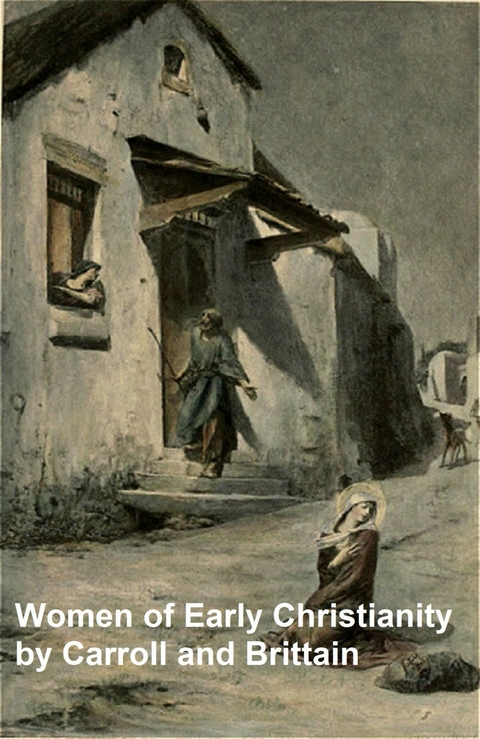
Women of Early Christianity (eBook)
351 Seiten
Seltzer Books (Verlag)
978-1-4554-1464-2 (ISBN)
First published in 1907.According to the Preface: 'Christianity introduced a new moral epoch in the course of human history. Its effect was necessarily transforming upon those who came under its sway. Being cosmopolitan in its nature, we have now to study woman as being somewhat dissociated from racial type and national manner, and we shall seek to ascertain how she met and was modified by Christian conditions. These had a larger effect upon her life than upon that of man; for, by its nature, Christianity gave an opening for the higher possibilities of her being of which the old religions took little account. In the realm of the spiritual, it, for the first time, assented to her equality with man. That the women of the first Christian centuries submitted themselves to the influence of that religion in a varying degree, the following pages will abundantly show.
First published in 1907. According to the Preface: "e;Christianity introduced a new moral epoch in the course of human history. Its effect was necessarily transforming upon those who came under its sway. Being cosmopolitan in its nature, we have now to study woman as being somewhat dissociated from racial type and national manner, and we shall seek to ascertain how she met and was modified by Christian conditions. These had a larger effect upon her life than upon that of man; for, by its nature, Christianity gave an opening for the higher possibilities of her being of which the old religions took little account. In the realm of the spiritual, it, for the first time, assented to her equality with man. That the women of the first Christian centuries submitted themselves to the influence of that religion in a varying degree, the following pages will abundantly show.
WE have already given some attention to certain famous Christian women who, in the earliest ages of the Church, dedicated themselves to the ascetic life. But monasticism, occupying as it did so extensive and important a field in the early Church, deserves the devotion of nothing less than a chapter to the consideration of its effect upon the life of women, and to the part they played in its establishment. In describing the friends of Jerome--Paula, Eustochium, Asella, and the others--we dwelt more on the moral aspect of primitive asceticism, its exaggerations, its wrong-headedness, its influence upon family life; it is now our purpose to take a brief glance at the organization of female monasticism, and to notice its effect upon the social life of women. For it cannot be otherwise than that so popular and general an institution as this must at the time have profoundly affected human existence. A great multitude of men and women taken out of common society and living apart under conditions entirely contradictory to the instinct and usages of the race must have shaken the body politic in every direction, causing a movement of influences far-reaching in its effect.
Monasticism was not the creation of Christianity; the religions of the East had their devotees, like the Jewish Essenes, who abandoned the common pursuits of men for a life of solitude, idle introspection, and rapt contemplation. The wildernesses and solitary places of the East had been made yet more weird by the presence of unhumanlike hermits, even before the days of John the Baptist. Christian monasticism, also, had its birth in the dreamy East. Antony, by his example, and Pachomius, by enthusiastic propaganda of monastic ideas, laid the foundations of that system which was to honeycomb the whole world with bands of men and women who repudiated the natural pleasures and the essential duties of the world.
Of the motive that inspired the monastic life, St. Augustine says: "No corporeal fecundity produces this race of virgins; they are no offspring of flesh and blood. Ask you the mother of these? It is the Church. None other bears these sacred virgins but that one espoused to a single husband, Christ. Each of these so loved that beautiful One among the sons of men, that, unable to conceive Him in the flesh as Mary did, they conceived Him in their heart, and kept for him even the body in integrity."
We may admit this intense love of God as a moving force, and still claim that the hermits and anchoresses of the early Church were actuated largely by the desire to redeem themselves from the wrath to come and to gain a personal entrance to the paradise of God. Salvation was an individual responsibility, and it admitted of no compromise with the world. The road to perfection could be cheered with company only, providing others were willing to set out upon it by first renouncing all natural joys, and by despising all human ties. The claims of close kindred were not allowed to hinder in the personal quest for heavenly rewards. The tearfully pleaded needs of an aged parent were not permitted to detain at home the daughter who had consecrated herself as the bride of Christ; Paula turned her back upon the outstretched hands of her infant son, in order that in the Holy Land she might spend her days in ecstatic contemplation of the Jerusalem above. It is recorded to the high praise of Saint Fulgentius that he sorely wounded his mother's heart by despising her sorrow at his departure.
True it is that many of the earliest consecrated handmaidens of the Church continued to reside in their city homes, and, in addition to their prayers, devoted themselves to works of charity and mercy. But they were scarcely less separated from the world and their kindred. Their manner of life interdicted all common intercourse. The virgin who could boast that for twenty-five years she never bathed, except the tips of her fingers, and these only when she was about to receive the Communion, must have been as foreign to the Rome in which she lived as if she inhabited a cave in the Thebaid. Her kinsfolk may have reverenced her sanctity, but it is doubtful if they unqualifiedly appreciated her presence. The explanation of this transcendent personal neglect is to be found in the dualism which was so considerable an element in the motif of monasticism. The religious sphere was exclusively spiritual and of the mind; the material world was considered to be wholly under the dominion of the devil if it were not, indeed, his work. The body, with all its appetites, instincts, pleasures, and pains, was regarded as a spiritual misfortune. Holiness was not deemed to be in any degree attainable except by constant and determined thwarting of all natural desire. The compulsion to give way to any extent to the most essential of these desires was, so far as it obtained, a moral imperfection. The three great human faults are lust, pride, and avarice. To subjugate these, celibacy, absolute submission, and complete poverty, were deemed necessary by the advocates of monasticism. Because purity is enjoined, the saint of one sex must treat a person of the other with the same avoidance as would be displayed toward a poisonous reptile; readiness to embrace a leper is none too severe a test of humility; and personal property in a hair blanket is a pitfall laid by wealth. A body so wasted by fasting as to be incapable of sustaining the continuous round of tears and prayers is the surest warrant of saintliness. A virgin who has so abused her stomach by improper and insufficient food that it refuses a meal necessary to a healthy body is the object of high veneration; indigestion is a most desirable corollary to holiness. In short, without outraging reason and contradicting every dictum of common sense, it is difficult to describe much that belonged to ancient monasticism in any other spirit than that of impatience.
Like most institutions, monasticism began in a formless, undirected enthusiasm. Men and women rushed into the wilderness with an abundantly zealous determination to get away from the wickedness of the world, but with a still greater scarcity of understanding regarding a reasonable discipline of life. Soon, however, organization was proposed by monks of experience, and rules formulated which were generally adopted. Saint Pachomius was the first to form monkish foundations in the East. These were visited by Athanasius while he was in exile, and he came back with a glowing account of the sanctity of life and the marvellous exploits of their members. His narrative fired the hearts of the more devout Christians of the West, especially of the women, and that of the monk or the nun became at once the most illustrious vocation which a Christian could follow. The result was, as the Count de Montalembert shows, that "the town and environs of Rome were soon full of monasteries, rapidly occupied by men distinguished alike by birth, fortune and knowledge, who lived there in charity, sanctity and freedom. From Rome, the new institution--already distinguished by the name of religion, or religious life, par excellence--extended itself over all Italy. It was planted at the foot of the Alps by the influence of a great bishop, Eusebius of Vercelli. From the continent, the new institution rapidly gained the isles of the Mediterranean, and even the rugged rocks of the Gargon and of Capraja, where the monks, voluntarily exiled from the world, went to take the place of the criminals and political victims whom the emperors had been accustomed to banish thither."
Western monasticism was inspired by a different genius from that of the Eastern. Instead of being speculative and characterized by dreamy indolence and meditative silence, it was far more practical. It was active, stirring; duty, rather than esoteric wisdom, was its watchword. Fasting, stated hours for prayer, reading, and vigorous manual work were strictly enjoined by every rule. Consequently, the nuns and monks of the West never went to the fantastic extremes which exhibited in the East a stylite, or a female recluse, dwelling, like an animal, in a hollow tree, or a drove of half wild and wholly maniacal humans who subsisted by browsing on such edible roots as they found in the earth on which they grovelled. Method, regularity, and purpose early gave character and efficiency to Western monasteries, and prepared them for the literary and industrial usefulness which followed in the wane of the first frenzy, and which made monasticism, in spite of itself, a powerful factor in the evolution of modern civilization. This systematizing was due to the efforts of Ambrose, Athanasius, Gregory the Great, but more especially to those of Benedict of Nursia.
The first known ceremonial recognition by the Church of a professed nun is the case of Marcellina. On Christmas Day, perhaps of the year 354, she received a veil from the hands of Pope Liberius, and made her vows before a large congregation gathered in the church of Saint Peter, at Rome. Saint Ambrose, her brother, has preserved for us a summary of the sermon preached by the bishop on the occasion. It consists of an earnest but not very convincing--so it would seem to modern ears--exhortation to abstinence from worldly pleasure and to perseverance in virginity. Marcellina continued to dwell in private in her own home, for it had not yet become customary for professed virgins to take up their residence in a common abode. The inauguration of this new departure had begun, however, as is shown by passages in the work of Saint Ambrose on virginity, which he dedicated to his sister. In the eleventh chapter of the first book, he says: "Some one may say, you are always singing the praise of virgins. What shall I do who am always singing them...
| Erscheint lt. Verlag | 1.3.2018 |
|---|---|
| Sprache | englisch |
| Themenwelt | Sozialwissenschaften ► Politik / Verwaltung |
| Sozialwissenschaften ► Soziologie ► Allgemeines / Lexika | |
| Sozialwissenschaften ► Soziologie ► Gender Studies | |
| ISBN-10 | 1-4554-1464-6 / 1455414646 |
| ISBN-13 | 978-1-4554-1464-2 / 9781455414642 |
| Informationen gemäß Produktsicherheitsverordnung (GPSR) | |
| Haben Sie eine Frage zum Produkt? |
 EPUB (Adobe DRM)
Größe: 1,7 MB
Kopierschutz: Adobe-DRM
Adobe-DRM ist ein Kopierschutz, der das eBook vor Mißbrauch schützen soll. Dabei wird das eBook bereits beim Download auf Ihre persönliche Adobe-ID autorisiert. Lesen können Sie das eBook dann nur auf den Geräten, welche ebenfalls auf Ihre Adobe-ID registriert sind.
Details zum Adobe-DRM
Dateiformat: EPUB (Electronic Publication)
EPUB ist ein offener Standard für eBooks und eignet sich besonders zur Darstellung von Belletristik und Sachbüchern. Der Fließtext wird dynamisch an die Display- und Schriftgröße angepasst. Auch für mobile Lesegeräte ist EPUB daher gut geeignet.
Systemvoraussetzungen:
PC/Mac: Mit einem PC oder Mac können Sie dieses eBook lesen. Sie benötigen eine
eReader: Dieses eBook kann mit (fast) allen eBook-Readern gelesen werden. Mit dem amazon-Kindle ist es aber nicht kompatibel.
Smartphone/Tablet: Egal ob Apple oder Android, dieses eBook können Sie lesen. Sie benötigen eine
Geräteliste und zusätzliche Hinweise
Buying eBooks from abroad
For tax law reasons we can sell eBooks just within Germany and Switzerland. Regrettably we cannot fulfill eBook-orders from other countries.
EPUB (Ohne DRM)Digital Rights Management: ohne DRM
Dieses eBook enthält kein DRM oder Kopierschutz. Eine Weitergabe an Dritte ist jedoch rechtlich nicht zulässig, weil Sie beim Kauf nur die Rechte an der persönlichen Nutzung erwerben.
Dateiformat: EPUB (Electronic Publication)
EPUB ist ein offener Standard für eBooks und eignet sich besonders zur Darstellung von Belletristik und Sachbüchern. Der Fließtext wird dynamisch an die Display- und Schriftgröße angepasst. Auch für mobile Lesegeräte ist EPUB daher gut geeignet.
Systemvoraussetzungen:
PC/Mac: Mit einem PC oder Mac können Sie dieses eBook lesen. Sie benötigen dafür die kostenlose Software Adobe Digital Editions.
eReader: Dieses eBook kann mit (fast) allen eBook-Readern gelesen werden. Mit dem amazon-Kindle ist es aber nicht kompatibel.
Smartphone/Tablet: Egal ob Apple oder Android, dieses eBook können Sie lesen. Sie benötigen dafür eine kostenlose App.
Geräteliste und zusätzliche Hinweise
Buying eBooks from abroad
For tax law reasons we can sell eBooks just within Germany and Switzerland. Regrettably we cannot fulfill eBook-orders from other countries.
aus dem Bereich