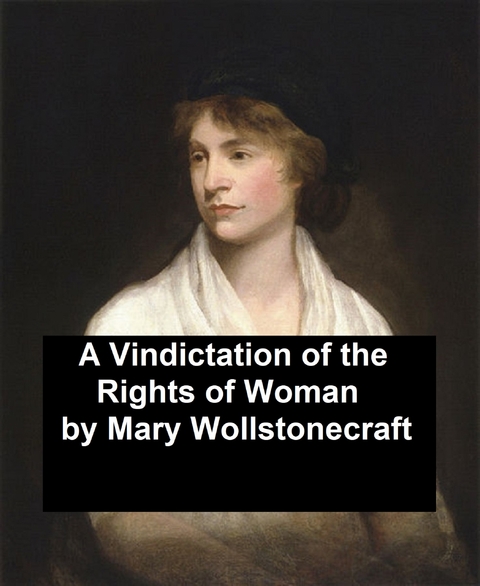
Vindication of the Rights of Woman (eBook)
489 Seiten
Seltzer Books (Verlag)
978-1-4553-8685-7 (ISBN)
Seminal work on the rights of woman. According to Wikipedia: 'A Vindication of the Rights of Woman: with Strictures on Political and Moral Subjects (1792), written by the 18th-century British feminist Mary Wollstonecraft, is one of the earliest works of feminist philosophy. In it, Wollstonecraft responds to those educational and political theorists of the 18th century who did not believe women should have an education. She argues that women ought to have an education commensurate with their position in society, claiming that women are essential to the nation because they educate its children and because they could be 'companions' to their husbands, rather than mere wives. Instead of viewing women as ornaments to society or property to be traded in marriage, Wollstonecraft maintains that they are human beings deserving of the same fundamental rights as men. Wollstonecraft was prompted to write the Rights of Woman after reading Charles Maurice de Talleyrand-Périgord's 1791 report to the French National Assembly, which stated that women should only receive a domestic education; she used her commentary on this specific event to launch a broad attack against sexual double standards and to indict men for encouraging women to indulge in excessive emotion. Wollstonecraft wrote the Rights of Woman hurriedly in order to respond directly to ongoing events; she intended to write a more thoughtful second volume but died before completing it.'
Seminal work on the rights of woman. According to Wikipedia: "e;A Vindication of the Rights of Woman: with Strictures on Political and Moral Subjects (1792), written by the 18th-century British feminist Mary Wollstonecraft, is one of the earliest works of feminist philosophy. In it, Wollstonecraft responds to those educational and political theorists of the 18th century who did not believe women should have an education. She argues that women ought to have an education commensurate with their position in society, claiming that women are essential to the nation because they educate its children and because they could be "e;companions"e; to their husbands, rather than mere wives. Instead of viewing women as ornaments to society or property to be traded in marriage, Wollstonecraft maintains that they are human beings deserving of the same fundamental rights as men. Wollstonecraft was prompted to write the Rights of Woman after reading Charles Maurice de Talleyrand-Perigord's 1791 report to the French National Assembly, which stated that women should only receive a domestic education; she used her commentary on this specific event to launch a broad attack against sexual double standards and to indict men for encouraging women to indulge in excessive emotion. Wollstonecraft wrote the Rights of Woman hurriedly in order to respond directly to ongoing events; she intended to write a more thoughtful second volume but died before completing it."e;
CHAPTER 5. ANIMADVERSIONS ON SOME OF THE WRITERS WHO HAVE RENDERED WOMEN OBJECTS OF PITY, BORDERING ON CONTEMPT.
-
The opinions speciously supported, in some modern publications on the female character, and education, which have given the tone to most of the observations made, in a more cursory manner, on the sex, remain now to be examined.
-
SECTION 5.1.
-
I shall begin with Rousseau, and give a sketch of the character of women in his own words, interspersing comments and reflections. My comments, it is true, will all spring from a few simple principles, and might have been deduced from what I have already said; but the artificial structure has been raised with so much ingenuity, that it seems necessary to attack it in a more circumstantial manner, and make the application myself.
-
Sophia, says Rousseau, should be as perfect a woman as Emilius is a man, and to render her so, it is necessary to examine the character which nature has given to the sex.
-
He then proceeds to prove, that women ought to be weak and passive, because she has less bodily strength than man; and from hence infers, that she was formed to please and to be subject to him; and that it is her duty to render herself AGREEABLE to her master--this being the grand end of her existence.
-
Supposing women to have been formed only to please, and be subject to man, the conclusion is just, she ought to sacrifice every other consideration to render herself agreeable to him: and let this brutal desire of self-preservation be the grand spring of all her actions, when it is proved to be the iron bed of fate, to fit which, her character should be stretched or contracted, regardless of all moral or physical distinctions. But if, as I think may be demonstrated, the purposes of even this life, viewing the whole, are subverted by practical rules built upon this ignoble base, I may be allowed to doubt whether woman was created for man: and though the cry of irreligion, or even atheism be raised against me, I will simply declare, that were an angel from heaven to tell me that Moses's beautiful, poetical cosmogony, and the account of the fall of man, were literally true, I could not believe what my reason told me was derogatory to the character of the Supreme Being: and, having no fear of the devil before mine eyes, I venture to call this a suggestion of reason, instead of resting my weakness on the broad shoulders of the first seducer of my frail sex.
-
"It being once demonstrated," continues Rousseau, "that man and woman are not, nor ought to be, constituted alike in temperament and character, it follows of course, that they should not be educated in the same manner. In pursuing the directions of nature, they ought indeed to act in concert, but they should not be engaged in the same employments: the end of their pursuits should be the same, but the means they should take to accomplish them, and, of consequence, their tastes and inclinations should be different." (Rousseau's 'Emilius', Volume 3 page 176.)
-
"Girls are from their earliest infancy fond of dress. Not content with being pretty, they are desirous of being thought so; we see, by all their little airs, that this thought engages their attention; and they are hardly capable of understanding what is said to them, before they are to be governed by talking to them of what people will think of their behaviour. The same motive, however, indiscreetly made use of with boys, has not the same effect: provided they are let to pursue their amusements at pleasure, they care very little what people think of them. Time and pains are necessary to subject boys to this motive.
-
"Whencesoever girls derive this first lesson it is a very good one. As the body is born, in a manner before the soul, our first concern should be to cultivate the former; this order is common to both sexes, but the object of that cultivation is different. In the one sex it is the developement of corporeal powers; in the other, that of personal charms: not that either the quality of strength or beauty ought to be confined exclusively to one sex; but only that the order of the cultivation of both is in that respect reversed. Women certainly require as much strength as to enable them to move and act gracefully, and men as much address as to qualify them to act with ease."
-
* * * * * * * * * * * * * *
-
"Children of both sexes have a great many amusements in common; and so they ought; have they not also many such when they are grown up? Each sex has also its peculiar taste to distinguish in this particular. Boys love sports of noise and activity; to beat the drum, to whip the top, and to drag about their little carts: girls, on the other hand, are fonder of things of show and ornament; such as mirrors, trinkets, and dolls; the doll is the peculiar amusement of the females; from whence we see their taste plainly adapted to their destination. The physical part of the art of pleasing lies in dress; and this is all which children are capacitated to cultivate of that art."
-
* * * * * * * * * * * * * *
-
"Here then we see a primary propensity firmly established, which you need only to pursue and regulate. The little creature will doubtless be very desirous to know how to dress up her doll, to make its sleeve knots, its flounces, its head dress, etc., she is obliged to have so much recourse to the people about her, for their assistance in these articles, that it would be much more agreeable to her to owe them all to her own industry. Hence we have a good reason for the first lessons which are usually taught these young females: in which we do not appear to be setting them a task, but obliging them, by instructing them in what is immediately useful to themselves. And, in fact, almost all of them learn with reluctance to read and write; but very readily apply themselves to the use of their needles. They imagine themselves already grown up, and think with pleasure that such qualifications will enable them to decorate themselves."
-
This is certainly only an education of the body; but Rousseau is not the only man who has indirectly said that merely the person of a young woman, without any mind, unless animal spirits come under that description, is very pleasing. To render it weak, and what some may call beautiful, the understanding is neglected, and girls forced to sit still, play with dolls, and listen to foolish conversations; the effect of habit is insisted upon as an undoubted indication of nature. I know it was Rousseau's opinion that the first years of youth should be employed to form the body, though in educating Emilius he deviates from this plan; yet the difference between strengthening the body, on which strength of mind in a great measure depends, and only giving it an easy motion, is very wide.
-
Rousseau's observations, it is proper to remark, were made in a country where the art of pleasing was refined only to extract the grossness of vice. He did not go back to nature, or his ruling appetite disturbed the operations of reason, else he would not have drawn these crude inferences.
-
In France, boys and girls, particularly the latter, are only educated to please, to manage their persons, and regulate their exterior behaviour; and their minds are corrupted at a very early age, by the worldly and pious cautions they receive, to guard them against immodesty. I speak of past times. The very confessions which mere children are obliged to make, and the questions asked by the holy men I assert these facts on good authority, were sufficient to impress a sexual character; and the education of society was a school of coquetry and art. At the age of ten or eleven; nay, often much sooner, girls began to coquet, and talked, unreproved, of establishing themselves in the world by marriage.
-
In short, they were made women, almost from their very birth, and compliments were listened to instead of instruction. These, weakening the mind, Nature was supposed to have acted like a step-mother, when she formed this after-thought of creation.
-
Not allowing them understanding, however, it was but consistent to subject them to authority, independent of reason; and to prepare them for this subjection, he gives the following advice:
-
"Girls ought to be active and diligent; nor is that all; they should also be early subjected to restraint. This misfortune, if it really be one, is inseparable from their sex; nor do they ever throw it off but to suffer more cruel evils. They must be subject, all their lives, to the most constant and severe restraint, which is that of decorum: it is, therefore, necessary to accustom them early to such confinement, that it may not afterward cost them too dear; and to the suppression of their caprices, that they may the more readily submit to the will of others. If, indeed, they are fond of being always at work, they should be sometimes compelled to lay it aside. Dissipation, levity, and inconstancy, are faults that readily spring up from their...
| Erscheint lt. Verlag | 1.3.2018 |
|---|---|
| Sprache | englisch |
| Themenwelt | Sozialwissenschaften ► Politik / Verwaltung |
| Sozialwissenschaften ► Soziologie ► Allgemeines / Lexika | |
| Sozialwissenschaften ► Soziologie ► Gender Studies | |
| ISBN-10 | 1-4553-8685-5 / 1455386855 |
| ISBN-13 | 978-1-4553-8685-7 / 9781455386857 |
| Informationen gemäß Produktsicherheitsverordnung (GPSR) | |
| Haben Sie eine Frage zum Produkt? |
 EPUB (Adobe DRM)
Größe: 488 KB
Kopierschutz: Adobe-DRM
Adobe-DRM ist ein Kopierschutz, der das eBook vor Mißbrauch schützen soll. Dabei wird das eBook bereits beim Download auf Ihre persönliche Adobe-ID autorisiert. Lesen können Sie das eBook dann nur auf den Geräten, welche ebenfalls auf Ihre Adobe-ID registriert sind.
Details zum Adobe-DRM
Dateiformat: EPUB (Electronic Publication)
EPUB ist ein offener Standard für eBooks und eignet sich besonders zur Darstellung von Belletristik und Sachbüchern. Der Fließtext wird dynamisch an die Display- und Schriftgröße angepasst. Auch für mobile Lesegeräte ist EPUB daher gut geeignet.
Systemvoraussetzungen:
PC/Mac: Mit einem PC oder Mac können Sie dieses eBook lesen. Sie benötigen eine
eReader: Dieses eBook kann mit (fast) allen eBook-Readern gelesen werden. Mit dem amazon-Kindle ist es aber nicht kompatibel.
Smartphone/Tablet: Egal ob Apple oder Android, dieses eBook können Sie lesen. Sie benötigen eine
Geräteliste und zusätzliche Hinweise
Buying eBooks from abroad
For tax law reasons we can sell eBooks just within Germany and Switzerland. Regrettably we cannot fulfill eBook-orders from other countries.
EPUB (Ohne DRM)Digital Rights Management: ohne DRM
Dieses eBook enthält kein DRM oder Kopierschutz. Eine Weitergabe an Dritte ist jedoch rechtlich nicht zulässig, weil Sie beim Kauf nur die Rechte an der persönlichen Nutzung erwerben.
Dateiformat: EPUB (Electronic Publication)
EPUB ist ein offener Standard für eBooks und eignet sich besonders zur Darstellung von Belletristik und Sachbüchern. Der Fließtext wird dynamisch an die Display- und Schriftgröße angepasst. Auch für mobile Lesegeräte ist EPUB daher gut geeignet.
Systemvoraussetzungen:
PC/Mac: Mit einem PC oder Mac können Sie dieses eBook lesen. Sie benötigen dafür die kostenlose Software Adobe Digital Editions.
eReader: Dieses eBook kann mit (fast) allen eBook-Readern gelesen werden. Mit dem amazon-Kindle ist es aber nicht kompatibel.
Smartphone/Tablet: Egal ob Apple oder Android, dieses eBook können Sie lesen. Sie benötigen dafür eine kostenlose App.
Geräteliste und zusätzliche Hinweise
Buying eBooks from abroad
For tax law reasons we can sell eBooks just within Germany and Switzerland. Regrettably we cannot fulfill eBook-orders from other countries.
aus dem Bereich