


An Immigrant Nation Seeks Cohesion (eBook)
236 Seiten
NBN International - Anthem Press (Verlag)
978-1-78308-768-6 (ISBN)
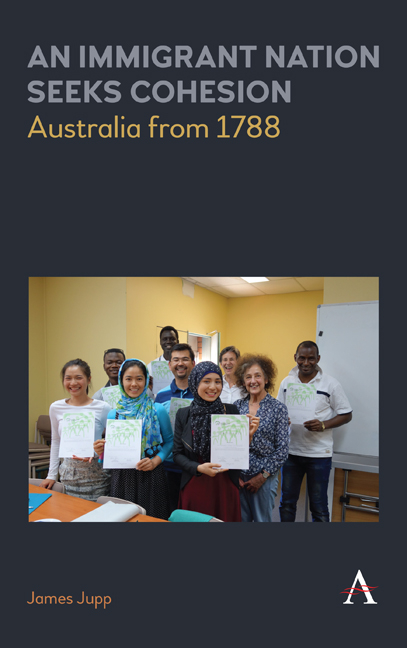
An Immigrant Nation Seeks Cohesion' is based on years of studying and teaching Australian politics and an active interest and involvement in immigration and settlement policies since the 1950s. This was a period of mass immigration from Britain and Europe, organised and mainly subsidised by the British and Australian governments.
‘An Immigrant Nation Seeks Cohesion’ is based on current events and developments in Australia and seeks to illuminate them using historical and contemporary issues. It is not a formal or chronological ‘history book’. Its sources are soundly based on the scholarship of existing history books. The transformation of Australia into a complex multicultural society comparable to the United States or Canada has not been fully dealt with by most conventional historians or taught extensively in schools and universities. Many conservative scholars either ignore this or even deplore the changes which have become so noticeable since the 1950s.
The most important of these changes has been the decline and virtual disappearance of the British Empire from the Asian regions and the growth of dozens of political powers and systems previously only subject to European control. These changes have created an international environment for Australia which is increasingly focussed on Asia and on powers as large and strong as China and India or as threatening as North Korea or some of the Islamic world. These may have been exaggerated, as was Communism in the past, but recently public policy is being reshaped to cope with them. This has normally exchanged British for United States protection, which may not be acceptable to some of Australia’s neighbours. In particular the newly discovered ‘Anglosphere’ may look just like the old British connection on a broader scale.
The Australian population reflects these changes in its quite recent nature by accepting and even welcoming immigration from the same Asian regions despite some official attempts to control and limit it after the end of the White Australia policy in the 1970s. Refugee pressures have even extended the intake to cover some parts of Africa. While some official policies have welcomed these changes, others have sought to limit them or to seek cohesion in what might seem like a dissolving society. There have been a series of public debates surrounding ethnicity, values, dangers and tensions, even though these are much less obvious than elsewhere. The book tracks backwards through history to show that dislike and even fear of non-British, non-white and undemocratic elements have existed since the earliest days of British settlement. These were first motivated by contact with the indigenous population, which was drastically reduced in size and driven from their lands within the first generation. This created lasting problems with which Australians have grappled with limited success right into the present, two centuries later. Others followed, including ‘enemy aliens’ such as Germans who were originally welcomed as civilized and Christian. Other potential enemies of British Protestantism and authority were soon included – the Irish, socialists, radicals and, eventually by 1920, Communists.
Most potential disturbers of stability were seen as foreigners in one sense or another, extending to Jews, Catholics, Chinese, Asians, Italians, Greeks, Slavs, Displaced Persons after 1945, Japanese and, most recently, Arabs and Muslims, including Muslims who were not Arabs and Arabs who were not Muslims. These latter were the victims of the only mass race riot of recent history at Cronulla (NSW) in 2005. The reality of Middle Eastern conflicts which were largely religious were distorted into claims that some such elements could never be accepted in Australia, despite the fact that the Arabic language by then was the fourth most widely used in Australia because of permitted immigrations. Fear of political disruptors is traced back to the Industrial Workers of the World in 1918, who were made illegal by the Hughes wartime government. At the same time Hughes was trying to recruit Australians into the massacres of the World War by urging support for King and Country.
‘An Immigrant Nation Seeks Cohesion’ traces many of the fears, real or imaginary, which characterized Australians in the past. As most citizens had become literate by 1900 they were subjected to a mass press which fanned these fears right through to the present. As adult Australians (and all British migrants until recently) could vote, political parties had an interest in maintaining the myths surrounding these enemies of progress and safety, whoever they were. The fear of Communists and other radicals was often combined with fear of the power of trade unions, although these were controlled by laws from the early years. Racist and fascist organizations did not arouse so much fear during the unstable 1930s or even post-war more recently. The fear of Communism was strong enough to rend the Australian Labor Party for two decades. Yet the Communists only won one parliamentary seat at the Commonwealth level in the whole of their half-century of existence. They were an agent of the Soviet Communist state but that was the cause of their eventual collapse and demise in the 1960s. It also ignores the fact that the World War II was turned against the enemy of Australia, Britain and the United States largely by the efforts of the Soviet Red Army. As in many other respects, history becomes very malleable in the hands of those with an interest in rehearsing it. The outstanding example in Australia has been the legend of Gallipoli, where the disastrous defeat of Australian volunteers invading Turkey was soon turned into a glorious victory and national legend.
‘An Immigrant Nation Seeks Cohesion’ presents Australian traditions, myths and legends in an understanding but often critical light in the belief that such devices have often been used by interested parties and even governments to maintain social solidarity and to mould a very complex people into a coherent and obedient whole. In the process Australians have often been misled about their failures and problems in the interest of consolidating their belief in their superiority. Australia is not and never has been an equal society. It has not always been a peaceful and tolerant society but it is more so than most other states and especially many of those sending immigrants. It is not a perfect democracy. Many have been mistreated and even persecuted but not as severely as in many other still-functioning societies. That most of those suffering at present are either indigenous or refugees should not be a cause of indifference. But at least some protest and assistance has been present since the passing of the original convict state in the 1860s. Australians may be suspicious of foreigners and social and political deviants. But they have passed a whole series of reforming laws since the Federation in 1901, not all of which have been as racist as the White Australia policy. In general, Australia has been a successful society, which does not mean that problems and mistakes need to be wiped off the slate. This book seeks to get a little bit closer to the truth of two hundred years of creating a liveable society in what was a remote and unknown part of the world. Nothing is perfect. Australia might have been served by better politicians and journalists or even by academics and intellectuals. But of how many societies in the modern world could that not also be true? The point is to record and contemplate specific faults and triumphs and act accordingly.
lt;p>James Jupp is a visiting scholar in the School of Demography, Australian National University. Educated in the UK, Jupp moved to Australia after graduation. His doctoral dissertation has been published as Sri Lanka: Third World Democracy (1978). Jupp is the author of several books and articles, the editor of three encyclopaedias and the co-editor of six books.
Preface; List of Abbreviations; Introduction; Part I; 1. Prisons in the Pacific, 1788–1850; 2. The British Inheritance; 3. White Australia and the Golden Age; 4. Peace, Order and Good Government; 5. Indigenous Australia and the South Pacific; 6. Rural Settlers, the Irish and the Chinese; 7. Radicals and Rebels; 8. Communists and their Allies; 9. The Australian Security Intelligence Organization; 10. Refugees before the UN Convention and Enemy Aliens; 11. Crime, Corruption and Terrorism; 12. The Multicultural Era; 13. Islam as the New Threat; Part II; 14. The Post-War Promise Ends; 15. Refugees and War; 16. The United Nations and Refugees; 17. Mandatory Detention; 18. ‘Stop the Boats’; 19. Finding a Decent Dumping Ground; 20. History as Tragedy and Farce; 21. Facing the Real World; 22. Cohesion and Humanity; 23. From Nation-Building to Border Protection; 24. An Unstable World; Chronology; References; Index.
| Erscheint lt. Verlag | 10.4.2018 |
|---|---|
| Reihe/Serie | Anthem Studies in Australian Politics, Economics and Society | Anthem Studies in Australian Politics, Economics and Society |
| Verlagsort | London |
| Sprache | englisch |
| Maße | 150 x 150 mm |
| Gewicht | 454 g |
| Themenwelt | Sozialwissenschaften ► Pädagogik |
| ISBN-10 | 1-78308-768-4 / 1783087684 |
| ISBN-13 | 978-1-78308-768-6 / 9781783087686 |
| Informationen gemäß Produktsicherheitsverordnung (GPSR) | |
| Haben Sie eine Frage zum Produkt? |
 EPUB (Adobe DRM)
Kopierschutz: Adobe-DRM
Adobe-DRM ist ein Kopierschutz, der das eBook vor Mißbrauch schützen soll. Dabei wird das eBook bereits beim Download auf Ihre persönliche Adobe-ID autorisiert. Lesen können Sie das eBook dann nur auf den Geräten, welche ebenfalls auf Ihre Adobe-ID registriert sind.
Details zum Adobe-DRM
Dateiformat: EPUB (Electronic Publication)
EPUB ist ein offener Standard für eBooks und eignet sich besonders zur Darstellung von Belletristik und Sachbüchern. Der Fließtext wird dynamisch an die Display- und Schriftgröße angepasst. Auch für mobile Lesegeräte ist EPUB daher gut geeignet.
Systemvoraussetzungen:
PC/Mac: Mit einem PC oder Mac können Sie dieses eBook lesen. Sie benötigen eine
eReader: Dieses eBook kann mit (fast) allen eBook-Readern gelesen werden. Mit dem amazon-Kindle ist es aber nicht kompatibel.
Smartphone/Tablet: Egal ob Apple oder Android, dieses eBook können Sie lesen. Sie benötigen eine
Geräteliste und zusätzliche Hinweise
Buying eBooks from abroad
For tax law reasons we can sell eBooks just within Germany and Switzerland. Regrettably we cannot fulfill eBook-orders from other countries.
aus dem Bereich


