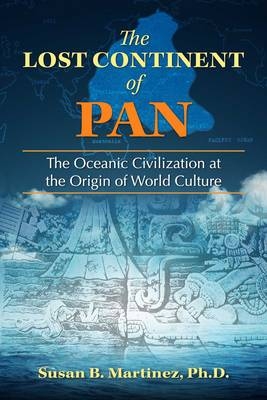
Lost Continent of Pan (eBook)
512 Seiten
Inner Traditions/Bear & Company (Verlag)
978-1-59143-268-5 (ISBN)
Reveals the Pacific Ur-culture that seeded the ancient civilizations of China, Egypt, India, Mexico, and Peru*; Shows how the Pan diaspora explains the similarities between Gobekli Tepe and Toltec carvings and stone towers in Japan and on Easter Island*; Reveals the mother tongue of Pan hidden in shared word roots in vastly different languages, including Quechua, Sanskrit, Japanese, Greek, and Sumerian*; Explains the red-haired Caucasian mummies of China, the Ainu of Japan, the presence of ';white' humans in early Native American legend, and other light-skinned peoples found in Southeast Asia and the Middle EastThe destruction of the vast continent of Pan--also known as Lemuria or Mu--in the Pacific Ocean 24,000 years ago was the greatest catastrophe that ever befell humanity. Yet it resulted in a prehistoric Golden Age of arts and technology thanks to the Sons of Noah, who, forewarned and prepared for the disaster, escaped in 5 organized fleets. Theirs was the masterful Ur-culture that seeded China, Egypt, India, Mexico, and Peru, explaining the sudden injection of the same advanced knowledge and sophisticated arts into those widely separated lands. Examining the diaspora from the sunken continent of Pan, Susan B. Martinez finds traces of the oceanic Pan civilization in arts and technologies from canal-works, masonry, and agriculture to writing, weaving, and pottery, but most importantly in the art of navigation, the hallmark of the survivors of the catastrophe. Using archaeo-linguistic analysis, she reveals the mother tongue of Pan hidden in strikingly similar words for royalty, deities, and important places in vastly different languages, including Quechua, Maori, Sanskrit, Japanese, Chinese, Greek, and Sumerian, as well as English through the prefix ';pan' which denotes ';all-encompassing.' The author reveals how the Pan diaspora explains the mound builders on each continent, the presence of ';white' humans in Native American legend, the red-haired mummies found in China, and the Ainu of Japan. She shares recent genetic studies that reveal Polynesian DNA in central Europeans, Mesopotamians, South Americans, and the 9000-year-old Kennewick man and shows how Pan provides the missing link. She reveals why carvings at Gobekli Tepe are similar to Toltec artistry, why stone towers in Japan and Easter Island are identical, and how the Pacific Ring of Fire was activated. Moving the Garden of Eden from the Fertile Crescent to the South Seas, Martinez strikes down the pervasive view of Atlantis as the source of ancient knowledge and exposes the original unity of mankind on the ancient Pacific continent of Pan.
| Erscheint lt. Verlag | 15.12.2016 |
|---|---|
| Sprache | englisch |
| Themenwelt | Sachbuch/Ratgeber ► Gesundheit / Leben / Psychologie ► Esoterik / Spiritualität |
| Geisteswissenschaften ► Archäologie | |
| Geschichte ► Allgemeine Geschichte ► Vor- und Frühgeschichte | |
| Geschichte ► Allgemeine Geschichte ► Altertum / Antike | |
| Sozialwissenschaften ► Soziologie | |
| ISBN-10 | 1-59143-268-5 / 1591432685 |
| ISBN-13 | 978-1-59143-268-5 / 9781591432685 |
| Informationen gemäß Produktsicherheitsverordnung (GPSR) | |
| Haben Sie eine Frage zum Produkt? |
 EPUB (Adobe DRM)
Kopierschutz: Adobe-DRM
Adobe-DRM ist ein Kopierschutz, der das eBook vor Mißbrauch schützen soll. Dabei wird das eBook bereits beim Download auf Ihre persönliche Adobe-ID autorisiert. Lesen können Sie das eBook dann nur auf den Geräten, welche ebenfalls auf Ihre Adobe-ID registriert sind.
Details zum Adobe-DRM
Dateiformat: EPUB (Electronic Publication)
EPUB ist ein offener Standard für eBooks und eignet sich besonders zur Darstellung von Belletristik und Sachbüchern. Der Fließtext wird dynamisch an die Display- und Schriftgröße angepasst. Auch für mobile Lesegeräte ist EPUB daher gut geeignet.
Systemvoraussetzungen:
PC/Mac: Mit einem PC oder Mac können Sie dieses eBook lesen. Sie benötigen eine
eReader: Dieses eBook kann mit (fast) allen eBook-Readern gelesen werden. Mit dem amazon-Kindle ist es aber nicht kompatibel.
Smartphone/Tablet: Egal ob Apple oder Android, dieses eBook können Sie lesen. Sie benötigen eine
Geräteliste und zusätzliche Hinweise
Buying eBooks from abroad
For tax law reasons we can sell eBooks just within Germany and Switzerland. Regrettably we cannot fulfill eBook-orders from other countries.
aus dem Bereich