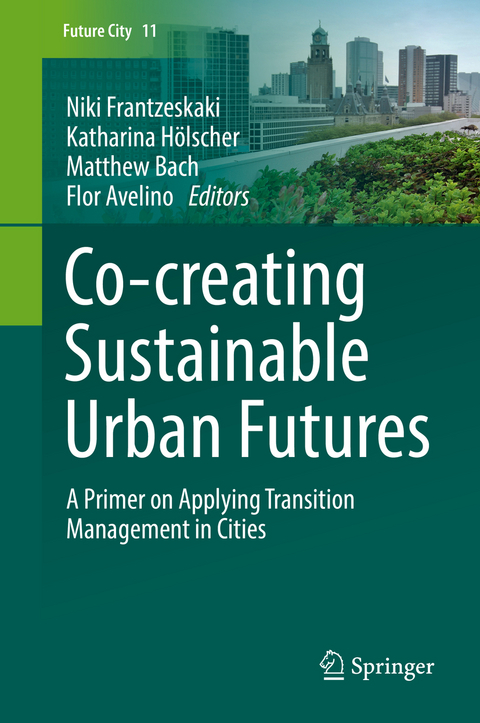
Co-creating Sustainable Urban Futures (eBook)
VIII, 425 Seiten
Springer International Publishing (Verlag)
978-3-319-69273-9 (ISBN)
This is a unique book that provides rich knowledge on how to understand and actively contribute to urban sustainability transitions. The book combines theoretical frameworks and tools with practical experiences on transition management as a framework that supports urban planning and governance towards sustainability. The book offers the opportunity to become actively engaged in working towards sustainable futures of cities. Readers of this book will be equipped to understand the complexity of urban sustainability transitions and diagnose persistent unsustainability problems in cities. Urban planners and professionals will build competences for designing transition management processes in cities and engaging with multidisciplinary knowledge in solution-seeking processes. The heart of the book marks the variety of very different local case studies across the world - including, amongst others, Rotterdam in the Netherlands, La Botija in Honduras, Sydney in Australia and Cleveland in the US. These rich studies give inspiration and practical insights to young planners on how to create sustainable urban futures in collaboration with other stakeholders.
The case studies and critical reflections on applications of transition management in cities offer food for thought and welcome criticism. They also introduce new lenses to understand the bigger picture that co-creation dynamics play in terms of power, (dis-)empowerment, legitimacy and changing actor roles. This will equip the readers with a deep understanding of the dynamics, opportunities and challenges present in urban contexts and urban sustainability transitions.
My Experience with Transition Management 6
Contents 8
Transition Management in and for Cities: Introducing a New Governance Approach to Address Urban Challenges 10
Introduction 10
How Has Transition Management Been Applied? 12
Outline of the Book 23
Part I: Introduction of Transition Thinking in Urban Context and Theoretical Grounds of Transition Management in and for Cities 24
Part II: Applications of Transition Management in Cities 25
Part III: What Transition Management Could Offer in Different Contexts 27
Part IV: Reflecting on the Impacts of Transition Management in Cities 29
What This Book Is About and How to Read It 29
References and Further Readings 31
Part I: Introduction of Transitions Thinking in Urban Context and Theoretical Grounds of Transition Management in and for Cities 50
Understanding the Urban Context and Its Challenges 52
Introduction 52
Change and Its Challenges 54
Sustainable Development 55
Persistent Problems and System Failures 56
The Urban Context 59
Defining the Urban 59
Urban Challenges 60
Scopes of Urban Sustainability 62
Governing the Urban 64
Urban Governance for Sustainability 64
References 68
Introducing Sustainability Transitions´ Thinking in Urban Contexts 71
Introducing Transitions to Sustainability 71
What Are Transitions? 72
Transitions Studies 74
Core Principles 74
Co-evolution 74
Coordinated Emergence 75
Evolutionary Revolution 75
Key Conceptual Frameworks 77
Multi-level Perspective 77
Macro Level 78
Meso Level 79
Micro Level 79
Inter-level Interaction 79
Multi-phase Model 80
Multi-path 81
Power and Agency 82
Approaches to Sustainability Transitions in the Urban Context 83
Geographical Approach (Cities as Transition Spaces) 83
Complexity Approach (Cities as `Convergence Hubs´) 84
Governance Approach (Cities as Innovation Drivers) 84
Cities as Transitionscapes to Discover Processes and Actions of Agents of Change 84
Further Reading 85
References 85
Transition Management: Guiding Principles and Applications 88
Influencing Transitions: The Transition Management Approach 88
From Understanding to Acting for Sustainability Transitions in Cities 89
Transition Management Basics 91
Governance Principles 91
Governance Framework 91
Strategic 91
Tactical 93
Operational 93
Reflexive 94
Putting Transition Management into Practice 94
Orienting 95
Phase 1: Setting the Scene 98
Phase 2: Exploring Local Dynamics 98
Phase 3: Framing the Transition Challenge 100
Phase 4: Envisioning a Sustainable City 101
Agenda Setting 102
Phase 5: Reconnecting Long-Term and Short-Term 102
Phase 6: Engaging and Anchoring 103
Activating 104
Phase 7: Getting into Action 105
Reflecting 105
Transition Management in and for Cities 106
References 107
Urban Planning and Transition Management: Rationalities, Instruments and Dialectics 109
Urban Planning: A Brief Introduction 109
Evolving Rationalities of Urban Planning 112
Rationalism in Urban Planning 112
Incrementalism in Urban Planning 113
Participation and Advocacy in Planning 114
Collaborative Planning 115
Strategic Planning 116
Multi-level- and Metropolitan Governance 118
Instruments of Urban Planning: Plans and Techniques 119
Spatial Plans 119
Sectoral and Thematic Plans 121
Environmental Assessments 122
Strategic Plans 123
Dialectics of Urban Planning and Transition Management 124
References 128
Part II: Applications of Transition Management in Cities 132
Empowering Actors in Transition Management in and for Cities 135
Introduction 135
Understanding Actors and Roles in Transition Management in and for Cities 138
Practical Roles in Transition Management in Cities 139
Transition Team 139
Transition Arena 141
Transition Network(s) 143
Heuristics to Understand Actors and Roles in Transition Management in Cities 144
The Multi-level Perspective 145
A Multi-actor Perspective 146
Roles of Societal Actors in Transition Management in Cities 150
Role(s) of Local Policy Officers and the Local Government 150
Role(s) of `Civil Society´ 152
Role(s) of Researchers 153
(Dis)empowerment in Transition Management in Cities 154
New Ties and Relationships 155
(Re-)defining Roles and Responsibilities 155
Intrinsic Motivation 156
Conclusions 157
References 158
Starting Up Transition Management: A Closer View on the Systems Analysis and How It Initiated Transformative Thinking in Ghent... 163
Introduction 164
Systems Analysis Methodology 166
Application of the Methodology 167
Case Studies: Ghent and Aberdeen Cities 171
Zooming In: Outcomes of the System Analysis in Ghent City 176
Macro Level 177
Landscape Influences 177
Historical Sketch 177
Meso Level 178
Main Assets 178
Dominant Culture, Structure and Practices 179
Micro Level 179
Identification of Niches 179
Systems Analysis in the Transition Team 179
Systems Analysis in the Transition Arena 180
Discussion 181
The Analysis of the History Inspired and Motivated Participants 182
The Systems Analysis Broadened the Problem Perception, Which Was Considered Valuable by the Participants 183
The Systems Analysis Revealed Institutional Barriers to Sustainable Development 183
The Systems Analysis Served as a Catalyst for Mutual Understanding and Learning Between the Participants 185
The Systems Analysis Falls Short in Creating a Sense of Urgency 185
Lessons for Future Applications of Systems Analysis Within Transition Management in Cities 186
Conclusions 187
References 188
Transition Management in Urban Neighbourhoods: The Case of Carnisse, Rotterdam, the Netherlands 190
Introduction 190
Methodology 192
Arena Process 192
Setting the Scene for Transition Management 193
Exploring Local Dynamics: The System and Actor Analyses 195
System Analysis 196
Actor Analysis 197
Framing the Transition Challenge 198
Envisioning a Sustainable Neighbourhood 199
Reconnecting Short/Long-Term 200
Engaging and Anchoring 201
Getting into Action 201
Evaluation and Monitoring 203
Results 203
Conclusions 204
Study Questions 206
References 206
A German Experience: The Challenges of Mediating `Ideal-Type´ Transition Management in Ludwigsburg 208
Introduction 208
Methodology 210
Transition Management in Ludwigsburg: Process Implementation and Results 211
Setting the Scene for Transition Management 212
Exploring Local Dynamics: The System and Actor Analyses 213
Framing the Transition Challenge 214
Envisioning the Energy Transition in Ludwigsburg 215
Reconnecting Short- and Long-Term 216
Engaging and Anchoring 217
Getting into Action 218
Discussion: `Ideal-Type´ Transition Management in Context 219
Allocating Time and Prioritising 219
Differentiating the `Transition Approach´ 220
Embracing Complexity 222
Overcoming Entrenched Role Relationships 223
Conclusions 225
References 226
Transition Management for Local Sustainability: A Case Study from La Botija Protected Area, San Marcos de Colón, Honduras 228
Introduction 228
Case Context 229
Methodology 230
Transition Management Process in La Botija Protected Area 232
Process Preparation and Setting 232
Headings0003351268 232
Exploration of the Local Context 232
Adaptation of the Process to the Context and Design of Transition Management Workshop Series 233
Transition Management Workshop Series and Results 234
Workshop Series #1: Understanding the Context and What Creates Persistence 234
Problem Structuring, Identifying Domains of Change and Local Opportunities 234
Description of the Local Context Dynamics 235
Connecting Environmental and Social Problems in La Botija Area 235
Context Analysis 236
Local Economy 236
Under-Developed and Under-Invested Infrastructures 236
Geophysical Conditions 238
Environmental Problems 238
Social Problems 239
Institutional Problems 240
Workshop Series #2: Co-creating a Vision and Guiding Principles 241
Workshop Series #3: Formulating Transition Pathways and a Strategic Transition Agenda 242
Cross-Cutting Workshops 252
Discussion 252
Understanding and Reflecting on the Interconnectedness of Problems and the Value of Ecosystem Services 252
Giving Voice to Individual and Collective Desires and Ambitions 253
Identification of Knowledge and Learning Needs to Solve Local Problems 253
Creating New Collaborations and Transition Initiatives 254
Realisation of Transition Agenda Post-Workshops and Cross-Cutting Workshops 255
Conclusions 256
References 257
Part III: What Transition Management Could Offer in Different Contexts 259
Translating Transitions Thinking and Transition Management into the City Planning World 262
Introduction 262
Planning Systems and Reform 265
City Planning and Urban Sustainability Governance 265
The Sydney Planning System Reform Project 265
Transitions Thinking, Planning and the SPSR Project 266
Translation Problems in Initial Attempts 266
Mainstream Planning Scholarship and System Reform 266
Beyond the Mainstream: Relational-Institutional Planning Thought 267
What´s Still Missing: And How Transition Management Can Help 268
Translating Transitions Ideas into the City Planning World 268
Conceptualising a Means of Translation 268
Taking the Logic into the World of Practice with Interviews 269
Towards a Planning System ``Transition´´ Framework 271
PST Framework Meets the Sydney Planning System Reform Project 272
Horizon 1: Intention 272
``Intention´´ Under the PST Framework: Sustainable Urban Settlement 272
``Intention´´ Driving the SPSR Project: Comparative Analysis 273
Horizon 2: Understanding 275
``Understanding´´ Under the PST Framework: Alertness to Complexity 275
``Understanding´´ Driving the SPSR Project: Comparative Analysis 275
Horizon 3: Action 278
``Action´´ Under the PST Framework: ``Transition Management´´ but in Context 278
``Action´´ Driving the SPSR Project: Comparative Analysis 281
Concluding Remarks 282
References 284
Transition Management in Urban China: Co-creation of New Homes or a Monopoly Game? 287
Introduction 287
Envisioning the Urban Future: Enacting or Reacting to Changes? 289
State Visions for Future Cities 290
Disequilibria for Transitions: Unrests and Emergencies in Urban China 292
Disequilibrium 1: Environmental Emergencies 292
Disequilibrium 2: Unlocking the Censorship 293
Disequilibrium 3: Environmental Protests 294
The Weakening of State-Imposed Visions of Urban Sustainability in China 298
Experimenting with Urban Visions in Shenzhen: Adapting Changes 299
Experiment 1: Compromised `Social Management´ 299
Experiment 2: Co-opting for Urban Niches 302
Conclusion: Disequilibria, Diversity and Participation in Transitions 305
References 308
A Transition Management Approach for Shrinking Cities in the United States 310
Introduction 310
Cleveland, Ohio: Past and Present 311
Transitions in Shrinking Cities 313
How Can Transition Management Approach Help Shrinking Cities to Better Manage Periods of Transition? 315
Complementarity: Planning Approaches That Relate to Transition Management 317
Limitations of Transition Management in a United States Context 321
Conclusion 323
References 323
Context-Driven Transition Management as a Necessary Vehicle for Sustainable Urban Futures in Suriname 325
Introduction 326
Developments and Trends in Suriname´s Urban Environment 326
Main Conditions for the Development of New Urban Settlements 329
An Evidence-Substantiated Vision of Possible New Urban Settlements in Suriname 330
Tapajai Hydropower Project 330
Brokopondo Tourism Project 331
Aerodrome Atjoni 332
Urbanization of Brownsweg and Atjoni 333
Road Through Drietabbetje to French-Guyana 334
Paranam Industrial and Commercial Project 334
Urbanization of Paranam-Overwacht-Zanderij 336
Urbanization of Groningen and Moengo 336
Recognizing Path Dependent Trajectories and Paradigms 336
Context-Driven Transition Management as a Tool to Engage in the Creation of New Urban Settlements 337
Conclusions 344
References 345
Urban Transition Management as a Democratic Practice? The Case of Rotterdam´s Waterfront Regeneration 347
Introduction 347
Transition Management and Its Democratic Aspects: Towards a Conceptual Framework 349
Cities as Sites to Grasp Democratic Transition Management 350
Insights from Critical Urban Research 351
A Democratic Transition Management Framework 352
The Case: Making Rotterdam´s Waterfront Sustainable 354
Imagining a Sustainable Waterfront 356
The Floating Communities Strategy: A Blue Revolution 358
Case Reflection: Democratic Waterfront Regeneration? 362
Urban Transition Strategy and Democratic Aspects 363
Urban Transition Tactics and Democratic Aspects 363
Urban Transition Operations and Democratic Aspects 364
Urban Transition Reflections and Democratic Aspects 364
Conclusions 365
Interviews 367
References 367
Part IV: Reflecting on the Impacts of Transition Management in Cities 370
So What? Transition Management as a Transformative Approach to Support Governance Capacities in Cities 371
Introduction 371
Transition Management in Different Contexts: The Cases Presented in This Book 374
Transition Management to Support Transformative Capacities for Disruptive Innovation 377
Enabling Novelty Creation 377
Increasing the Visibility of Novelties 379
Anchoring Novelty in Context 380
Transition Management to Support Orchestrating Capacities for Coordinated Self-Organisation 382
Strategic Alignment of Actors and Networks 382
Mediating Knowledge and Resources 385
Creating Opportunity Contexts for Synergies 387
Concluding Remarks: Lessons for Transition Management as `Transformative´ Governance Approach in Cities 388
References 390
Appendix: Exercises and Exam Questions for Lecturers Using This Book 393
Introduction 393
Questions to Make Lectures Interactive 394
Exam Questions 394
Exam Exercises 398
Transition Management and Complexity 398
System Analysis 399
Exercise 1 399
Exercise 2 399
Identifying Persistent Problems 400
Actor Analysis 400
The Role of the Frontrunners 401
Organisation of a Transition Arena 402
Envisioning 405
Backcasting 406
Interactive Exercises and Group Assignments 406
A `Quick and Dirty´ Transition Management Workshop Experience 406
Strategic Niche Management (SNM) 407
Strategic Niche Management (SNM) 411
Multi-level Perspective (MLP) 412
Identification of Frontrunners 413
Formulate a Regional Challenge 415
Actor Analysis 416
Actor, Network or Stakeholder Analyses 418
Multi-actor Roles in Transitions 419
Backcasting Transition Scenarios 421
| Erscheint lt. Verlag | 9.1.2018 |
|---|---|
| Reihe/Serie | Future City | Future City |
| Zusatzinfo | VIII, 425 p. 62 illus. |
| Verlagsort | Cham |
| Sprache | englisch |
| Themenwelt | Naturwissenschaften ► Biologie ► Ökologie / Naturschutz |
| Sozialwissenschaften ► Politik / Verwaltung | |
| Technik ► Architektur | |
| Schlagworte | Cities • sustainability • Transformation • Transition management • urban geography and urbanism • Urbanism |
| ISBN-10 | 3-319-69273-9 / 3319692739 |
| ISBN-13 | 978-3-319-69273-9 / 9783319692739 |
| Informationen gemäß Produktsicherheitsverordnung (GPSR) | |
| Haben Sie eine Frage zum Produkt? |
 PDF (Wasserzeichen)
DRM: Digitales Wasserzeichen
Dieses eBook enthält ein digitales Wasserzeichen und ist damit für Sie personalisiert. Bei einer missbräuchlichen Weitergabe des eBooks an Dritte ist eine Rückverfolgung an die Quelle möglich.
Dateiformat: PDF (Portable Document Format)
Mit einem festen Seitenlayout eignet sich die PDF besonders für Fachbücher mit Spalten, Tabellen und Abbildungen. Eine PDF kann auf fast allen Geräten angezeigt werden, ist aber für kleine Displays (Smartphone, eReader) nur eingeschränkt geeignet.
Systemvoraussetzungen:
PC/Mac: Mit einem PC oder Mac können Sie dieses eBook lesen. Sie benötigen dafür einen PDF-Viewer - z.B. den Adobe Reader oder Adobe Digital Editions.
eReader: Dieses eBook kann mit (fast) allen eBook-Readern gelesen werden. Mit dem amazon-Kindle ist es aber nicht kompatibel.
Smartphone/Tablet: Egal ob Apple oder Android, dieses eBook können Sie lesen. Sie benötigen dafür einen PDF-Viewer - z.B. die kostenlose Adobe Digital Editions-App.
Buying eBooks from abroad
For tax law reasons we can sell eBooks just within Germany and Switzerland. Regrettably we cannot fulfill eBook-orders from other countries.
aus dem Bereich