


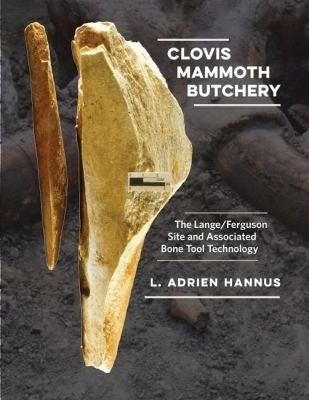
Clovis Mammoth Butchery
The Lange/Ferguson Site and Associated Bone Tool Technology
Seiten
2018
Texas A & M University Press (Verlag)
978-1-62349-592-3 (ISBN)
Texas A & M University Press (Verlag)
978-1-62349-592-3 (ISBN)
The Lange/Ferguson site is the earliest dated archaeological site in South Dakota and one of the few North American sites that provides evidence of a Clovis-period mammoth butchering event. L. Adrien Hannus provides a comprehensive look at one of the few New World Clovis-era sites with in-place buried deposits exhibiting evidence for an expedient bone tool technology.
Thirteen millennia ago, in a small creek valley in western South Dakota, two mammoths perished. The mammoths, an adult and a juvenile, likely a cow and calf pair, died at the edge of an ancient pond.
The Lange/Ferguson site is the earliest dated archaeological site in South Dakota and one of the few North American sites that provides evidence of a Clovis-period mammoth butchering event. In addition to the preserved remains of the two mammoths, the site yielded diagnostic Clovis weaponry—three Clovis projectile points recovered in context and stratigraphically associated with the mammoth bonebed—and flaked bone tools. The site offers a rare snapshot in time detailing early Paleoindian interactions with now-extinct megafauna nearly 13,000 years ago.
In Clovis Mammoth Butchery: The Lange/Ferguson Site and Associated Bone Tool Technology, L. Adrien Hannus provides a comprehensive look at one of the few New World Clovis-era sites with in-place buried deposits exhibiting evidence for an expedient bone tool technology. Multidisciplinary investigations include paleoenvironmental and geochronological reconstructions—pollen and phytoliths, geology and geomorphology, diatoms and ostracodes, mollusks, and vertebrate paleontology—as well as taphonomic evaluations and a microwear analysis of the chipped stone tools.
Clovis Mammoth Butchery offers readers a rare glimpse into a singular moment in prehistory that captures human interaction with extinct animals during a rapidly changing world for which there is no modern comparison. This book shares great insight into hunting and procurement strategies used by big game hunters during the Late Pleistocene and Early Holocene.
Thirteen millennia ago, in a small creek valley in western South Dakota, two mammoths perished. The mammoths, an adult and a juvenile, likely a cow and calf pair, died at the edge of an ancient pond.
The Lange/Ferguson site is the earliest dated archaeological site in South Dakota and one of the few North American sites that provides evidence of a Clovis-period mammoth butchering event. In addition to the preserved remains of the two mammoths, the site yielded diagnostic Clovis weaponry—three Clovis projectile points recovered in context and stratigraphically associated with the mammoth bonebed—and flaked bone tools. The site offers a rare snapshot in time detailing early Paleoindian interactions with now-extinct megafauna nearly 13,000 years ago.
In Clovis Mammoth Butchery: The Lange/Ferguson Site and Associated Bone Tool Technology, L. Adrien Hannus provides a comprehensive look at one of the few New World Clovis-era sites with in-place buried deposits exhibiting evidence for an expedient bone tool technology. Multidisciplinary investigations include paleoenvironmental and geochronological reconstructions—pollen and phytoliths, geology and geomorphology, diatoms and ostracodes, mollusks, and vertebrate paleontology—as well as taphonomic evaluations and a microwear analysis of the chipped stone tools.
Clovis Mammoth Butchery offers readers a rare glimpse into a singular moment in prehistory that captures human interaction with extinct animals during a rapidly changing world for which there is no modern comparison. This book shares great insight into hunting and procurement strategies used by big game hunters during the Late Pleistocene and Early Holocene.
L. Adrien Hannus is professor of anthropology, holds the David B. Jones Distinguished Chair in Anthropology, and is the director of the Archeology Laboratory at Augustana University in Sioux Falls, South Dakota.
| Erscheinungsdatum | 14.06.2018 |
|---|---|
| Reihe/Serie | Peopling of the Americas Publications |
| Co-Autor | C. Vance Haynes, Pat Shipman, Marvin Kay, Eric C. Grimm |
| Zusatzinfo | 55 colour, 30 black & white photographs, 58 line art, 10 maps, 13 figures, 30 tables |
| Verlagsort | College Station |
| Sprache | englisch |
| Maße | 220 x 281 mm |
| Gewicht | 1087 g |
| Themenwelt | Geisteswissenschaften ► Archäologie |
| Sozialwissenschaften ► Ethnologie | |
| Sozialwissenschaften ► Soziologie | |
| ISBN-10 | 1-62349-592-X / 162349592X |
| ISBN-13 | 978-1-62349-592-3 / 9781623495923 |
| Zustand | Neuware |
| Informationen gemäß Produktsicherheitsverordnung (GPSR) | |
| Haben Sie eine Frage zum Produkt? |
Mehr entdecken
aus dem Bereich


aus dem Bereich
maternal health science and the reproduction of harm
Buch | Softcover (2024)
University of California Press (Verlag)
CHF 52,35
long-lasting legacies of colonialism and nationalism in Israel, …
Buch | Softcover (2025)
Vernon Press (Verlag)
CHF 109,95


