


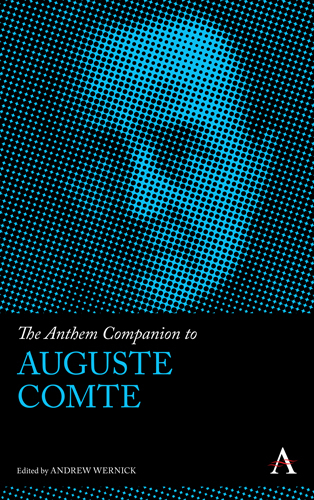
The Anthem Companion to Auguste Comte (eBook)
282 Seiten
NBN International - Anthem Press (Verlag)
978-1-78308-648-1 (ISBN)
A collection of new essays on Auguste Comte by leading Comte scholars, social theorists, philosophers and intellectual historians. The collection aims to further the critical re-examination of Auguste Comte, an important but long neglected figure, while also providing a multi-faceted introduction to key aspects of his thought, its genesis and its place in the modern Western tradition.
Auguste Comte was a controversial but highly influential nineteenth-century figure, but his work and voluminous oeuvre were largely ignored, even in France, for most of the twentieth century. In the field of sociology, the science he claimed to have invented and the cornerstone of his positive philosophy, Comte became regarded more as an eccentric precursor to Durkheim than a real founder of the discipline, or even a significant contributor to its stock of ideas. Recently, however, Comte’s life and writings have begun to be searchingly re-examined together with the wider religious, social and political project of reform to which his intellectual labors were devoted. What has emerged is a much more complicated picture of his thought and its significance. ‘The Companion to Auguste Comte’ – with ten new critical essays by leading Comte scholars, sociologists, intellectual historians, social theorists and philosophers – contributes to this re-examination, providing a multi-faceted introduction to Comte’s thought and to current discussion about him.
Essays in the volume consider all the phases of Comte’s work, treat a wide range of key areas and provide a broad overview of those aspects most pertinent to sociology and related fields. Areas examined include: Comte’s philosophy of science, his concepts of the social and the political, the statics and dynamics of his sociology, positive religion, art and architecture, civic education and universities, gender and his culte de femmes, and his analyses of the ‘great crisis’, the metaphysical state and the coming positivist order.
Against views of Comte that minimize or distort his place in the modern intellectual tradition, a particular aim of the collection is to examine afresh the multifarious links of his thought and its legacy to other major figures and currents. These include Comte’s relation to the ‘second scientific revolution’, to conservative Catholic theology, to Durkheim and (post)classical socology, British Fabianism, (neo) liberalism and post-positivism, as well as to a host of figures from De Maistre, Saint-Simon, J. S Mill, Spencer, Eliot and Beatrice Webb to Nietzsche, Heidegger, Weber, Wagner, De Corbusier, Bourdieu and Foucault. The chapters move in emphasis from considerations of Comte’s context and formation, to influence and reception and finally to ways in which Comte’s long abandoned historical schema may hold renewed interest for understanding our own times.
lt;p>Andrew Wernick is emeritus professor of cultural studies and sociology at Trent University, Canada, and a life member of Clare Hall, Cambridge. A social theorist, intellectual historian, sociologist of culture and sometime jazz musician, he is the author of more than seventy essays on contemporary culture and cultural/social theory. His writings include Promotional Culture: Advertising, Ideology and Symbolic Expression (1991), Auguste Comte and the Religion of Humanity (2001), and the coedited anthologies Shadow of Spirit: Religion and Postmodernism (1992) and Images of Aging: Cultural Representations of Later Life (1995).
Acknowledgements; Introduction – Andrew Wernick; 1. Auguste Comte and the Second Scientific Revolution – Johan Heilbron; 2. ‘Structure’ and ‘genesis’ and Comte’s conception of social science – Derek Robbins; 3. The social and the political in the work of Auguste Comte – Jean Terrier; 4. The counter-revolutionary Comte: theorist of the two powers and enthusiastic medievalist – Carolina Armenteros; 5. The “great crisis”: Comte, Nietzsche and the religion question – Andrew Wernick; 6. “Les ar-z et les sciences”: aesthetic theory and aesthetic politics in Comte's late work – Stefanos Geroulanos; 7. Comte’s civic comedy: secular religion and modern morality in the age of classical sociology – Thomas Kemple; 8. Auguste Comte and the curious case of English women – Mary Pickering; 9. Comte and his liberal critics: from Spencer to Hayek – Mike Gane; 10. Living after positivism, but not without it – Robert C. Scharff; Appendix A: Calendrier positiviste, ou tableau concret de la preparation humaine; Appendix B: Classification positive des dix-huit fonctions du cerveau, ou Tableau systématique de l’àme; Appendix C: Hiérarchie théorique des conceptions humaines, ou tableau synthétique de l’ordre universel; Appendix D: Tableau des quinze grandes lois de philosophie première, ou principes universels sur lesquels repose le dogme positif; Appendix E: Positivist Library in the Nineteenth Century; Notes on contributors; Index.
| Erscheint lt. Verlag | 15.5.2017 |
|---|---|
| Reihe/Serie | Anthem Companions to Sociology | Anthem Companions to Sociology |
| Sprache | englisch |
| Maße | 150 x 150 mm |
| Gewicht | 454 g |
| Themenwelt | Sozialwissenschaften ► Pädagogik |
| ISBN-10 | 1-78308-648-3 / 1783086483 |
| ISBN-13 | 978-1-78308-648-1 / 9781783086481 |
| Informationen gemäß Produktsicherheitsverordnung (GPSR) | |
| Haben Sie eine Frage zum Produkt? |
 EPUB (Adobe DRM)
Kopierschutz: Adobe-DRM
Adobe-DRM ist ein Kopierschutz, der das eBook vor Mißbrauch schützen soll. Dabei wird das eBook bereits beim Download auf Ihre persönliche Adobe-ID autorisiert. Lesen können Sie das eBook dann nur auf den Geräten, welche ebenfalls auf Ihre Adobe-ID registriert sind.
Details zum Adobe-DRM
Dateiformat: EPUB (Electronic Publication)
EPUB ist ein offener Standard für eBooks und eignet sich besonders zur Darstellung von Belletristik und Sachbüchern. Der Fließtext wird dynamisch an die Display- und Schriftgröße angepasst. Auch für mobile Lesegeräte ist EPUB daher gut geeignet.
Systemvoraussetzungen:
PC/Mac: Mit einem PC oder Mac können Sie dieses eBook lesen. Sie benötigen eine
eReader: Dieses eBook kann mit (fast) allen eBook-Readern gelesen werden. Mit dem amazon-Kindle ist es aber nicht kompatibel.
Smartphone/Tablet: Egal ob Apple oder Android, dieses eBook können Sie lesen. Sie benötigen eine
Geräteliste und zusätzliche Hinweise
Buying eBooks from abroad
For tax law reasons we can sell eBooks just within Germany and Switzerland. Regrettably we cannot fulfill eBook-orders from other countries.
aus dem Bereich


