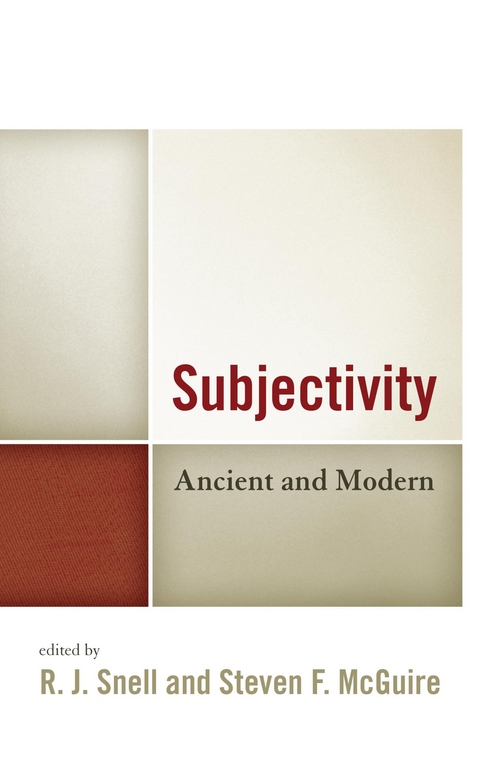
Subjectivity (eBook)
306 Seiten
Lexington Books (Verlag)
978-1-4985-1319-7 (ISBN)
In Subjectivity, sixteen leading scholars examine the turn to the subject in modern philosophy and consider its historical antecedents in ancient and medieval thought. Some critics of modernity reject the turn to the subject as a specifically modern error, arguing that it logically leads to nihilism and moral relativism by divorcing the human mind from objective reality. Yet, some important thinkers of the last half-century--including Leo Strauss, Eric Voegelin, John Finnis, and Bernard Lonergan--consider a subjective starting point and claim to find a similar position in ancient and medieval thought. If correct, their positions suggest that one can adopt the subjective turn and remain true to the tradition. This is a timely question. The common good of our polity encounters a situation in which many believe that there is no objective reality to which human minds and wills ought to conform, a conclusion that suggests we can define and construct reality. In light of this, the notion of a natural or objective reality to which human beings ought to conform becomes particularly vital. Should we, then, adopt the modern turn to subjectivity and argue for objective truth and moral order on its basis, or reject the subjective turn as part of the problem and return to an earlier approach that grounds these things in nature or some other external reality? Critics of modern subjectivity argue that the modern turn to subjectivity must be abandoned because it is the very source of the nominalism that threatens to undermine liberal democracy. Others argue, however, that subjectivity itself logically leads to the recognition of an objective reality beyond the mind of the individual. Edited by R. J. Snell and Steven F. McGuire, this collection will be of particular interest to intellectual historians, political philosophers, theologians, and philosophers.
R. J. Snell is professor of philosophy at Eastern University and executive director of the Agora Institute for Civic Virtue and the Common Good.Steven F. McGuire is assistant professor of political science at Eastern University and a research director at the Agora Institute for Civic Virtue and the Common Good.
IntroductionSubjectivity and Metaphysics in Voegelin’s Reading of AristotleSteven F. McGuireResponse by Lee TrepanierObjectivity as Authentic SubjectivityElizabeth A. MurrayResponse by Matthew B. O’BrienSubjectivity without Subjectivism: Revisiting the Is/Ought GapFirst and Third Person Standpoints in the New Natural Law TheoryChristopher O. Tollefsen Response by Amy Gilbert RichardsThe Claims of Subjectivity and the Limits of Politics The Turn to the Subject as the Turn to the PersonDavid WalshResponse by Phillip CaryPersonalism and Common Good: Thomistic Political Philosophy and the Turn to SubjectivityV. Bradley LewisResponse by Daniel MarkExistential Authority, Belonging, and the Commissioning that is Subjectivity: A Medieval Philosophical Anthropology James GreenawayResponse by Jeremy D. Wilkins
| Erscheint lt. Verlag | 4.3.2016 |
|---|---|
| Co-Autor | Phillip Cary, Amy Gilbert Richards, Mark Shiffman, Christopher O. Tollefsen, Lee Trepanier, Richard Velkley, David Walsh, Jeremy D. Wilkins, Sherif Girgis, James Greenaway, Ralph C. Hancock, V. Bradley Lewis, DANIEL MARK, Steven F. McGuire, Elizabeth A. Murray, Matthew B. O'Brien |
| Verlagsort | Lanham |
| Sprache | englisch |
| Themenwelt | Geisteswissenschaften ► Philosophie ► Allgemeines / Lexika |
| Geisteswissenschaften ► Philosophie ► Geschichte der Philosophie | |
| Geisteswissenschaften ► Philosophie ► Metaphysik / Ontologie | |
| Geisteswissenschaften ► Philosophie ► Philosophie der Neuzeit | |
| Sozialwissenschaften | |
| Schlagworte | Ancient Philosophy • Aristotle • Bernard Lonergan • Epistemology • Eric Voegelin • Metaphysics • modern philosophy • New Natural Law • phenomenology of consciousness • Political Philosophy • Thomas Aquinas • thumos |
| ISBN-10 | 1-4985-1319-0 / 1498513190 |
| ISBN-13 | 978-1-4985-1319-7 / 9781498513197 |
| Informationen gemäß Produktsicherheitsverordnung (GPSR) | |
| Haben Sie eine Frage zum Produkt? |
 EPUB (Adobe DRM)
Kopierschutz: Adobe-DRM
Adobe-DRM ist ein Kopierschutz, der das eBook vor Mißbrauch schützen soll. Dabei wird das eBook bereits beim Download auf Ihre persönliche Adobe-ID autorisiert. Lesen können Sie das eBook dann nur auf den Geräten, welche ebenfalls auf Ihre Adobe-ID registriert sind.
Details zum Adobe-DRM
Dateiformat: EPUB (Electronic Publication)
EPUB ist ein offener Standard für eBooks und eignet sich besonders zur Darstellung von Belletristik und Sachbüchern. Der Fließtext wird dynamisch an die Display- und Schriftgröße angepasst. Auch für mobile Lesegeräte ist EPUB daher gut geeignet.
Systemvoraussetzungen:
PC/Mac: Mit einem PC oder Mac können Sie dieses eBook lesen. Sie benötigen eine
eReader: Dieses eBook kann mit (fast) allen eBook-Readern gelesen werden. Mit dem amazon-Kindle ist es aber nicht kompatibel.
Smartphone/Tablet: Egal ob Apple oder Android, dieses eBook können Sie lesen. Sie benötigen eine
Geräteliste und zusätzliche Hinweise
Buying eBooks from abroad
For tax law reasons we can sell eBooks just within Germany and Switzerland. Regrettably we cannot fulfill eBook-orders from other countries.
aus dem Bereich