


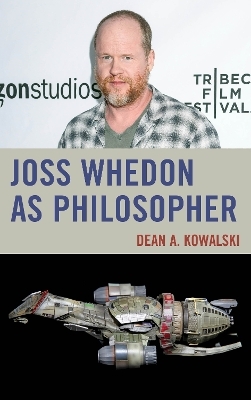
Joss Whedon as Philosopher
Seiten
2017
Lexington Books (Verlag)
978-0-7391-9665-6 (ISBN)
Lexington Books (Verlag)
978-0-7391-9665-6 (ISBN)
In this book, Dean Kowalski argues that filmmakers can “do” philosophy when creating a fictional narrative film, and utilizes a careful and extensive analysis of Joss Whedon’s fictive creations—Buffy the Vampire Slayer, Angel, Firefly, Dollhouse, and The Cabin in the Woods (among others)—to establish this thesis.
This book appeals to many different readers. For the many admirers of Whedon’s fictive creations, it offers one of the most comprehensive analyses of his corpus. It reprises many examples and dialogue passages from the far corners of the so-called “Whedonverse.” You’ll get a chance to re-experience your favorite dramatic moments, and think about them in novel ways. For popular culture scholars, it offers illustrations of various philosophical theories, explains how those theories pertain to relevant data points in Whedon’s oeuvre, and assesses whether, or to what extent, they have real-world application. For philosophers of film, it explicates crucial issues germane to the film-as-philosophy debate, but also expands them to television—all in the attempt to demonstrate why it is that Whedon ought to be included among those rare filmmakers who engage the philosophical process via their artistry.
This book appeals to many different readers. For the many admirers of Whedon’s fictive creations, it offers one of the most comprehensive analyses of his corpus. It reprises many examples and dialogue passages from the far corners of the so-called “Whedonverse.” You’ll get a chance to re-experience your favorite dramatic moments, and think about them in novel ways. For popular culture scholars, it offers illustrations of various philosophical theories, explains how those theories pertain to relevant data points in Whedon’s oeuvre, and assesses whether, or to what extent, they have real-world application. For philosophers of film, it explicates crucial issues germane to the film-as-philosophy debate, but also expands them to television—all in the attempt to demonstrate why it is that Whedon ought to be included among those rare filmmakers who engage the philosophical process via their artistry.
Dean A. Kowalski is professor of philosophy at the University of Wisconsin-Waukesha.
Acknowledgements
Dedication
Introduction
Photo Credits and Captions
Part I: Philosophy in the Whedonverse
Chapter 1: Seeking Authenticity in the Whedonverse
Chapter 2: On Being Horrible (and an Angel)
Chapter 3: Ethics in an Atheistic Whedonverse
Chapter 4: Religious Ambivalence in the Whedonverse
Chapter 5: Freedom of the Will: A Whedonverse Paradox (or Not)
Part II: Film-as-Philosophy, Whedonesquely
Chapter 6: Mulhall and His Detractors
Chapter 7: The Russell-Wartenberg Debate
Chapter 8: Exploring The Cabin in the Woods
Chapter 9: Angel, Angelus, and Personal Identity
Conclusion: The Whedonverse, Television, and Philosophy
Bibliography
| Erscheinungsdatum | 17.02.2018 |
|---|---|
| Reihe/Serie | The Philosophy of Popular Culture |
| Zusatzinfo | 20 BW Photos |
| Sprache | englisch |
| Maße | 159 x 236 mm |
| Gewicht | 621 g |
| Themenwelt | Geisteswissenschaften ► Philosophie ► Ethik |
| Sozialwissenschaften | |
| ISBN-10 | 0-7391-9665-0 / 0739196650 |
| ISBN-13 | 978-0-7391-9665-6 / 9780739196656 |
| Zustand | Neuware |
| Informationen gemäß Produktsicherheitsverordnung (GPSR) | |
| Haben Sie eine Frage zum Produkt? |
Mehr entdecken
aus dem Bereich



aus dem Bereich
Buch | Hardcover (2025)
Suhrkamp (Verlag)
CHF 32,15


