


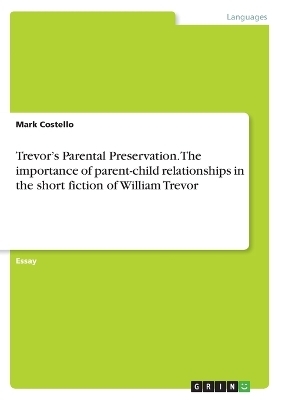
Trevor's Parental Preservation. The importance of parent-child relationships in the short fiction of William Trevor
Seiten
2017
|
17001 A. 1. Auflage
GRIN Verlag
978-3-668-44737-0 (ISBN)
GRIN Verlag
978-3-668-44737-0 (ISBN)
- Titel nicht im Sortiment
- Artikel merken
Essay from the year 2017 in the subject Didactics - English - Literature, Works, grade: 70, Trinity College Dublin (The School of English), course: TSM English, language: English, abstract: William Trevor's acclaimed short fiction is deeply concerned with the social dynamic of rural Ireland. He describes an Ireland that Stinson notes, is heavily laden "with an oppressive atmosphere". Such an evocation, when considered alongside Trevor's focus on familial social ties, suggests that the oppressive climate in Ireland is grounded in family relationships that are characterised by notions of inheritance and legacy. This reveals how Trevor's imagined parent-child relationships serve as valuable literary devices contributing to an overall portrayal of a culturally stagnant Ireland. In this paper, I will firstly show how Trevor links societal oppression to his characters' misguided loyalties to outdated social frameworks and conventions. This loyalty is depicted by Trevor, as passed down from parent to child, in a society in which parents control every aspect of their children's lives. Parents are depicted by Trevor as constantly encouraging their children to adhere to their own outdated social traditions. It is this that elucidates the importance of parent-child relationships in Trevor's stories. The relationships themselves perform as the vehicles through which social oppressiveness and entrapment is sustained in rural Irish society, themes not only central to Trevor's work but the whole canon of Irish short fiction with which Trevor is in discourse. I will also look at briefly, the child-parent relationship from the psychoanalytical perspective of Freud, describing how through parental encouragement of their children to internalize their values, they initiate a psychological regression in their child. I will further argue that this regression to immaturity mirrors the repetitive and repressive social cycle that is further depicted by Trevor. He seems to be suggesting that rural Ireland is mired in a debilitating timelessness which is consolidated by the reoccurring motifs of children characters being killed. This leads to a lasting impression of a stagnant and deteriorating nation, that is reflected in its characters as a result of influential parental relationships.
| Erscheinungsdatum | 23.06.2017 |
|---|---|
| Sprache | englisch |
| Maße | 148 x 210 mm |
| Gewicht | 44 g |
| Themenwelt | Literatur ► Essays / Feuilleton |
| Literatur ► Lyrik / Dramatik | |
| Geisteswissenschaften ► Sprach- / Literaturwissenschaft ► Anglistik / Amerikanistik | |
| Geisteswissenschaften ► Sprach- / Literaturwissenschaft ► Sprachwissenschaft | |
| Sozialwissenschaften ► Pädagogik ► Schulpädagogik / Grundschule | |
| Sozialwissenschaften ► Pädagogik ► Schulpädagogik / Sekundarstufe I+II | |
| Schlagworte | ballroomofromance • Child • Cycle • Deterioration • Freud • Generation • generational • History • Internalization • Ireland • IrishShortFiction • Nationhood • Oppression • parent • Repression • shortfiction • Sprache, allgemein & Nachschlagewerke • Sprache, allgemein & Nachschlagewerke • TheDressmaker'sChild • williamtrevor |
| ISBN-10 | 3-668-44737-3 / 3668447373 |
| ISBN-13 | 978-3-668-44737-0 / 9783668447370 |
| Zustand | Neuware |
| Informationen gemäß Produktsicherheitsverordnung (GPSR) | |
| Haben Sie eine Frage zum Produkt? |
Mehr entdecken
aus dem Bereich



aus dem Bereich
Affektordnungen des Sozialen in der Gegenwartsliteratur
Buch | Softcover (2025)
De Gruyter (Verlag)
CHF 62,90


