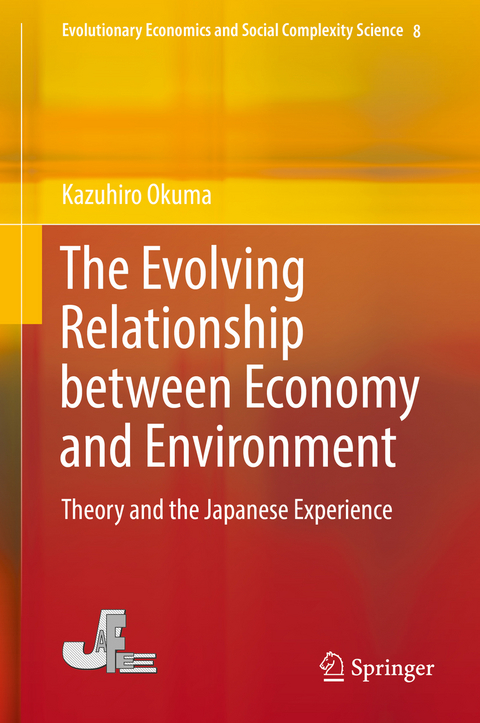
The Evolving Relationship between Economy and Environment (eBook)
IX, 140 Seiten
Springer Singapore (Verlag)
978-981-10-4100-6 (ISBN)
This book sheds new light on the relationship between economy and the environment by approaching the issue from evolutionary and institutional economics. Building a framework of theory and empirical analysis, it provides an in-depth perspective on how economic growth and environmental policy interact and historically evolve.
Orthodox environmental economics usually understands environmental issues under the rules of market economy, while environmental sciences subordinate economy to physical constraints of the environment. Instead of these hierarchical visions, this book recognizes economy and the environment as co-evolving systems.
The theoretical framework is elaborated based on the régulation and post-Keynesian theories combined. An idea of three-dimensional factors-capital, labor, and the environment-leads to conceptual and mathematical models, which will be applicable to wider analyses.
Using this framework, Japanese history is analyzed as a typical example of environmental policy development. Historical transformations of environmental policies and growth regimes are explained using indices and econometric analysis. Experiences of strict regulations with positive economic impacts are also identified.
These works lead to some interesting implications, which include mechanisms, the possibility, and conditions of 'green growth''. This book proposes a new approach by bridging the gap between evolutionary-institutional economics and environmental economics, which should be stimulating to them both and possibly open the door for a new research avenue.
Kazuhiro Okuma, Tohoku University, Japan
This book sheds new light on the relationship between economy and the environment by approaching the issue from evolutionary and institutional economics. Building a framework of theory and empirical analysis, it provides an in-depth perspective on how economic growth and environmental policy interact and historically evolve.Orthodox environmental economics usually understands environmental issues under the rules of market economy, while environmental sciences subordinate economy to physical constraints of the environment. Instead of these hierarchical visions, this book recognizes economy and the environment as co-evolving systems.The theoretical framework is elaborated based on the regulation and post-Keynesian theories combined. An idea of three-dimensional factors-capital, labor, and the environment-leads to conceptual and mathematical models, which will be applicable to wider analyses.Using this framework, Japanese history is analyzed as a typical example of environmental policy development. Historical transformations of environmental policies and growth regimes are explained using indices and econometric analysis. Experiences of strict regulations with positive economic impacts are also identified. These works lead to some interesting implications, which include mechanisms, the possibility, and conditions of "e;green growth''. This book proposes a new approach by bridging the gap between evolutionary-institutional economics and environmental economics, which should be stimulating to them both and possibly open the door for a new research avenue.
Kazuhiro Okuma, Tohoku University, Japan
Part I: Overview.- Chapter 1: Introduction.- Chapter 2: Evolutionary and Institutional Approach to Economy and the Environment.- Part II: Theoretical Analysis.- Chapter 3: Socioeconomic System as Reproductions of Economy, Humans and the Environment.- Chapter 4: Formalizing Triple Reproductions and Environmental Costs.- Chapter 5: Institutional Coordination in the Economy-environment Nexus and the Growth Regime.- Chapter 6: A Kaleckian Model for Economy-environment Analysis.- Part III: Long-term Transformation in Japan.- Chapter 7: Overview of Long-term Trends of the Economy-environment Nexus in Japan.- Chapter 8: Econometric Analysis of the Impacts of Environmental Measures on Growth.- Chapter 9. Interpreting the Historical Transformation.- Part IV: Conclusion.- Chapter 10: Searching for a Vision into the Future: Evolutionary Economy-environment Coordination.- Appendix: Data Sources and Estimation Methods.
| Erscheint lt. Verlag | 29.3.2017 |
|---|---|
| Reihe/Serie | Evolutionary Economics and Social Complexity Science | Evolutionary Economics and Social Complexity Science |
| Zusatzinfo | IX, 140 p. 28 illus. |
| Verlagsort | Singapore |
| Sprache | englisch |
| Themenwelt | Sozialwissenschaften ► Politik / Verwaltung |
| Wirtschaft ► Allgemeines / Lexika | |
| Wirtschaft ► Volkswirtschaftslehre ► Wirtschaftspolitik | |
| Schlagworte | Environmental Cost • Environmental Policy • green growth • Growth Regime • Kaleckian Model • Post-Keynesian theory • Régulation Theory |
| ISBN-10 | 981-10-4100-8 / 9811041008 |
| ISBN-13 | 978-981-10-4100-6 / 9789811041006 |
| Informationen gemäß Produktsicherheitsverordnung (GPSR) | |
| Haben Sie eine Frage zum Produkt? |
 PDF (Wasserzeichen)
DRM: Digitales Wasserzeichen
Dieses eBook enthält ein digitales Wasserzeichen und ist damit für Sie personalisiert. Bei einer missbräuchlichen Weitergabe des eBooks an Dritte ist eine Rückverfolgung an die Quelle möglich.
Dateiformat: PDF (Portable Document Format)
Mit einem festen Seitenlayout eignet sich die PDF besonders für Fachbücher mit Spalten, Tabellen und Abbildungen. Eine PDF kann auf fast allen Geräten angezeigt werden, ist aber für kleine Displays (Smartphone, eReader) nur eingeschränkt geeignet.
Systemvoraussetzungen:
PC/Mac: Mit einem PC oder Mac können Sie dieses eBook lesen. Sie benötigen dafür einen PDF-Viewer - z.B. den Adobe Reader oder Adobe Digital Editions.
eReader: Dieses eBook kann mit (fast) allen eBook-Readern gelesen werden. Mit dem amazon-Kindle ist es aber nicht kompatibel.
Smartphone/Tablet: Egal ob Apple oder Android, dieses eBook können Sie lesen. Sie benötigen dafür einen PDF-Viewer - z.B. die kostenlose Adobe Digital Editions-App.
Buying eBooks from abroad
For tax law reasons we can sell eBooks just within Germany and Switzerland. Regrettably we cannot fulfill eBook-orders from other countries.
aus dem Bereich