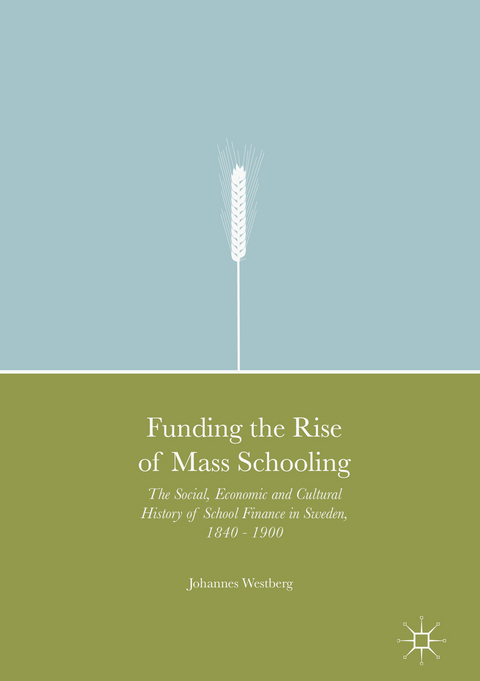
Funding the Rise of Mass Schooling (eBook)
XVII, 242 Seiten
Springer International Publishing (Verlag)
978-3-319-40460-8 (ISBN)
This book presents expert analysis on how the remarkable rise of mass schooling was funded during the nineteenth century. Based on rich source materials from rural Swedish school districts, and drawing up evidence from schooling in countries including France, Germany, England and the U.S., Westberg examines the moral considerations that guided economic practices and sheds new light on how the advent of schooling did not only rest upon monies, but also on grains, firewood and cow fodder. Exploring school districts' motives and economic culture, this book shows how schooling was neither primarily guided by frugal impulses nor motivated by a fear of the growing working classes. Instead, school spending served multiple purposes in school districts that pursued a fair and reasonable economic practice.
Johannes Westberg is Associate Professor in History and Senior Lecturer at Uppsala University, Sweden. Since defending his thesis in 2008, Westberg has published widely on the history of early years education and primary schooling.
Johannes Westberg is Professor of Education at Örebro University, Sweden. Since defending his thesis in 2008, Westberg has published widely on the history of early years education and primary schooling.
Chapter 1. A Mundane History of School Finance Pieces of a larger puzzle Three issues in the history of school finance A history from below The Swedish setting The rural school districts of Sundsvall Sources and methods The structure of the bookChapter 2. The Political Will to Levy Local Taxes The school act of 1842 Tackling population growth and long school routes Unfit school buildings and ambulatory schools Economic issues and social status ConclusionChapter 3. Pursuing a Fair and Reasonable Economy The management of school districts’ affairs A multifaceted economic culture Balancing needs and resources Budgets determined by school spending A “billig” economy The issue of frugality Strategies to increase revenues ConclusionChapter 4. The In-kind Economy of Early School Districts An economy of in-kind transactions Taxes in grain, hay and firewood Gifts and boarding arrangements Farmwork and janitorial services The restricted use of account books State subsidies, local taxes and interest payments ConclusionChapter 5. An Expanding Monetary Economy An increasingly monetized economy A liberation or a loss? A variety of local monetary taxes Rising state subsidies Loans from banks, funds and individuals ConclusionChapter 6. School Funding and Mass Schooling An affordable and flexible in-kind economy The benefits of an in-kind salary The thorny cow fodder question The abolition of cow fodder Damp firewood and other concerns Conflicting regimes of value ConclusionChapter 7. Conclusions The political will and economic culture From in-kind to monies The rise of mass schooling School finance and beyond
| Erscheint lt. Verlag | 24.11.2016 |
|---|---|
| Zusatzinfo | XVII, 242 p. 13 illus., 1 illus. in color. |
| Verlagsort | Cham |
| Sprache | englisch |
| Themenwelt | Geisteswissenschaften ► Geschichte |
| Sozialwissenschaften ► Pädagogik ► Allgemeines / Lexika | |
| Wirtschaft | |
| Schlagworte | Common Schools • Educational Finance • history of education • Moral Economy • Scandinavia • School Economy |
| ISBN-10 | 3-319-40460-1 / 3319404601 |
| ISBN-13 | 978-3-319-40460-8 / 9783319404608 |
| Informationen gemäß Produktsicherheitsverordnung (GPSR) | |
| Haben Sie eine Frage zum Produkt? |
 PDF (Wasserzeichen)
DRM: Digitales Wasserzeichen
Dieses eBook enthält ein digitales Wasserzeichen und ist damit für Sie personalisiert. Bei einer missbräuchlichen Weitergabe des eBooks an Dritte ist eine Rückverfolgung an die Quelle möglich.
Dateiformat: PDF (Portable Document Format)
Mit einem festen Seitenlayout eignet sich die PDF besonders für Fachbücher mit Spalten, Tabellen und Abbildungen. Eine PDF kann auf fast allen Geräten angezeigt werden, ist aber für kleine Displays (Smartphone, eReader) nur eingeschränkt geeignet.
Systemvoraussetzungen:
PC/Mac: Mit einem PC oder Mac können Sie dieses eBook lesen. Sie benötigen dafür einen PDF-Viewer - z.B. den Adobe Reader oder Adobe Digital Editions.
eReader: Dieses eBook kann mit (fast) allen eBook-Readern gelesen werden. Mit dem amazon-Kindle ist es aber nicht kompatibel.
Smartphone/Tablet: Egal ob Apple oder Android, dieses eBook können Sie lesen. Sie benötigen dafür einen PDF-Viewer - z.B. die kostenlose Adobe Digital Editions-App.
Buying eBooks from abroad
For tax law reasons we can sell eBooks just within Germany and Switzerland. Regrettably we cannot fulfill eBook-orders from other countries.
aus dem Bereich